No products in the cart.


Newsletter
[contact-form-7 id=”4235″ title=”Contact form 1″]

By andrea – Editor @lorologiese
A movement does not lie. Marketing does. This four-part series develops a practical framework for reading watchmaking quality directly — through finishing, decoration, architecture, and regulation — independently of brand name or price.
By Part 4, a collector will have the diagnostic tools to evaluate any movement, including those produced by the independent sector, where the distance between story and substance is most variable and most consequential.


Most collectors open a caseback and look at a movement the way a tourist looks at a cathedral — they register an impression of quality without being able to read the specific evidence in front of them. Surface finishing is the most immediately visible quality layer in any mechanical movement, and it is also the most consistently misread.
The reason is straightforward: industrial finishing and artisanal finishing can produce results that appear similar at a glance but are profoundly different under magnification. Knowing what to look for, and in what order, converts an impression into a diagnosis.
The sequence matters. Finishing is not a collection of independent techniques applied in any order — it is a causal chain. The quality of the lateral surface of a component, the flanc, determines what is possible in the anglage. The quality of the anglage determines whether the internal corners are readable as hand or machine work.
The finishing of the perçages — the drilled holes — is the final indicator, invisible to a casual inspection and fully legible to a collector who knows where to look. Each layer depends on the one beneath it.


The flanc is the lateral surface of a bridge or plate — the vertical face between the upper decorated surface and the lower functional surface. In industrial production it receives minimal attention beyond deburring: the removal of machining marks and attachment points left by the cutting process.
In high-grade finishing, the flanc is treated as a primary surface in its own right, because its quality directly determines the quality of the anglage that will be applied to its upper edge.
The requirement is precise: the flanc must be perfectly flat, regular, and free of any undulation or surface irregularity. A flanc that is not flat produces a bevel that is not flat — the waviness transfers directly and cannot be corrected at the anglage stage without going back to the flanc.

This is the causal dependency that industrial production breaks: CNC-machined flancs are clean and regular enough for mid-range production, but they do not meet the standard that haute horlogerie anglage requires.
In high-grade work, even stamped components — which have no attachment points and arrive with relatively regular flancs — are re-worked by hand for purely aesthetic reasons, because the standard demanded by the subsequent anglage makes it necessary.
Artisanal flanc preparation follows a defined sequence. Attachment points and machining marks are removed with a file. The surface is then worked progressively with different file profiles — a round-section file for concave forms and small-radius internal corners, a sage-leaf file for larger concave forms, a flat file for flat and convex surfaces — until the flanc is plane and regular.


A satined finish is then applied with progressively finer Dégussit stones and cabrons, producing a smooth, matte surface with sharp edges at the transitions. It is this sharpness at the edge — the arête vive — that makes quality anglage possible.
The practical diagnostic: through a loupe, a well-prepared flanc shows a consistent satin finish without undulation, with clean, sharp transitions to the upper surface. A flanc that shows visible tool marks, inconsistent texture, or rounded transitions to the upper surface identifies industrial preparation — and predicts the quality of the anglage before you have looked at it.
Anglage — the bevelling of the upper edges of bridges and plates at approximately 45 degrees — is the single most reliable quality indicator in movement finishing. The reason is technical and absolute: internal corners, where two bevelled edges meet toward the inside of a component, cannot be produced by any machine currently in use. They can only be finished by hand.
A movement with sharp, fully polished internal corners has been worked by a skilled angleur. A movement where internal corners are rounded or absent has been machine-bevelled, regardless of what appears on the dial. This distinction deserves to be stated precisely because it is frequently obscured in marketing. CNC milling can produce clean, regular bevels on straight edges and external corners. The diameter of any milling cutter is always too large to produce a sharp internal corner — the geometry is physically impossible.
Internal corners produced by CNC are rounded at the intersection, and must subsequently be “emptied” with a file. In practice, on industrial production, they are left rounded. In high-grade artisanal finishing, they are worked with files and then burnished to a mirror surface. The presence or absence of a sharp, polished internal corner is not a matter of degree — it is a clear indicator. The artisanal process involves two primary methods. The burnisher method — the most purely manual — uses a sequence of files to form and refine the bevel, followed by progressively finer abrasives applied with cabrons, a fine stone shaped to the specific geometry of the component, and finally a wooden peg charged with diamond paste to achieve the final polish.

The wood wheel method uses a polishing wheel charged with diamantine on a lathe to achieve the mirror surface more rapidly on accessible straight edges, but cannot reach internal corners — for which the burnisher must always be used. High-grade work typically combines both, maintaining aesthetic consistency across the full component. Several characteristics of artisanal anglage are readable under a 5x or 10x loupe: the internal corner is the primary indicator — sharp, with a single clean line at the intersection, fully polished to the same standard as the straight edges. A rounded or unfinished internal corner identifies machine work.
The external corner — where two bevels meet outward — must be sharp and not rounded or blunted. A blunted external corner identifies insufficient hand work or excessive machine polishing.
The mirror quality of the bevel surface changes as the movement is tilted under light — a continuous, geometrically precise reflection that shifts direction uniformly. Machine-cut bevels produce a clean surface that does not respond to directional light in the same way.
The width of the bevel should be consistent along its full length, including through corners and curves. Inconsistent width identifies either machine work or insufficient artisanal control.
One further point worth stating: the slight irregularities visible in high-grade artisanal anglage under magnification — minor variations in bevel width, the subtle trace of hand tool work — are not defects. They are the signature of hand execution and the evidence of authenticity. A perfectly uniform bevel across every edge of a complex bridge is more likely to indicate machine work than exceptional hand skill.


Skilled angleurs are rare. No formal training programme exists for the profession — it is transmitted internally within manufactures from master to apprentice, and a talented apprentice requires approximately one year to reach a working standard. Some components require up to ten hours of work. This context explains both the price differential between hand and machine-finished movements and why the internal corner remains, decades after the introduction of CNC machining, the one diagnostic that industrial production cannot falsify.
Every drilled hole in a movement — and a complex movement contains many — produces raw edges that require finishing. The functional minimum is deburring: removing the sharp burrs left by the drill bit that could detach during assembly or operation and contaminate the movement. In mid-range production this is where finishing of perçages ends. In high-grade work it is where it begins.
Four distinct finishing levels exist for drilled holes, each representing a higher standard of execution:
The chanfrein is a light chamfer applied by hand with a small cutter, purely functional, intended to remove sharp edges and machining burrs.
It is the industrial minimum and present on virtually all Swiss movements.
The creusure is the countersunk seat machined into a bridge or plate to receive a screw, a pinion, or a tenon. In high-grade work it is polished manually to the desired surface standard — in the finest movements, to a mirror finish.
The chaton is a metal ring, usually in gold, or brass, into which a jewel is pressed. Originally developed to display natural rubies to greater visual effect — the polished gold ring reflecting light around the stone, making it appear larger — the chaton has been largely replaced by direct jewel setting in industrial production.


Prestigious manufactures continue to use chatons as a mark of traditional execution, and their presence is an unambiguous quality signal. In contemporary movement finishing they also serve a practical function when jewels must be set into hard materials where direct pressing carries a risk of fracture.
The découverte — also known as goutte, parabole, or œil de perdrix — is a deep concave chamfer that frames the jewel setting. In high-grade production it is polished to a mirror finish using a wooden peg, producing a concave reflective surface that dramatically increases the visual presence of the jewel. The quality of the découverte polish is readable under a loupe: a true mirror finish with consistent curvature and sharp transitions to the surrounding surface identifies hand work. A matte or inconsistently finished découverte identifies industrial execution or chemical polishing.
The diagnostic sequence for perçages: first confirm that all holes are chamfered — their absence indicates below-standard production. Then assess the creusures for polish quality. Then look for chatons — their presence is a positive quality indicator. Finally examine the découvertes, if present, for the quality and consistency of the concave mirror finish.
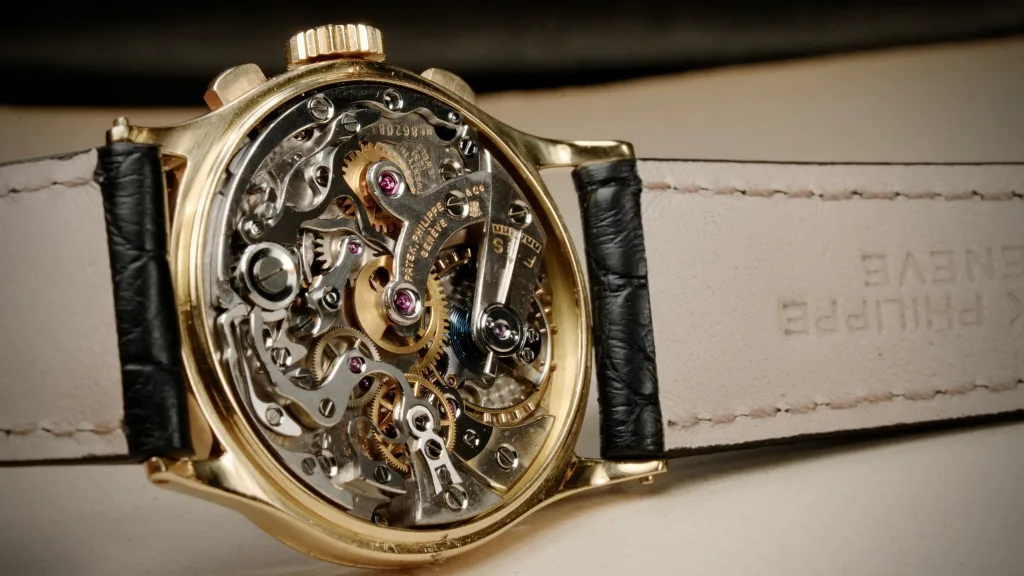
This Patek Philippe cal. 130 has quality where you do not see it: the movement under the dial has a superb perlage, anglage and satinage finish on the leverages, the screws are mirror polished
Caseback open, loupe at 5x to 10x, light source at an oblique angle: first, examine the flancs of the main bridges. Look for consistent satin finish, sharp edge transitions, and absence of tool marks or surface undulation. This takes thirty seconds and predicts the quality of everything that follows. Second, find an internal corner in the anglage — any point where two bevelled edges meet toward the inside of a bridge. Examine the intersection. A single sharp line, fully polished: hand work. A rounded intersection: machine work. This one observation carries more diagnostic weight than any other single feature of the movement.
Third, assess the mirror quality of the bevel surface under directional light. Tilt the movement. Watch how the reflection shifts. Continuous, directional, geometrically precise: hand finished. Flat, uniform, non-directional: machine finished. Fourth, examine the screws. Thermally blued screws show a deep, graduated blue with tonal variation from centre to edge. Chemically blued screws show a flat, uniform colour without graduation. Slot alignment — all slots oriented consistently — identifies individual attention at assembly.

Fifth, examine the découvertes and creusures around jewel settings. Mirror finish with consistent curvature: hand finished to high grade. Matte or chemically polished finish: industrial standard. These five observations, made in sequence, produce a reliable quality reading of the finishing layer of any movement — independent of the name on the dial, the price on the tag, or the marketing narrative attached to the piece
Most movement illustrations belongs to:
[contact-form-7 id=”4235″ title=”Contact form 1″]