No products in the cart.

Newsletter
[contact-form-7 id=”4235″ title=”Contact form 1″]

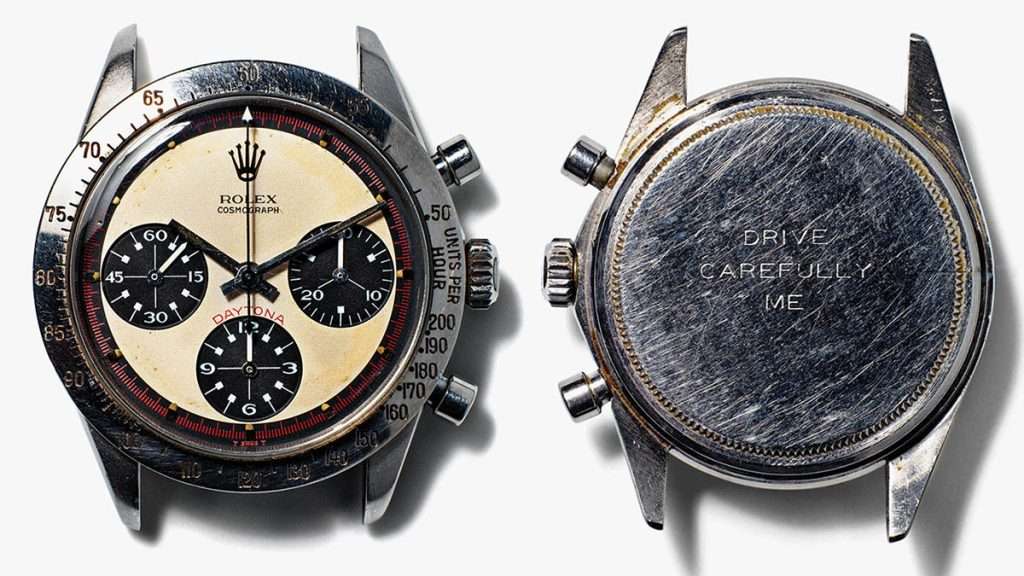
A watch with a story sells for more than the same watch without one. The Paul Newman Daytona ref. 6239 — gifted by Joanne Woodward in 1968 with “DRIVE CAREFULLY ME” engraved on the caseback, worn through two decades of racing and film sets, documented in period photographs, accompanied by a signed letter from Newman’s daughter and a verifiable chain of custody from Newman to James Cox to Phillips — sold in October 2017 for $17.75 million.
The provenance was exhaustive, credible, and cross-referenced at every point. The result permanently transformed how the market understood the relationship between documented ownership and auction value. That sale also, less usefully, taught the market something else: that a convincing story attached to a famous name is worth an extraordinary amount of money. With consequences.
Paul Newman – PhotoCredit Douglas Kirkland Corbis via GettyImages


Provenance in the vintage watch market operates across three broad categories, each with a different risk profile.
JF Kennedy`s Omega – Watches.co.uk
Celebrity ownership is the most valuable and the most fabricated. The mechanism is straightforward: a watch credibly associated with a recognisable name commands a premium that bears no relationship to the watch’s intrinsic qualities. The premium is for the story.
Military attribution is the second category. The distinction between a watch issued to military personnel and one privately purchased by someone who happened to serve is rarely made in secondary market listings. “Military provenance” is applied to both indiscriminately — and the documentation required to distinguish them almost never exists.
Churchill`s Lemania chronograph – Esquire Middle East


Military issue watches occupy a specific position in the provenance discussion — and a more tractable one than celebrity attribution.
CYMA WWW DIRTY DOZEN MILITARY AP BRWN
Issue markings are well documented: government marks, serial number formats, contract codes, and symbols such as the British broad arrow — property of the Crown — follow known conventions that have been catalogued in detail. CYMA WWW DIRTY DOZEN MILITARY AP BRWN

The British WWW “Dirty Dozen” watches, for instance, each carried a caseback engraving of WWW for “Wrist, Watch, Waterproof,” the broad arrow symbol, and two serial numbers — one from the manufacturer, one from military stores. The NATO coding system used from 1974 onward is similarly standardised: country code, item classification, and individual watch number follow a fixed structure that can be cross-referenced.
HANHART FLIEGERCHRONO FLYBACK AP BLK SNAIL DIAL


Dial typography, movement calibre, serial number ranges, and case specifications for the major military contracts are all documented, which means that a watch claiming military issue can be assessed against a known standard.
Fake military markings exist and circulate — the Rolex Submariner ref. 5517 and the Panerai ref. 3646 markets are particularly affected — but inconsistencies in font, engraving depth, typeface, or serial range are detectable by anyone with reference access and patience.
Where military issue provenance becomes as uncertain as any other category is when the claim shifts from the watch having been owned or worn by a specific named individual within the military. At that point, the question is identical to any celebrity provenance case: what documentation exists, who can confirm it, and does the physical evidence corroborate the story ?
HANHART FLIEGERCHRONO FLYBACK AP BLK SNAIL DIAL
Expedition provenance illustrates both ends of the spectrum with unusual clarity. The thirteen Rolex Oyster Perpetual ref. 6098 watches issued to members of the 1953 British Everest expedition are one of the cleaner cases in collector history: each caseback was individually engraved “Everest 1953” followed by the expedition member’s name, and all fall within a specific, documented serial number batch.
Rolex 6098 Everest Expedition – Lambert- Phillips


The serial numbers cross-reference. The Royal Geographical Society holds expedition records. This is what documented expedition provenance looks like — physical evidence, institutional records, and individual identification that corroborate each other independently.
Rolex 6098 Everest Expedition – Lambert – caseback – Phillips
At the opposite end sits the question of what watch was actually worn at the Everest summit on 29 May 1953. Rolex equipped Hillary with a watch for the expedition, but Hillary’s own admission points to a Smiths De Luxe at the summit — and the Smiths watch, held by the Worshipful Company of Clockmakers in London, carries a curator’s note stating it was worn by Hillary during the successful climb.
Rolex’s watch was returned to the manufacturer after the expedition for testing and eventually placed in the Beyer Watch and Clock Museum in Zürich — raising the question of whether it ever reached the summit at all.
Smiths a409 – beloning to Hillary – science museum


Rolex has built a significant portion of its Explorer narrative on the 1953 ascent. The documentation does not fully support the claim. The gap between what the records show and what the marketing states is, in microcosm, the provenance problem.
Smiths Everest 1953 Ad
In 2018 Phillips announced the upcoming sale of a Rolex Submariner ref. 5513 gifted by Steve McQueen to his stuntman Loren Janes — pre-sale estimate $300,000–$600,000. The watch came with a letter attesting to McQueen’s ownership.In 2018 Phillips announced the upcoming sale of a Rolex Submariner ref. 5513 gifted by Steve McQueen to his stuntman Loren Janes — pre-sale estimate $300,000–$600,000. The watch came with a letter attesting to McQueen’s ownership.
Steve-McQueen-Rolex-Submariner


That letter had been signed by Janes in the last year of his life, during a period when he had already been battling Alzheimer’s disease. Collector and researcher Jake Ehrlich launched an investigation. The McQueen estate engaged an attorney, who stated on record that McQueen would not have written the caseback inscription.
Phillips withdrew the watch — acknowledging that new information had emerged regarding the timing of McQueen’s gift and whether he had ever worn it. The pre-sale estimate had been built entirely on a story, which did not hold.
The Panerai vintage market has produced some of the most extensively documented provenance fraud in collecting history. A vintage Rolex-Panerai ref. 3646 with Italian Navy markings sold at Christie’s in 2013 for $161,000.
Panerai 3646_Christies`
Researcher Jose Pereztroika subsequently published irrefutable evidence that the original dial had been replaced with an altered Panerai dial carrying fake engravings. Christie’s proceeded with a second sale of the same watch in 2016 — the piece fetched CHF 37,500, a loss of over $120,000 for the second buyer.
The authentication layer itself needs attentive scrutiny. A Rolex Daytona belonging to an Italian super-collector was presented with a fake “Yacht Master” dial — a non-existent Daytona variant — and submitted for authentication to a known expert , who issued a report validating the watch and its supposed rarity. Through a private treaty deal orchestrated with the assistance of a major auction house, the watch was subsequently sold to an unsuspecting collector for $2.2 million. The dial was not a rare variant. It did not exist as a factory configuration. The dial has been fabricated, and the authentication purchased.
Rolex-cosmograph-yacht-master-6239-christies-auction-catalogue

This fraud operated at the level of the validation structure. The certification was the instrument of the deception. It is worth noting that a collector with solid reference knowledge would have raised doubts before any expert was consulted: the print quality on the fake dial fell below the standard of any known Rolex production dial, in terms of typography weight, spacing, and finish. Knowledge, here as elsewhere, is the first line of defence that no certification can replace.

The Paul Newman Daytona and the Rolex ref. 6062 “Bao Dai” — consigned first in 2002 by the Vietnam`s late emperor’s own descendants, with the purchase documented to a specific Geneva retailer on a specific date in 1954, and bearing a dial configuration unique in all of Rolex production — represent the standard. Rolex 6062 Bao Dai – Phillips
Both share the same characteristics: an unbroken chain of custody, contemporaneous documentation, physical evidence that corroborates the story independently, and family or estate confirmation. The checklist is simple.
When any of these elements is missing, the provenance premium should be discounted
proportionally. When all are absent and the claim rests on a single letter or a verbal
account from a deceased party, the premium should be zero.
The cases above are not arguments against collecting. They are arguments for collecting differently. Knowledge is the most durable protection available in this market. A collector who understands reference-specific details — correct dial typography, movement serialisation, hands styles — is harder to deceive than one who relies on documentation alone.

Provenance and watch conditions can be fabricated, knowledge does not eliminate risk, but it shifts the odds meaningfully. The second layer of protection is the network. In the vintage watch market, you do not only buy a watch — you buy its seller. A dealer with a verifiable track record, transparent sourcing, and a reputation built over years in a specialist community represents a different risk profile from an anonymous listing, however compelling the accompanying story.

Relationships with a small group of trusted specialists — watchmakers who know how to read a movement, dealers who will stand behind what they sell, auction specialists who will answer difficult questions before the hammer falls rather than after — are worth more than any single authentication report. The market rewards seriousness. Collectors who invest in building genuine expertise, who ask uncomfortable questions, who verify independently rather than defer to authority, and who buy from people they know over time rather than from stories they cannot trace, navigate this environment with considerably more confidence than those who do not. The pitfalls documented here are real. They are also, with preparation and the right relationships, largely avoidable.
Rolex 5517 MilSub – Curated Classics
Several of the documented cases in this article draw on research by Jose Pereztroika, known to the watch community as @perezcope. His work has been acknowledged by the Financial Times, GQ, and Robb Report as among the most rigorous horological forensics. In a market where institutional authentication has repeatedly failed, independent research of this quality performs a function the industry has not managed to provide for itself. The watch community owes him a debt that is rarely acknowledged.

[contact-form-7 id=”4235″ title=”Contact form 1″]