No products in the cart.


Newsletter
[contact-form-7 id=”4235″ title=”Contact form 1″]

By andrea – Editor @lorologiese
Every mechanical watch is a system of controlled friction. Power enters through the mainspring, travels through the gear train, is metered by the escapement, and arrives at the balance wheel — where it must be used with as little loss as possible.
Every surface that touches another surface is a point where energy is either transmitted or wasted. The difference between a movement that runs accurately for decades and one that loses amplitude after five years is, in large part, a question of how those contact surfaces were finished. This is a guide to reading the components that do the work.


A pivot is the thin axle extension at each end of a wheel’s arbor — the part that sits inside the jewel bearing and rotates. It is the point of highest friction in the gear train, and the point where finishing quality has the most direct effect on timekeeping.
Three types of pivot are used in watchmaking.
The shouldered pivot — cylindrical, with a flat portée that bears against the face of the jewel — is the standard for the gear train from the barrel through to the fourth wheel.
grazia malaysia watchmaking and craftmanship
The non-shouldered pivot, which rests only on its rounded tip against the cap jewel, reduces friction further and is used for the escape wheel in high-grade movements. The conical pivot tapers to a point that rotates in a cupped jewel called a crapaudine; it is the standard for the balance wheel axis and is more resistant to shock than a shouldered pivot of the same diameter.
Courtesy R Papi


The balance wheel pivot demands the highest standard of finishing in the entire movement. In a well-finished balance, the pivot must be totally silent during oscillations — any audible noise indicates a surface defect that will cause friction, accelerate wear, and degrade timekeeping. The rounded tip must be concentric with the axis; if the summit is off-centre, it will describe a circle on the cap jewel rather than rotating on a fixed point, generating unnecessary friction with every oscillation.
Industrial pivots are finished by tumble polishing or electrolytic bath — methods that produce a uniform surface but without individual attention to each component.
The roller method — where a circular grinding wheel compresses the pivot to its final diameter — is used for larger production runs and produces good results, but artisanal finishing remains the standard for haute gamme production. On the traditional watchmaker’s pivoting lathe, each pivot is burnished individually in a precisely fitted notch, using a hardened steel burnisher applied against the rotating surface with continuous lubrication to prevent metal particles from scoring the finish. The burnisher must maintain perfect contact with the cone throughout the operation. The process is slow, tactile, and entirely dependent on the skill of the hand.
What the collector sees under a loupe: a high-grade pivot shows a mirror surface with no visible tool marks, scratches, or roughness. The portée is flat and clean. The transition between the cylindrical section and the shoulder is sharp. On an industrial movement, the surface may show fine circumferential lines from the rolling process — functional, but not invisible.
Courtesy R Papi Pivot Balancier
A typical watch movement can count as many as one hundred screws. They are, collectively, the single most visible indicator of finishing quality — and the most difficult to fake, because every screw has multiple surfaces that must be individually addressed: the head, the slot, the slot edges, the perimeter, the thread, and the tip.
Two head shapes dominate. The flat-head screw is the standard in haute gamme — it offers the best aesthetic result but is the hardest to polish, because any deviation from a perfectly flat plane is immediately visible. FP Journe resonance remontoir cal. 1520
The domed-head screw is easier to finish but is rarely used in high-grade movements. In both cases, the slot must be deep enough to prevent the screwdriver from slipping — a shallow slot risks burr formation, which damages the finish permanently. The edges of the slot are bevelled (anglé) on high-grade screws, both for appearance and for preservation: a bevelled edge is less likely to show damage from future servicing.
The perimeter of a flat-head screw receives its own anglage — a circumferential bevel, polished to match the head. This detail is reserved for flat-head screws; domed heads do not receive it.
Threading quality separates grades. Three methods exist: lathe-cut threading, where a cutting tool carves the thread as the screw rotates — the most precise method, producing sharp-edged thread crests and roots;
die-cut threading, where the screw is forced through a hardened steel plate with pre-cut threads;
Courtesy R Papi VIS


and roller-die threading, where the thread is formed by compression without removing material. Roller-die threading is economical and produces mechanically strong threads, but it rounds the thread roots and crests — a result that is incompatible with haute gamme standards, where sharp edges are required throughout.
Lange & Sohne
The head is polished by progressive abrasion. Industrial methods include tumble polishing (screws loose in a drum with polishing media), electrolytic polishing (current applied through an electrolyte bath to level surface irregularities), brush polishing (screws mounted on perforated plates under rotating brushes charged with paste), and lapidary polishing (screws on plates under abrasive-coated discs, producing a flat polish up to black polish standard). Each of these methods produces a uniform result — but also a uniform sameness. grazia-malaysia-watchmaking-and-craftmanship
Artisanal polishing, by contrast, uses a jig (posage) to hold each screw individually while the head is worked against a zinc plate charged with diamantine, finished to black polish through circular motions. The result shows the slight individuality of hand work.
Heat bluing — heating the polished screw on a brass tray to approximately 290°C and observing the colour progression from straw through brown and purple to a deep, intense blue — is both decorative and functional: the oxide layer protects against corrosion.
Chemical bluing, applied by immersion in a chemical bath, produces a more uniform colour but lacks the depth and tonal variation of heat bluing. Under magnification, heat-blued screws show a subtle gradation; chemically blued screws are flat and monotone. Chemical Bluing
Goupilles — pins — are the least discussed components in movement finishing, but they are among the most revealing. A movement can have polished bridges and blued screws and still betray its grade through unfinished pins.
Pins serve several functions. Positioning pins (pieds de pont, or bridge feet) locate a bridge on the mainplate before it is screwed down. Limitation pins in the escapement restrict the angular travel of the anchor. Conical assembly pins secure levers, springs, and other steel components.
Rolex 1030


In haute gamme production, pins are machined to a surface roughness of N5 to N6 — a value of 0.4 micrometres — and are delivered in their final shape, including any anglage, before being hardened by quenching and tempering and then polished. The machining leaves residual burrs of approximately 20 micrometres — completely unacceptable in high-grade work, and removed during polishing.
The quality of assembly is as important as the quality of the pin itself. A pin must be driven perfectly perpendicular to the surface. A pin driven at even a slight angle is a visible defect under magnification.
The diameter must be precisely matched to the hole: too loose and the pin will not hold; too tight and the surrounding metal will bulge. To prevent this, the bore is polished with a cylindrical or slightly tapered reamer before the pin is driven, removing any internal burrs that could scratch the polished surface during insertion.
The conical pin deserves special attention. In haute gamme work, a conical pin is driven slightly proud of the surface, and the excess material is then crushed flat, filling the gap between the pin and the bore. When the surface decoration — perlage, circular graining — is subsequently applied, the pin disappears entirely. It becomes invisible. This technique is the quiet signature of a movement finished without compromise: the pin is there, performing its function, but no trace of its presence disturbs the decorated surface.
The collector’s diagnostic is simple: look at the bridge feet. On a high-grade movement, they are polished, perpendicular, and flush. On an industrial movement, they may show machining marks, slight angles, or rough tips. The difference is immediately visible under a loupe.


The wheels and pinions of the gear train are functional components first and aesthetic ones second — but their finishing has a direct effect on how efficiently power moves from the mainspring to the balance wheel.
A pinion’s leaves (the teeth of the pinion) mesh with the teeth of the next wheel in the train. If the contact surfaces are rough, friction increases and energy is lost at every interface. Polished pinion flanks — traditionally finished with shaped boxwood sticks charged with diamantine, working each leaf individually — reduce this friction measurably. The result is not visible to the naked eye, but it is felt in the movement’s amplitude and power reserve.
Patek Philippe Cal.30-255
On high-grade movements, the wheel spokes themselves receive anglage — each arm of the wheel is bevelled and polished, a refinement that serves no mechanical function whatsoever but signals the depth of attention applied to the movement. Kari Voutilainen’s work is a good example for this level of wheel finishing.
Tooth profile geometry — the shape of the curve that defines each tooth — determines how smoothly power is transferred between wheels. Epicycloidal and involute profiles are the two standards. A well-cut tooth with the correct profile and a polished flank will mesh with its mating pinion smoothly, without backlash or stuttering. A poorly cut tooth, or one with a rough surface, will transmit power in small jerks that propagate through the train and affect the regularity of the escapement’s impulse to the balance wheel.
Kari Voutilainen Vinght


Wolf’s teeth gearing — dents de loup — uses an asymmetric, pointed tooth profile rather than the standard involute or epicycloidal shape.
The technique dates to the eighteenth century and was adopted by Jean-Adrien Philippe, Louis Audemars, and Charles Antoine LeCoultre in the nineteenth century. Wolf’s teeth are typically found on the crown wheel and ratchet wheel of the winding train, where their asymmetric profile transmits power in one direction only, meshing with minimal backlash and disengaging cleanly.
The cutting is more complex and more expensive than standard gearing, which is why the technique disappeared from mainstream production in the twentieth century. It survives today exclusively in independent, high-grade watchmaking — Simon Brette, Hervé Schlüchter, Greubel Forsey — where it functions as a statement of technical fluency and a refusal to take the shorter path.
Wolf’s teeth are not necessary in a modern movement. That is precisely the point. Simon Brette Wolf`s Teeth
In a standard movement, jewel bearings are pressed directly into the mainplate or bridge — a functional, economical solution.
In haute gamme production, the jewel is instead mounted in a small gold cup — a chaton — which is itself secured to the plate by a screw. The chaton sits in a polished countersink, and the screw head is (usually) polished and blued.
Lange & Sohne Cal. L.051.1 Lang & Heyne Friedrich III
The functional justification is serviceability: a screwed chaton allows the jewel to be removed and replaced without damage to the plate, preserving the movement across multiple service cycles over decades. A pressed jewel, by contrast, risks enlarging or deforming the seat each time it is removed. The aesthetic consequence is also significant — a movement with screwed gold chatons, each sitting in a mirror-polished countersink, has a visual depth and articulation that pressed jewels lack.
The presence or absence of gold chatons is one of the fastest diagnostics available to the collector: visible at a glance through a display back, it separates the grades immediately.
The most demanding standard in movement finishing is also the least visible: whether the maker finishes the surfaces that will never be seen once the movement is assembled. The underside of a bridge. The area between the mainplate and the dial. The interior of a barrel recess.
In a movement finished to the highest standard, every surface — seen and unseen — receives the same treatment: Côtes de Genève, perlage, anglage, polished countersinks. The logic is not aesthetic, since no one will see these surfaces in normal use. The logic is disciplinary. A maker who finishes hidden surfaces is stating that the standard is absolute and not conditional on whether anyone is looking.
Philippe Dufour, Patek Philippe, and a small number of independents apply this principle consistently. Most manufacturers do not. It is the single most reliable way to determine where a movement sits in the hierarchy: ask what happens on the hidden side of the movement.
Patek Philippe Cal. 130

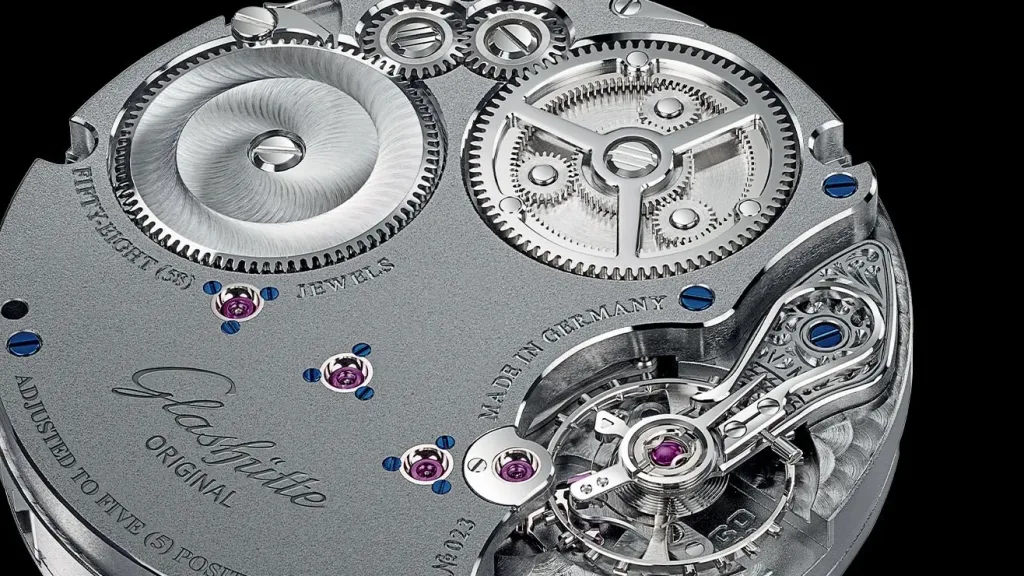
Snailing is a spiral decorative pattern applied to flat, circular components — typically the barrel cover, the ratchet wheel, and the winding wheel. The pattern radiates from the centre outward in a continuous Archimedean spiral of fine, concentric arcs.
Hand-applied snailing is produced on a lathe using a shaped cutter or abrasive tool advanced gradually from centre to edge while the component rotates. The result is a continuous, even spiral with consistent depth and spacing throughout. Machine-applied snailing often shows discontinuities at the transition points — where the tool resets or the feed rate changes — producing a pattern that is regular in broad strokes but inconsistent under magnification. The diagnostic is straightforward: examine the spiral under a loupe where it begins at the centre and where it terminates at the edge. A hand-applied spiral maintains its regularity to both extremes. A machine-applied spiral does not. Glashutte Original Senator Chronometer
Movement finishing in watchmaking is not decoration applied “per se”. It is an integral part of how the movement performs.
A polished pivot turning in a jewelled bearing with correctly dosed lubrication will run with near-zero friction for years. A polished pinion flank transmitting power to the next wheel will lose less energy at every mesh. A precisely threaded, properly seated screw will hold its bridge in position without distortion. A perpendicular, flush-fitted pin will keep its component exactly where it needs to be, every time the movement is assembled and reassembled across decades of servicing.
FP Journe Chronometre Optimum
The cumulative effect of these details — each one small, each one invisible to anyone not looking through a loupe — is a movement that runs more accurately, operates more smoothly, and lasts longer. This is not theory. It is the observable difference between a movement that maintains its amplitude and accuracy across its power reserve and one that does not. Between a movement that emerges from a service in the same condition it entered, and one that shows wear at every pivot hole and every pinion.
The finishing of a movement is, in the end, a statement about time — not the time displayed on the dial, but the time the movement is expected to keep working. A movement finished to the standards described in this article is built to be serviced, reassembled, and returned to service indefinitely. One that is not will, eventually, wear beyond the point of economical repair. The quality is in the surfaces, that`s where a lot of finishing work is done. Lange & Sohne Cal. L.043.8 2
[contact-form-7 id=”4235″ title=”Contact form 1″]