No products in the cart.


Newsletter
[contact-form-7 id=”4235″ title=”Contact form 1″]

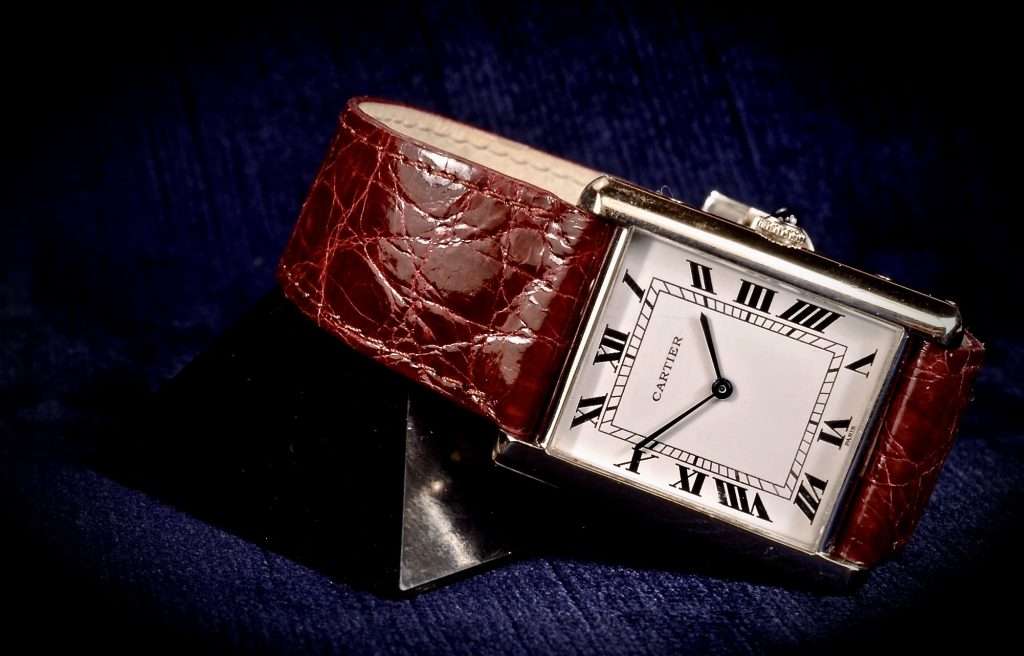
The Tank Louis Cartier was one of the twelve models in the 1973 Collection Louis Cartier, but it was not one among equals. It was the watch that carried the founder’s name.
The Tank Normale was older, the Santos more storied, the Ceinture more unusual — but the Tank Louis Cartier, with its rounded brancards and clean rectangular dial, was the design that had come to represent Cartier in watchmaking. Louis Cartier himself had worn it. When Hocq and Perrin set out to relaunch the maison’s horological identity, the Tank Louis Cartier was the centrepiece.


The launch references were the ref. 78086 (Grand Modèle, 23 × 30 mm) and the ref. 78087 (Petit Modèle, 20 × 28 mm). Both were offered in 18kt yellow gold and 18kt white gold. The movement in both was the Cal. 78-1, a manual-wind calibre based on an ETA ébauche — a reliable, thin movement suited to the flat profile of the Tank case. The dials were white lacquer, signed “Cartier” above the centre and “Paris” at 6 o’clock, with black Roman numerals, a chemin de fer minute track, and blued steel sword-shaped (épée) hands. The crown was set with the blue sapphire cabochon that had been a Cartier signature since the early twentieth century.
Production was small. No confirmed figures exist, but the language across all available sources is consistent: limited quantities, sold through Cartier’s own boutiques and a small number of authorised retailers. Between 1920 and 1960, Cartier had produced approximately 15,000 wristwatches in total. The Collection Louis Cartier continued in that tradition.


In 1974, Cartier introduced a third size of the Tank Louis Cartier: the ref. 17002, a larger model measuring approximately 28 × 35 mm, powered by an automatic movement designated Cal. 170. (also ETA based) This was a departure.
The Tank had always been conceived as a thin, elegant watch, and fitting a self-winding movement with a rotor into a rectangular case required a compromise: the caseback was given a convex profile — a “bubble back” — to accommodate the movement’s additional height. The result was a watch that sat differently on the wrist than the flat-backed manual-wind versions.


The Jumbo Automatic was offered in yellow and white gold. It was not produced in large numbers, and it remains one of the less commonly encountered Tank Louis Cartier references. For collectors, it represents an engineering curiosity: the moment Cartier tried to reconcile the Tank’s silhouette with the convenience of automatic winding — a tension the maison would revisit repeatedly in later decades.
In 1976, Les Must de Cartier was formally established as a diffusion line within Cartier, with Alain-Dominique Perrin as its CEO. The concept had begun in 1973 with lighters, pens, leather goods, and key holders, but it was the extension to watches in 1977 that transformed it from an accessory business into a global luxury brand.


The Must de Cartier Tank was the core watch product: a Tank Louis Cartier case in vermeil (sterling silver with 20-micron gold plating), initially fitted with the same Cal. 78-1 manual-wind movement used in the 18kt gold models, and priced at approximately $500 — a fraction of the solid gold equivalent.
The coloured lacquer dials — burgundy, blue, black, ivory — gave the Must watches a visual identity that was distinct from the white-dial, gold-case palette of the Collection Louis Cartier. The Tank was not the only Must watch: the Vendôme (round case with T-bar lugs), the Ronde, and the Colisée were also produced in vermeil.
The Santos appeared in Must de Cartier advertising material but was never part of the actual product lineup. The timing was critical. The quartz crisis — triggered by Seiko’s introduction of affordable quartz movements in 1969 — was eroding the foundations of the traditional Swiss watch industry. Cartier’s response was not to compete on technology but to compete on identity: the Must line offered the Cartier name, the Cartier design, and the Cartier experience at a price point that captured a new demographic.
By 1980, the round-cased Vendôme Must was available with a quartz movement; the Tank Must followed with quartz in 1982. The transition from mechanical to quartz kept the watches affordable and aligned with the consumer expectations of the era.


The Must line did not stop at watches. Under Perrin’s direction, the brand extended into handbags, silk scarves, sunglasses, fragrances, writing instruments, and desk accessories. Each product category carried the same logic: Cartier design codes, executed in accessible materials, distributed through an expanding network of boutiques and authorised retailers. The Must line became a complete lifestyle proposition — and it worked. By the 1980s, Must de Cartier revenue alone exceeded one billion dollars and dominated the combined company’s sales.
Hundreds of thousands of Must watches were produced. It was this revenue that financed Cartier’s international expansion, its retail network, and its later acquisitions of Piaget and Baume & Mercier in 1988.
In 1977, Cartier introduced a hidden micro-engraving of the word “Cartier” on the dial — the so- called secret signature, typically placed within the VII or X Roman numeral. The measure was introduced as the Must line’s commercial success increased the brand’s visibility and, with it, the risk of counterfeiting.
At the time, it was an effective deterrent: counterfeiting technology was primitive, and reproducing a micro-engraving of this precision was beyond the capability of most forgers. Today, the secret signature should not be considered a decisive element in determining a dial’s originality. Modern printing and engraving technology has made it relatively straightforward to reproduce, and its presence alone does not guarantee authenticity — nor does its absence on a pre-1977 dial indicate a problem.
For collectors, it remains one detail among several to examine when evaluating a dial, but it is no longer the definitive test it once was.


In 1977, Cartier introduced the Tank Arrondie — a new model within the Tank family, distinct from the Tank Louis Cartier despite sharing a common ancestor. The name referenced the original 1922 “Tank à Bords Arrondis” from which the Tank Louis Cartier itself had evolved, but the 1977 Arrondie was not a reissue. It was a new design with curved brancards that gave the case a shape midway between a rectangle and an ellipse — softer and more cushion-like than the Tank Louis Cartier, whose brancards, while rounded, retained a more clearly rectangular profile
The Arrondie was offered in 18kt yellow and rose gold. Early pieces were fitted with the Cal. 78- 1; later Extra-Plate versions (ref. 96041) used the Frédéric Piguet Cal. 21 and had guilloché soleil dials. Production continued into the 1990s. The Tank Arrondie was never a high-volume model and is not commonly encountered today.
In 1978, Cartier relaunched the Santos as a modernised sports watch: the Santos de Cartier, with a two-tone steel-and-gold case, exposed screws on the bezel, and an integrated metal bracelet.
The Santos was not a Tank, and its reintroduction marked a deliberate diversification of Cartier’s watch portfolio away from the pure dress-watch territory that the Tank occupied. It is relevant here because the Santos’ commercial success confirmed that Cartier could sell watches in steel — a material the maison had historically avoided — and to a younger, more casual audience. The Santos pointed toward the future; the Tank Louis Cartier remained anchored in tradition.


The Extra-Plate (ultra-thin) versions of the Tank Louis Cartier were introduced after the initial 1973 launch, fitted with the Frédéric Piguet Calibre 21 — a movement of a different order from the ETA-based Cal. 78-1 used in the standard models.
Developed in 1925 by Henri-Louis Piguet in Le Brassus, the Cal. 21 is one of the well respected manual-wind calibres. It served as the base movement for Patek Philippe (Cal. 175 and 177), Rolex (Cal. 650). That Cartier sourced this movement for its Extra-Plate models placed the Tank Louis Cartier in the company of the finest ultra-thin dress watches ever produced.


The Extra-Plate (ultra-thin) versions of the Tank Louis Cartier were introduced after the initial 1973 launch, fitted with the Frédéric Piguet Calibre 21 — a step above the ETA-based Cal. 78-1 used in the standard models.
Developed in 1925 by Henri-Louis Piguet in Le Brassus, the Cal. 21 is a proven and widely used ultra-thin manual-wind ébauche with a resonant name in the industry. It is not a haute horlogerie calibre — it is a solid, reliable movement that found its way into the catalogues of numerous Swiss manufacturers over the course of nearly a century. For Cartier, it represented a higher tier of movement than the utilitarian Cal. 78-1, and its use in the Extra-Plate models signalled a more refined product within the Tank Louis Cartier range.
The Extra-Plate references include the ref. 96019 (GM, yellow or white gold) — the only confirmed Tank Louis Cartier Extra-Plate reference. Other Extra-Plate references in the 96xxx range (96052, 96053, 96054, 96061, 96062) are associated with the Santos Dumont Extra-Plate series, not the Tank Louis Cartier. These watches represent the high point of the Tank Louis Cartier as a mechanical dress watch in this period. The combination of a solid gold case, a Paris-signed dial, and an ultra-thin Piguet movement placed the Extra-Plate models at the summit of Cartier’s horological offering — above the standard Cal. 78-1 models in both price and prestige.
They were produced in limited quantities and are among the most sought-after Tank Louis Cartier references on the secondary market today.


By the early 1980s, the commercial centre of gravity in Cartier’s watch business had shifted decisively toward quartz. The Must Tank and Must Vendôme were now primarily quartz- powered. The mechanical Tank Louis Cartier in 18kt gold continued in production, but it was no longer the volume driver — it had not been one since 1973. The gold watches served the same function they had always served: prestige, heritage, and creative credibility.
Around them, the brand was expanding rapidly. In 1985, Cartier introduced the Pasha — a round, water-resistant sports watch, named after the Pasha of Marrakech. The Pasha was a further step away from the Tank aesthetic and toward a broader, more diverse watch catalogue. In 1988, Cartier acquired Piaget and Baume & Mercier, and the Compagnie Financière Richemont was formed under Anton Rupert’s leadership — the beginning of the luxury conglomerate structure that would come to define the Swiss watch industry in the following decades.

| Reference | Size | Calibre | Case Material | Dimensions | Production Period |
|---|---|---|---|---|---|
| 78086 | GM (Large) | Cal. 78-1 (manual) | 18kt YG or WG | 23 × 30 mm | 1973 onward |
| 78087 | PM (Small) | Cal. 78-1 (manual) | 18kt YG or WG | 21 × 28 mm | 1973 onward |
| 96019 | GM (Large) Extra-Plate | Cal. 021 / FP 21 (manual) | 18kt YG or WG | 23 × 30 mm | 1973 onward |
| 17002 | Jumbo Automatic | Cal. 170 (automatic) | 18kt YG or WG | 28 × 35 mm | 1974 onward |
In the 1970s and 1980s, the commercial hierarchy was clear: the Must line sold in volume, generated revenue, and built the brand. The 18kt gold Tank Louis Cartier was the quiet anchor — produced in small numbers, sold to a selected clientele, and less visible in the wider market. Today, that hierarchy has reversed. The 18kt gold mechanical Tank Louis Cartier references from this period — with their Paris-signed dials, their secret signatures, their manually wound Cal. 78-1 or ultra-thin Piguet Cal. 21 movements — are the watches that collectors seek. The Must watches, once dismissed as “cheap Cartier” and trading at a few hundred dollars, have themselves appreciated significantly since around 2020, driven by renewed interest in 1970s and 1980s design and by the visibility of vintage Cartier on social media. The coloured-dial Must variants now command prices that would have been unthinkable a decade ago. But the gold watches remain at the top.
A Tank Louis Cartier ref. 78086 in yellow gold with an original Paris dial and secret signature, in honest unpolished condition, is a watch that documents both the maison’s design heritage and the specific commercial moment — 1973 — when Cartier reinvented itself. The Extra-Plate models with the Frédéric Piguet movement occupy an even more rarefied position. These are the watches that the Must line was built to echo, and they remain the standard against which all subsequent Tank production is measured.
[Part III will cover the Tank Louis Cartier from 1990 onward: the transition to the Collection Privée Cartier Paris (CPCP) in 1998, the introduction of new calibres, and the current production references.]
[contact-form-7 id=”4235″ title=”Contact form 1″]