No products in the cart.

Newsletter
[contact-form-7 id=”4235″ title=”Contact form 1″]

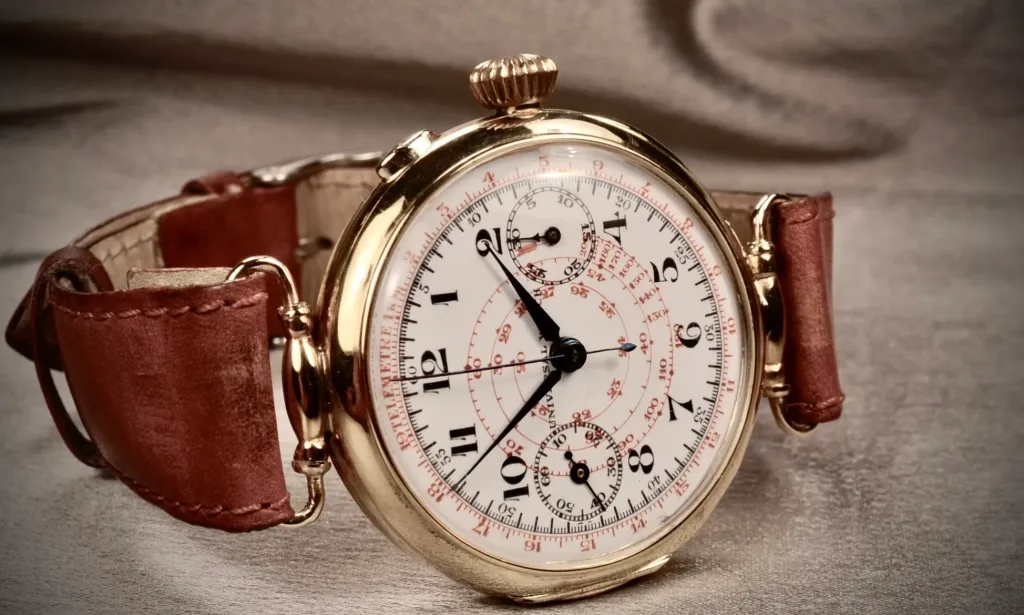
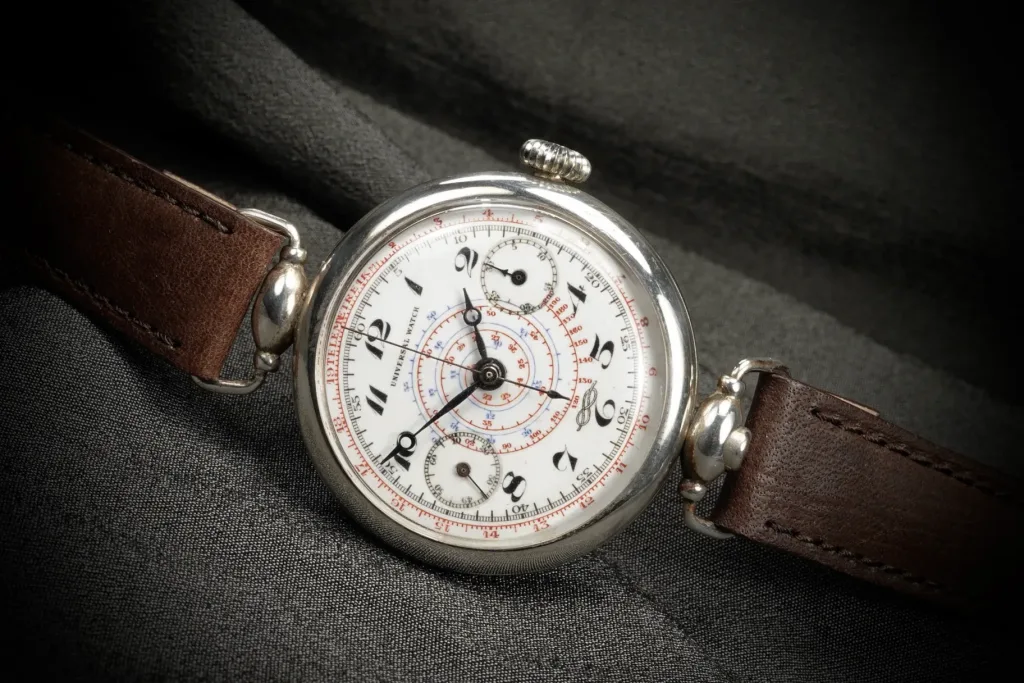
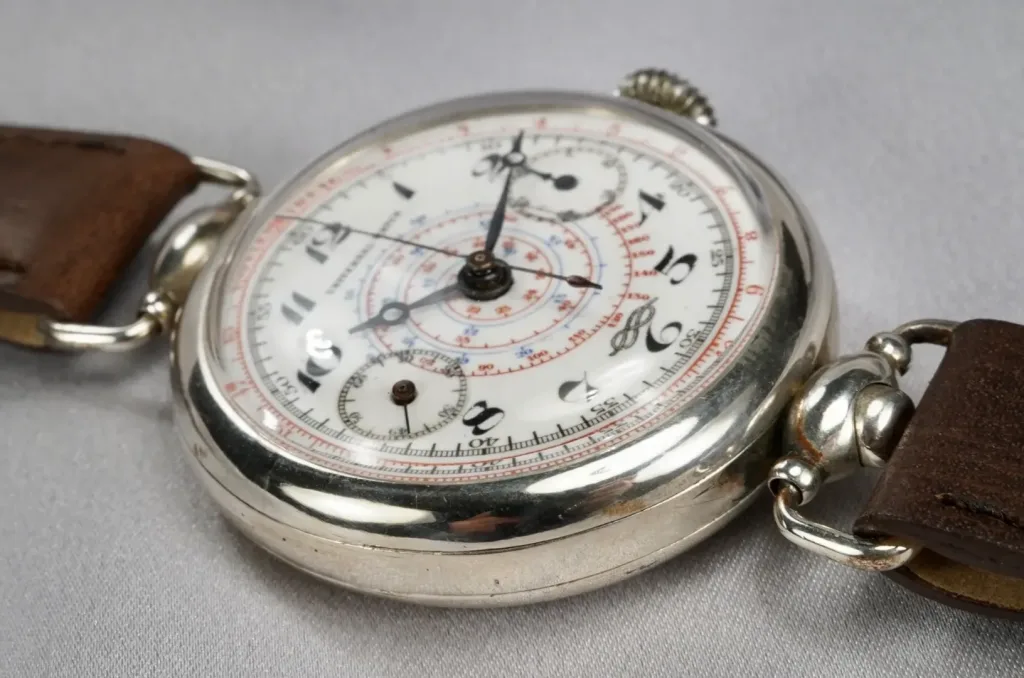
There is no model name on the dial. Not Compur, not Compax, or Uni-Compax as those did not yet exist. What is written on the dial – usually – is Universal Watch, on dials that were mostly white grand feu enamel. The case seems to be derived from a pocket watch with wire lugs soldered to it. There often is one pusher only.
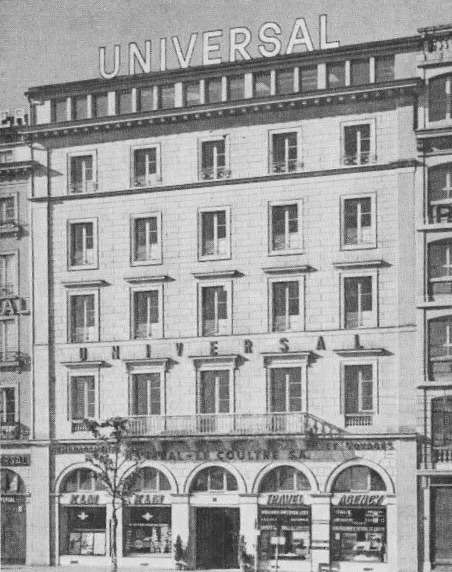
The Universal factory, 1919 – Courtesy Universal Geneve
These are the first wrist-chronograph Universal sold, built before the company had a name for it. It is also the least written-about corner of the marque. Almost every account of Universal’s chronographs begins in 1934, with the Compur name, and treats what came before as a preamble. It was not a preamble, it was roughly a decade of production with some interesting survivers with all of the Universal quality.
This is where the Universal begins.
Universal Watch was founded in Le Locle at eight o’clock on the morning of 18 January 1894, by Numa Descombes and Georges Ulysse Perret, under trademark no. 6731. The stated object of the company is worth reading in the original: fabrication de boîtes, des cuvettes, des cadrans, de mouvements, d’étuis et emballages de montres.
Cases, cuvettes, dials, movements, boxes and packaging. A house that assembled and sold watchesand parts thereof.
Descombes died in 1897, at thirty-four. On 22 July that year Perret took Louis Berthoud as his partner, and every trademark and patent passed to the new firm of Perret & Berthoud under registration no. 9420.
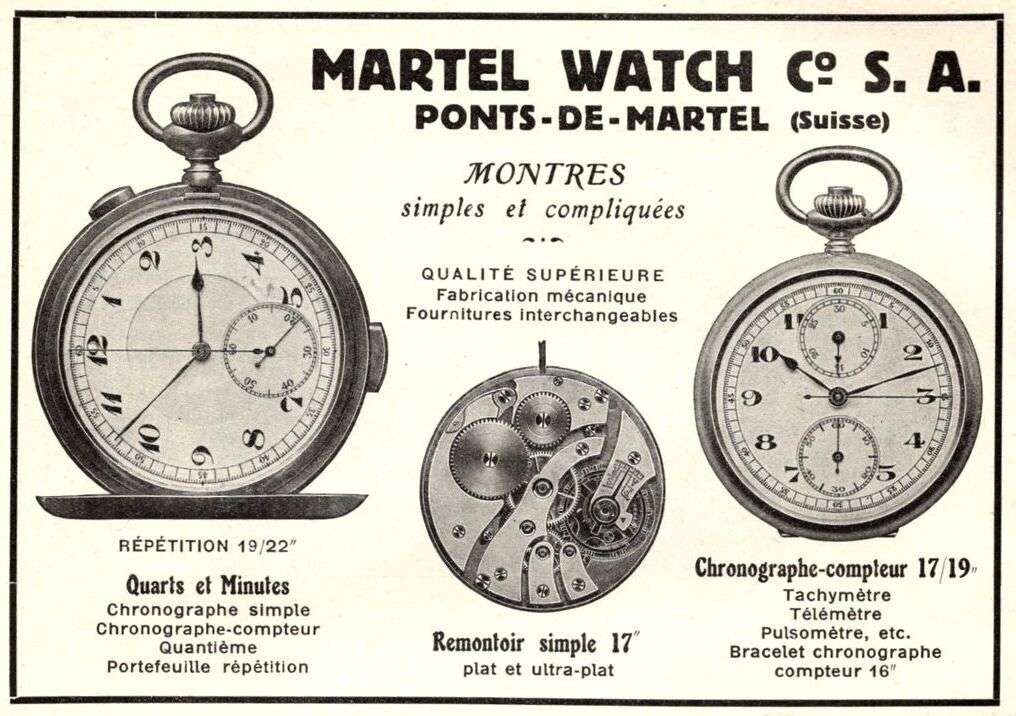
Martel Pocket Watch ad, circa 1920
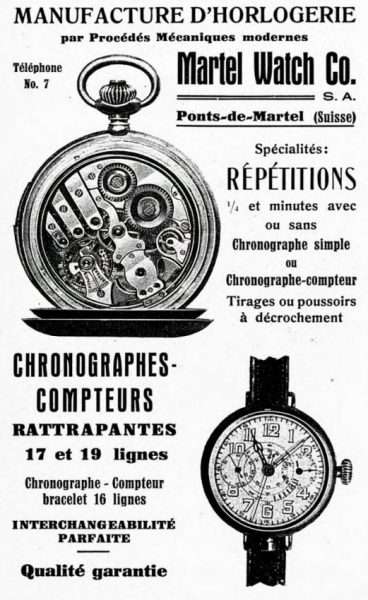
Then, on 2 September 1898, they registered trademark no. 10407, Universal Watch Extra — which Sala records as describing a chronograph with a 30-minute counter and a pushpiece at 6 o’clock, set in the centre of the case horns.
Four years after the founding. Thirty-six years before Compur. So far as we can establish it is the earliest documented Universal chronograph of any kind.
One further detail from those first years runs through everything that follows. Among the models / trade names Universal registered in those years, in Italian, are La Meridiana, Uso Militare (Miltary Use) , Cronometro Ferroviario (Railway Chronometer, 1894). and Uso Ferrovie (Railway Use, 1920).
It seems the Italian market was a relevant one from the beginning.
Martel Pocket Chronograph + Watch ad, circa 1920
Sala dates the first Universal wrist chronograph to 1917: a single push-button set in the crown, a gilt brass 17-ligne movement, and an enamelled dial carrying both tachymetric and telemetric scales.
Martel Chronographs ad, 1927
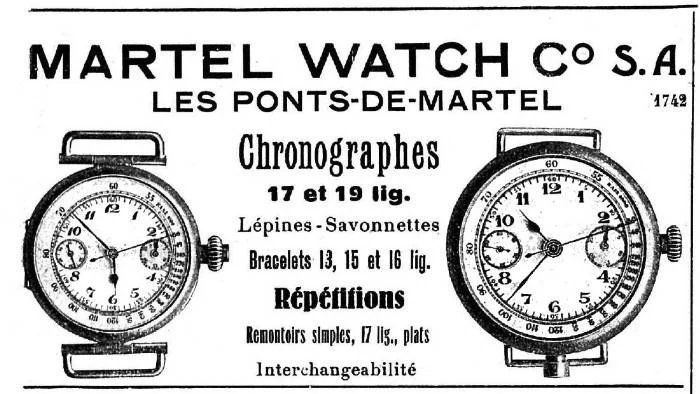
Treat the “first in the world” claim that usually attaches to this watch with care. It is Universal’s own, it is repeated by others because Universal made it, and the period there are other watchmakers doing similar things. What is not in doubt is that Universal was selling wrist chronographs from the end of the First World War.
At the time Universal produced through the 1920s a small family of chronographs, and the honest way to organise it is by movement size rather than by model, because there are no model names to organise by.
The 14½ ligne. The smallest of the three. The chronograph pusher sits at 2 o’clock. Cases run around 38 mm.
Universal Watch Cal. 14 1:2
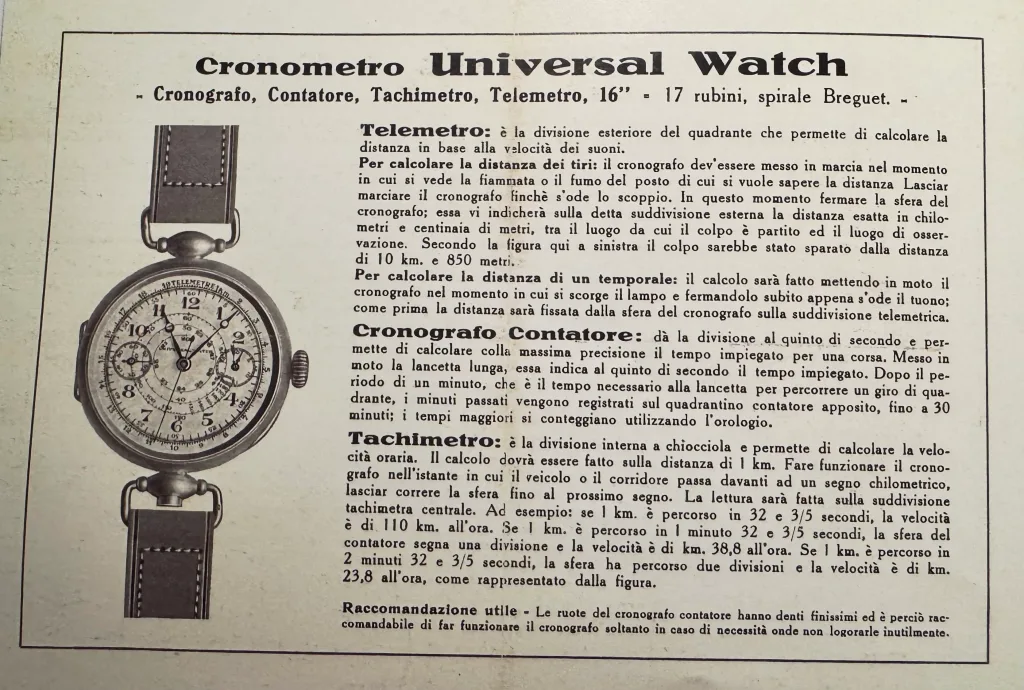
The 16 ligne. The same case idiom, a single pusher, and here the pusher is usually at 6 o’clock — though examples do turn up with it at 2. This is the size in the advertisement below.
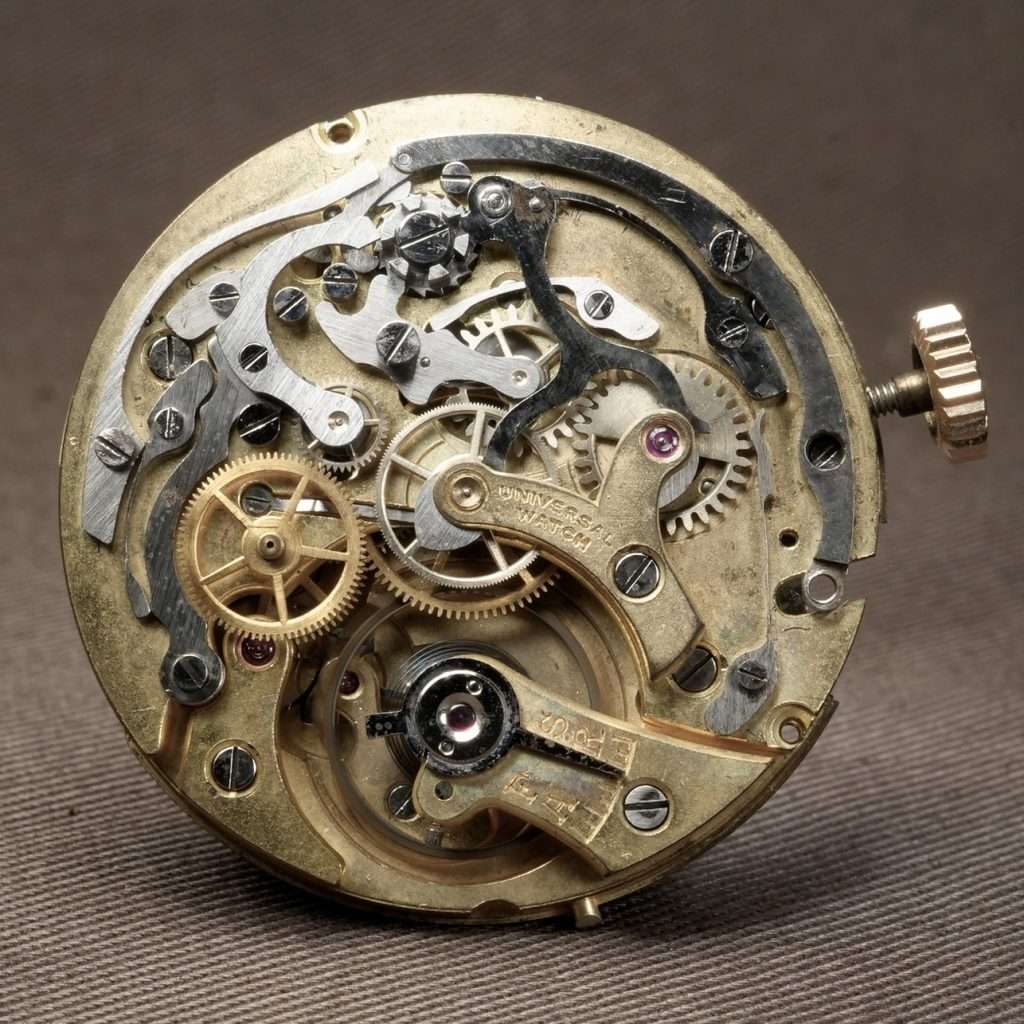
Martel chronograph movements

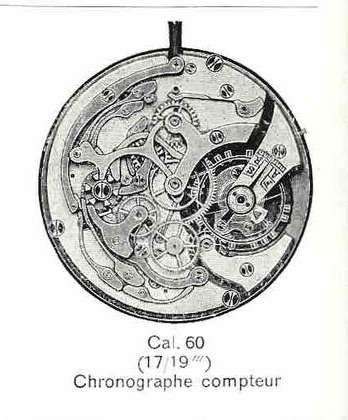
Martel Cal. 60 – Universal Cal. 297
Across all three, the case looks a pocket watch persuaded onto a wrist. Wire lugs are common. Backs are found both hinged and pressure-fitted. The metals are gold, silver or sterling alloy, occasionally steel, and occasionally chromed base metal, one we found gold plated, which indicates these were sold across a wide range of prices. The dials are almost always grand feu enamel, rarely, usually from the 1930`s, metal
Universal Watch ad – Circa 1920
A period Italian advertisement for one of these, from our own material — sets out the specification plainly:
Cronometro Universal Watch — Cronografo, Contatore, Tachimetro, Telemetro, 16”’ – 17 rubini, spirale Breguet
Sixteen lignes, seventeen jewels, Breguet hairspring. Beneath it, three columns explaining to the buyer how to use a telemeter to find the distance of a gunshot, how the counter reads to a fifth of a second across a thirty-minute register, and how to time a kilometre on the tachymetre.
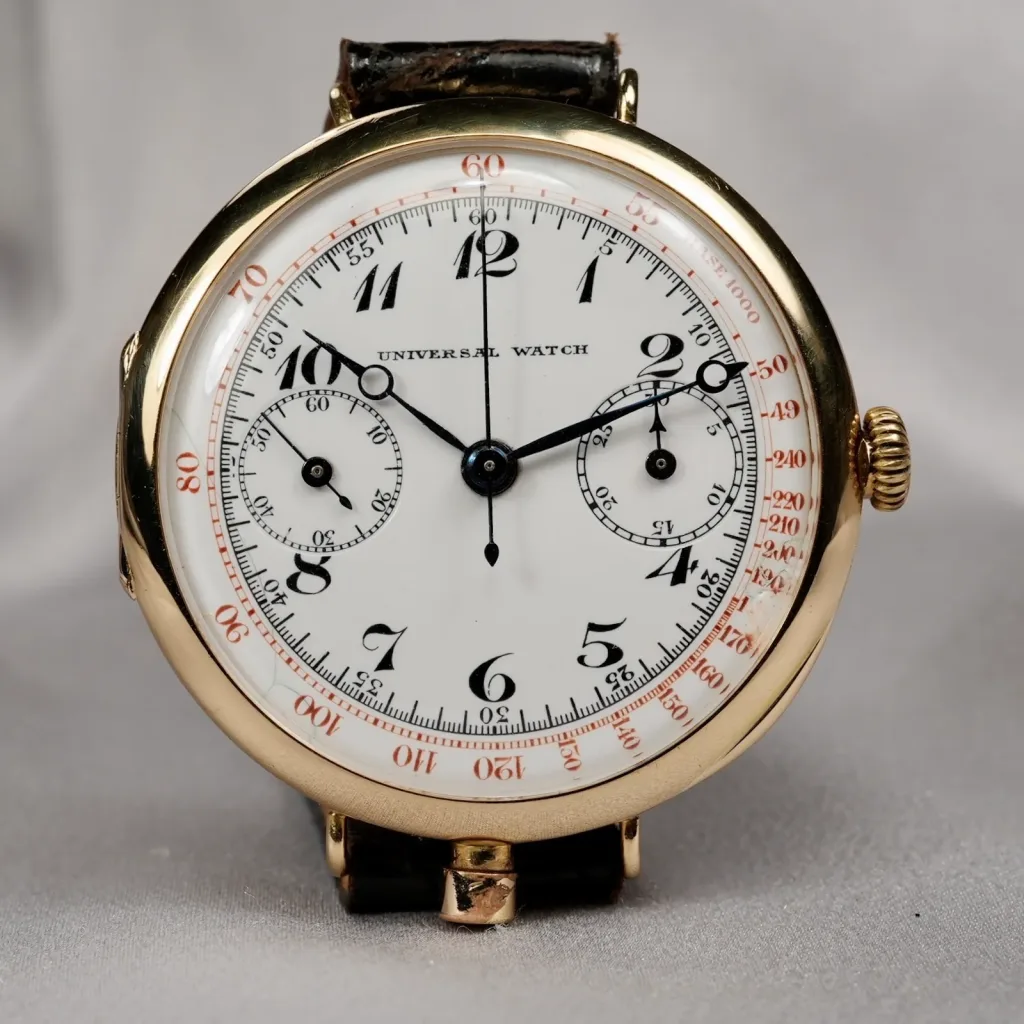
UNIVERSAL WATCH CHRONO 1Cal. 16 3:4
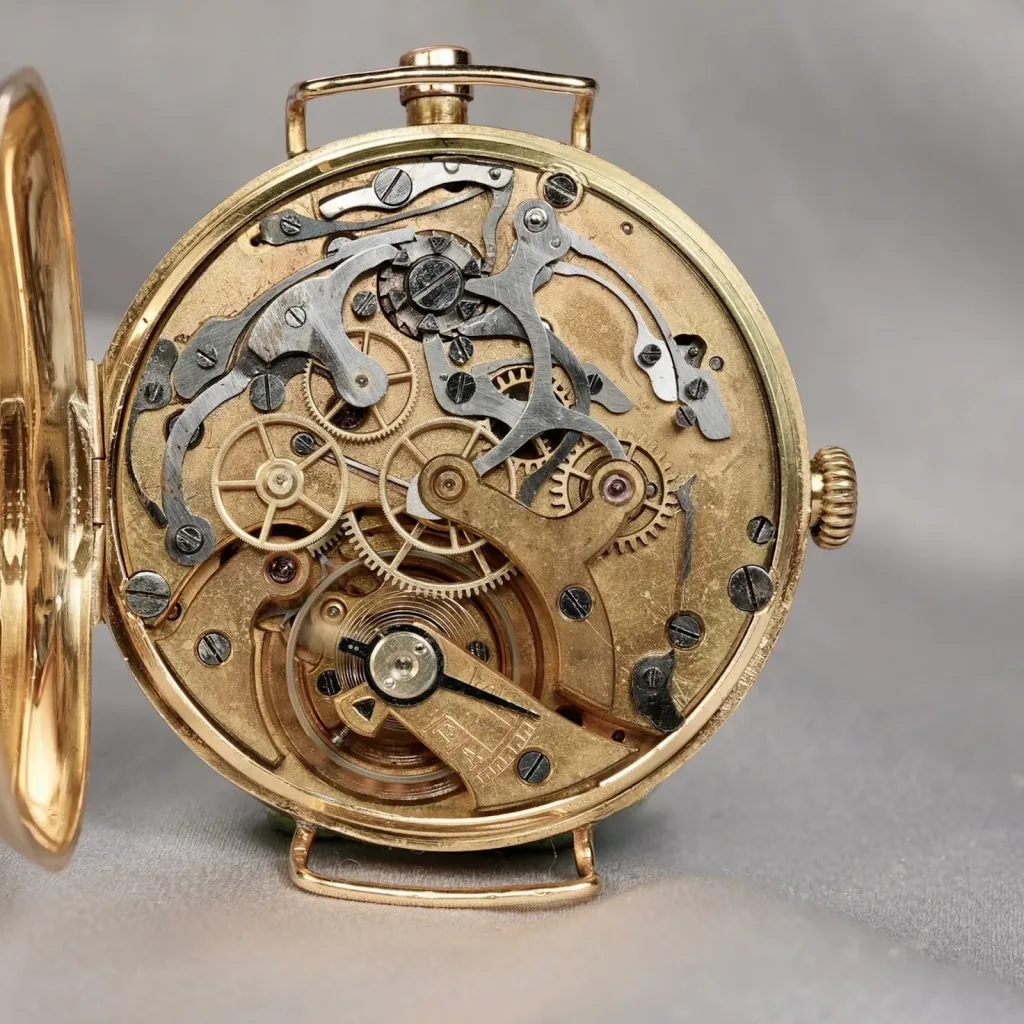
UNIVERSAL WATCH CHRONO 1Cal. 16 3:4
Then, at the foot, a prescription that also hold true today : le ruote del cronografo contatore hanno denti finissimi ed è perciò raccomandabile di far funzionare il cronografo soltanto in caso di necessità onde non logorarle inutilmente. The counter wheels have very fine teeth, so run the chronograph only when you need it, so as not to wear them out for nothing. This is still true today and it is one f the easons why the chronograph function should not be engaged all of the time
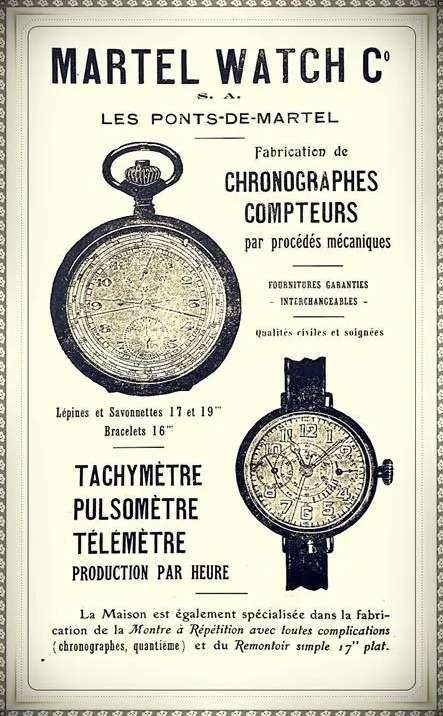
Martel Watch Co. — the chronograph house at Les Ponts-de-Martel, formally registered on 23 June 1914 by Georges Pellaton-Steudler, who had begun ébauche production in Le Locle around 1910–11.
We have written its history separately, here, and the short version is that Martel spent sixty years specialized in making qualitative chronographs delivered to a few select brands.
The relationship with Universal begins around 1917–18 and is the making of both firms. By roughly 1929 Universal held about a third of Martel’s shares: financial backing given in exchange for chronograph supply, an arrangement that ran for some twenty years. In 1934 Raoul Perret, Universal Geneve`s “Director” joined the boards of both Martel and Zenith.
Martel Advertising, circa 1920
In January 1941 a fully renovated Martel factory was inaugurated with Universal’s money, and Universal’s name on the façade, although Martel remained a legally independent company throughout. By 1950 the tie was cut; Zenith began buying Martel in 1959 and owned it outright by 1966.
So the movement supplier is well known.
UNIVERSAL WATCH CHRONO 1P 0.800 STERLING AP WHT 16
The common assertion of the type, including the one in our own Martel article, which this post corrects, is that the early monopushers were pocket chronograph movements adapted to the wrist. The cases invite that reading. They are pocket cases with lugs soldered on, and the reading follows from them without anyone having to check.
Yet, the watches do not support this claim.
UNIVERSAL WATCH with FLEXIBLE LUGS Cal. 14 1:2 JPG
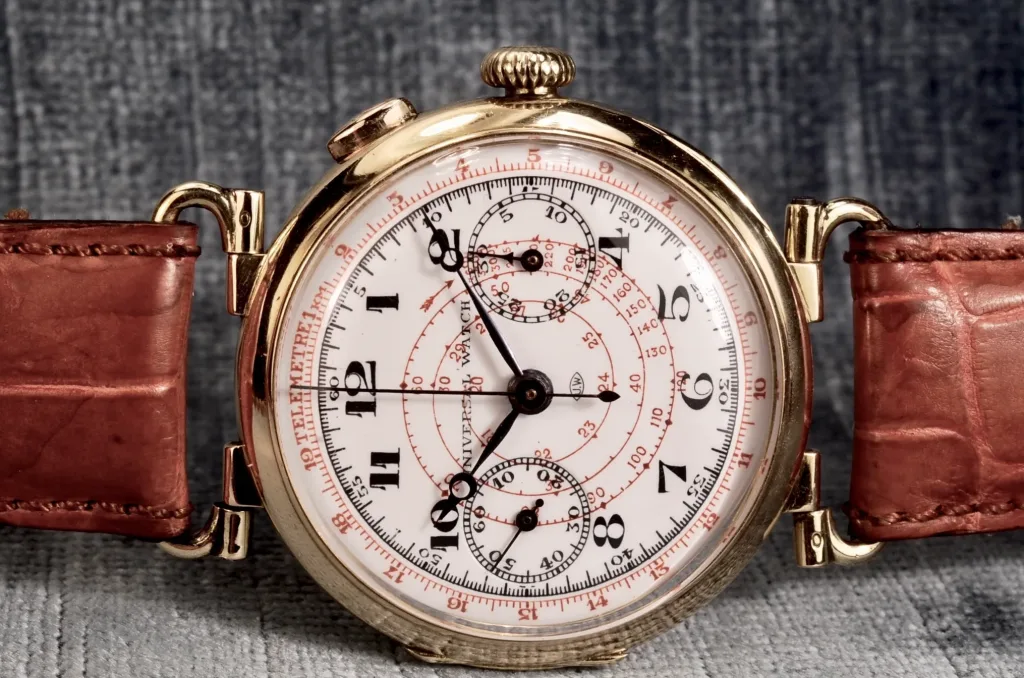
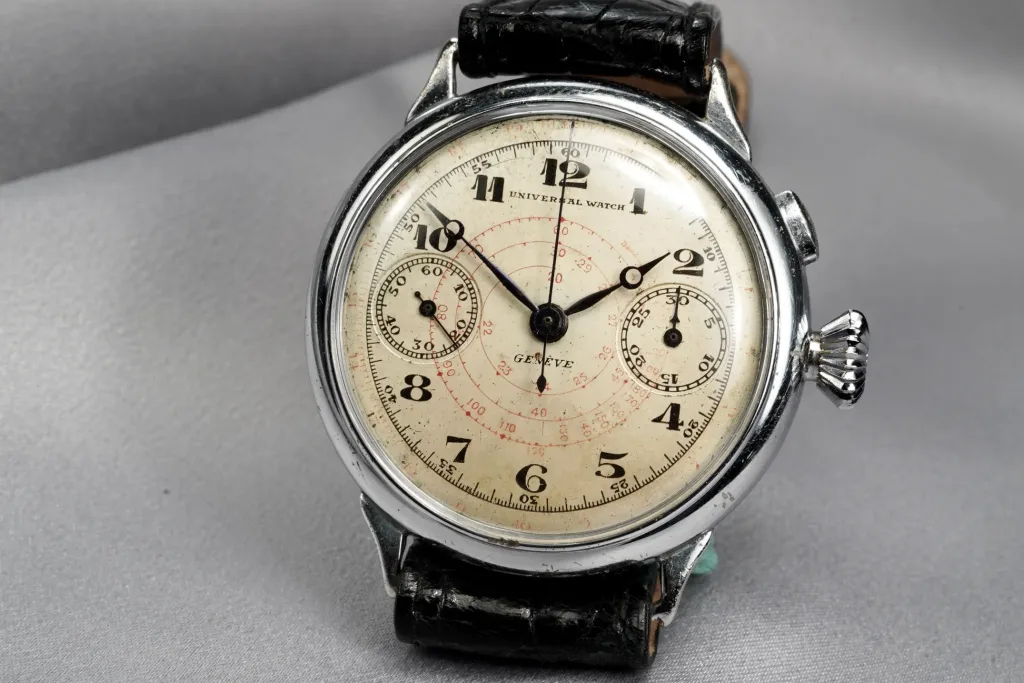
We have handled these pieces for years and they are only very rarely encountered in a pocket watch. The overwhelming majority are in wrist cases, and they sit there in the original configuration, not re-cased, not converted, not a pocket movement with a later dial. If the 14½, 16 and 16¾ had genuinely begun life as pocket calibres, the pocket watches would exist in numbers, because pocket watches of the 1920s survive better than wristwatches. As they do not exist in numbers, this asymmetry is evidence.
The conclusion: most likely as the demand for wrist chronographs surged, some pocket watches were factory-modified for wrist use, but a substantial number of cases were made directly for these movements for wrist use.
A UNIVERSAL WATCH CHRONO with a rare metal dial Cal. 16 3:4
Martel was designing and building chronograph calibres for wrist use in the early 1920s, while the casemakers were still working from a pocket vocabulary, because that was the vocabulary they had. This transitional watch is an “older” modern movement in an old shell.
Two Universal Pocket Chronographs from the factory`s archives
Courtesy G. Sala
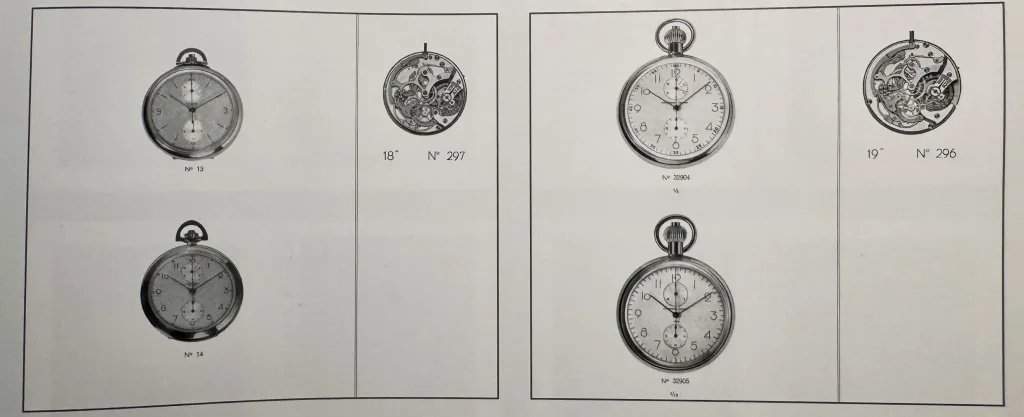
Every published Universal serial table begins at 500,000, in 1930. There is no table for the 1920s for a plain reason: most of the company’s archives apparently are incomplete or missing. The watches in this article carry numbers below that threshold, outside this documented series.
One caution before anyone dates a period watch from a number. In this era the number on the case and, if available, the number on the movement may belong to different series, components were made in batches, cased when an order arrived, and delivered when a retailer asked for them; the date a movement was finished, the date it went into a case, and the date it reached a shop window could be separated by years.
An UNIVERSAL WATCH CHRONO, 0.800 STERLING Cal. 16
Demand moved far more slowly than it does now, and twice in these years it collapsed outright — in the post-war slump of 1920–21, and again after October 1929, with the existing stock that was already cased simply waiting.
A serial from this decade will place a watch inside a band of a few years, it will not give you an exact year. Dating a watch of this period to the precision we expect of a modern one is not possible, what is being reported is not the exact production year of the watch but the age, usually of the case as this is where most of these serial numbers are.
So serials below 500,000 are useful indication, not a precise date.
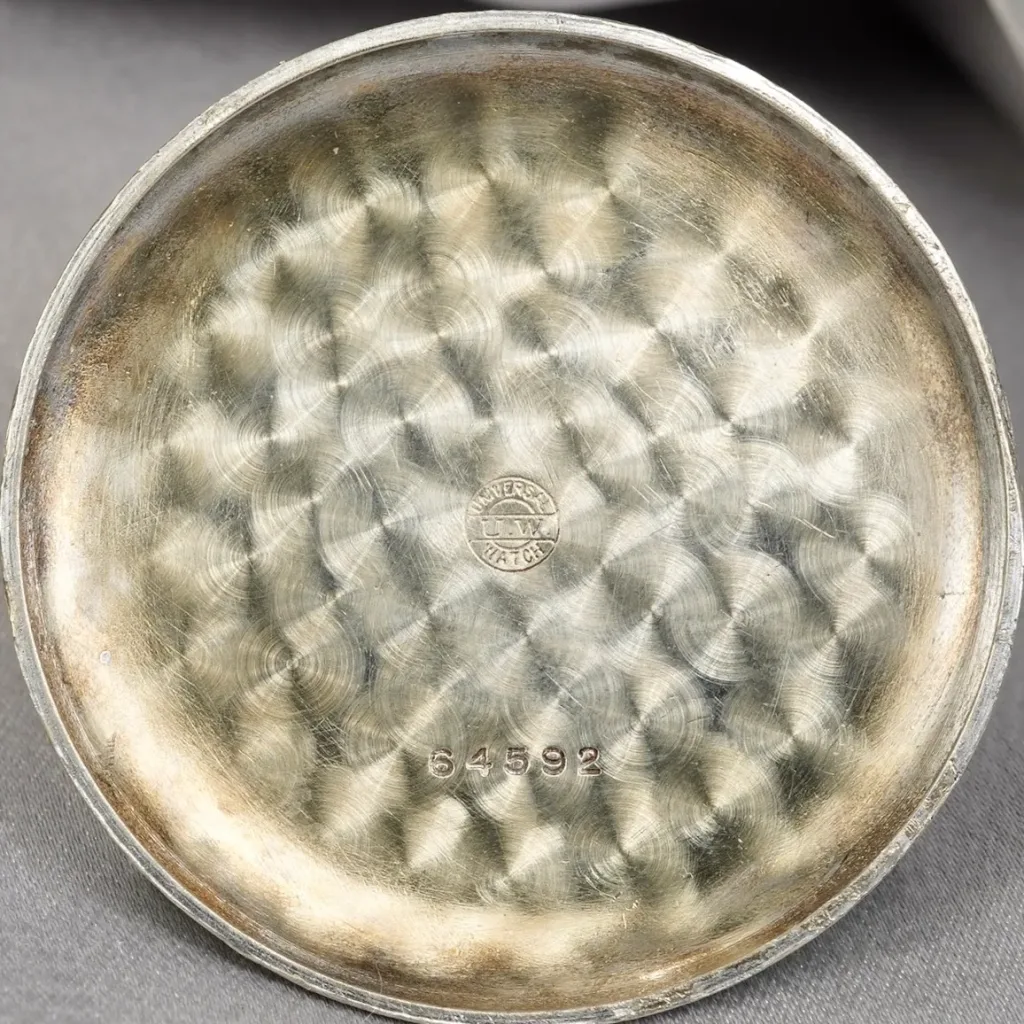
A 65K range early UNIVERSAL WATCH Cal. 16 3:4
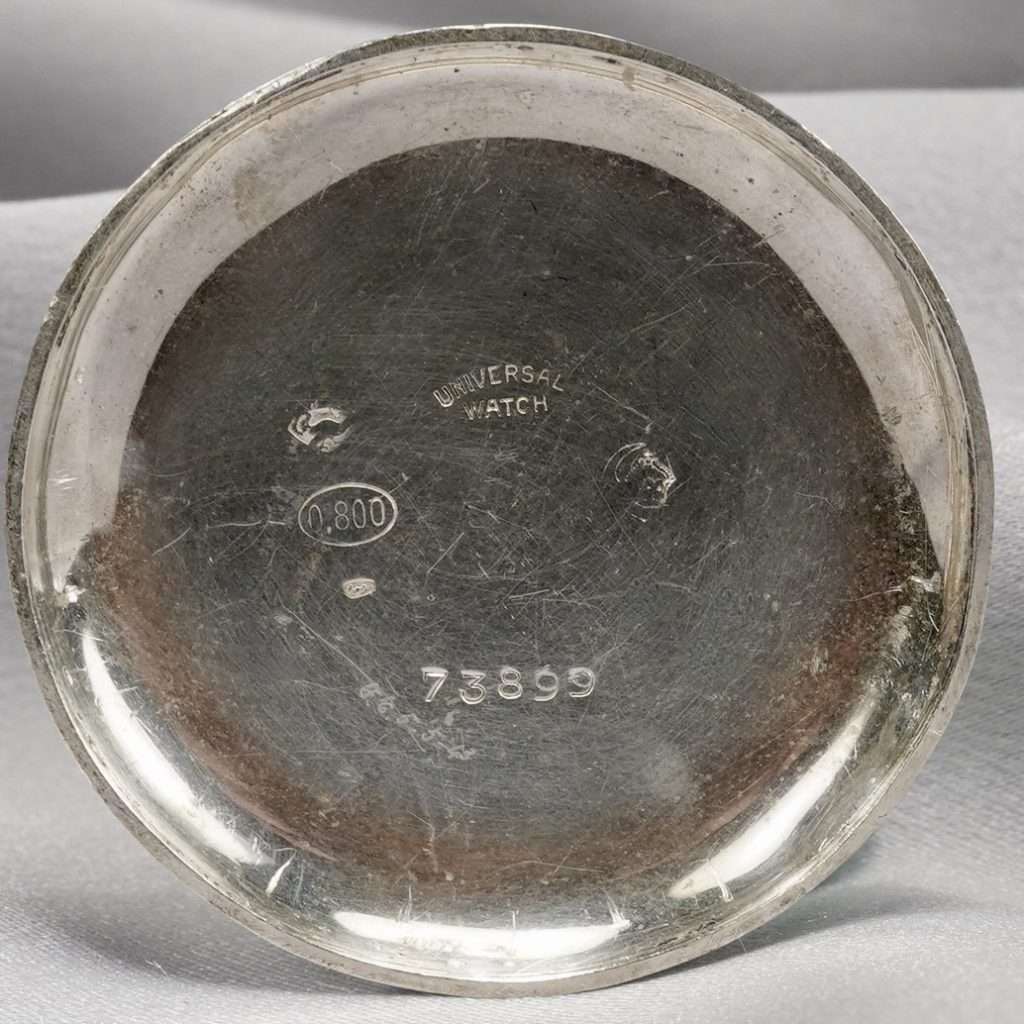
A 73K range early UNIVERSAL WATCH Cal. 16 3:4
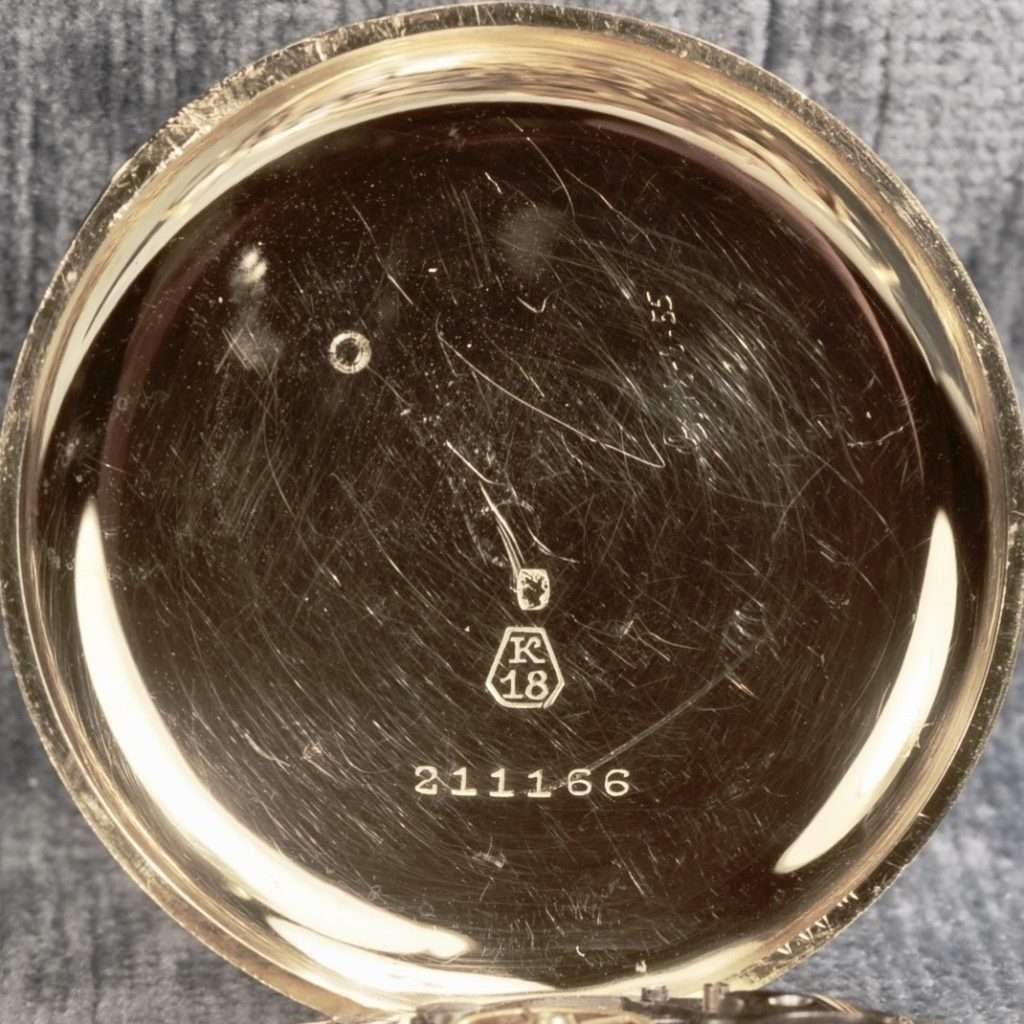
A 211K range UNIVERSAL WATCH Cal. 16 3:4
Which places these watches, by the classification we set out in our article on what “in-house” actually means, in the category: manufacture: movements designed and built in house, because by about 1929 Universal is reported to have bought a one-third of Martel’s shares, and appointed Raoul Perret, Universal`s “Directeur” onto the Martel board in 1934, thus making Universal a manufacture, as it owned a significant share in one.
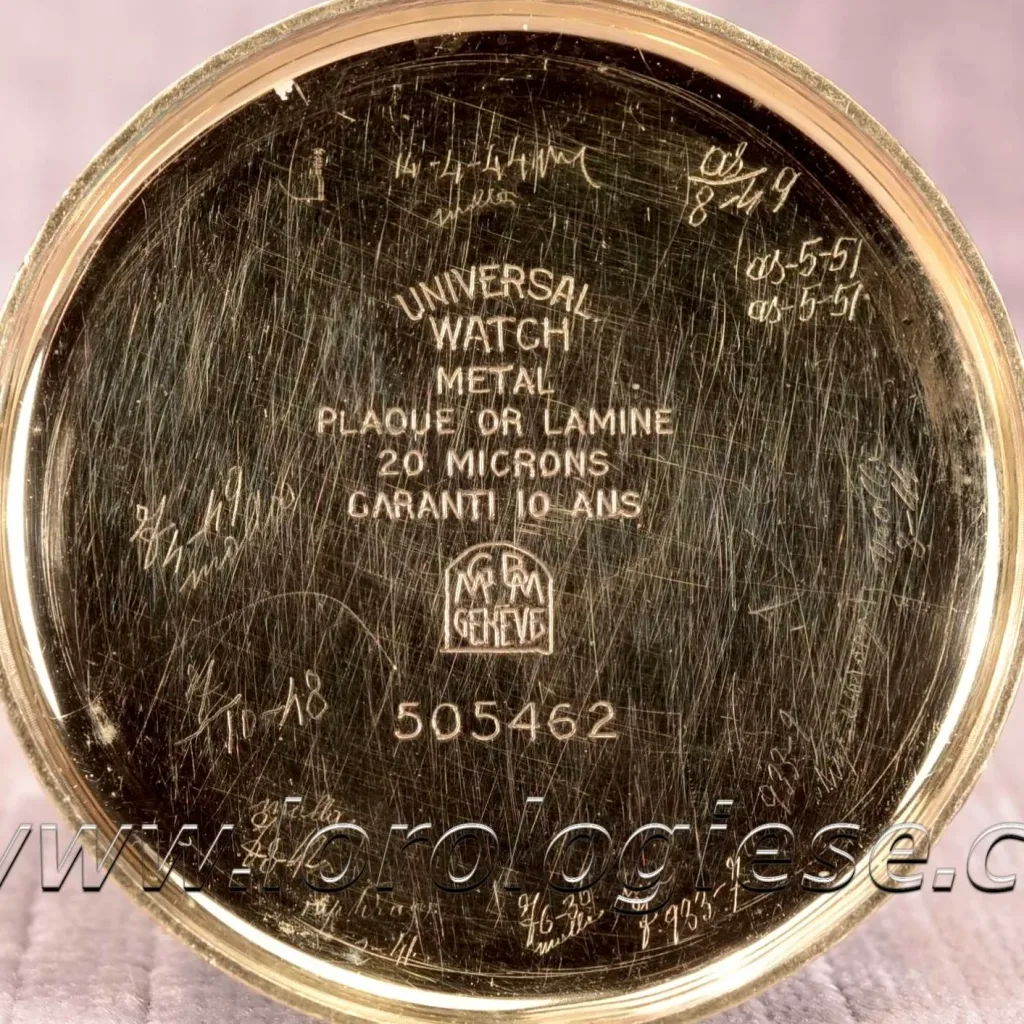
A rare UNIVERSAL WATCH Gold Plated chronograph
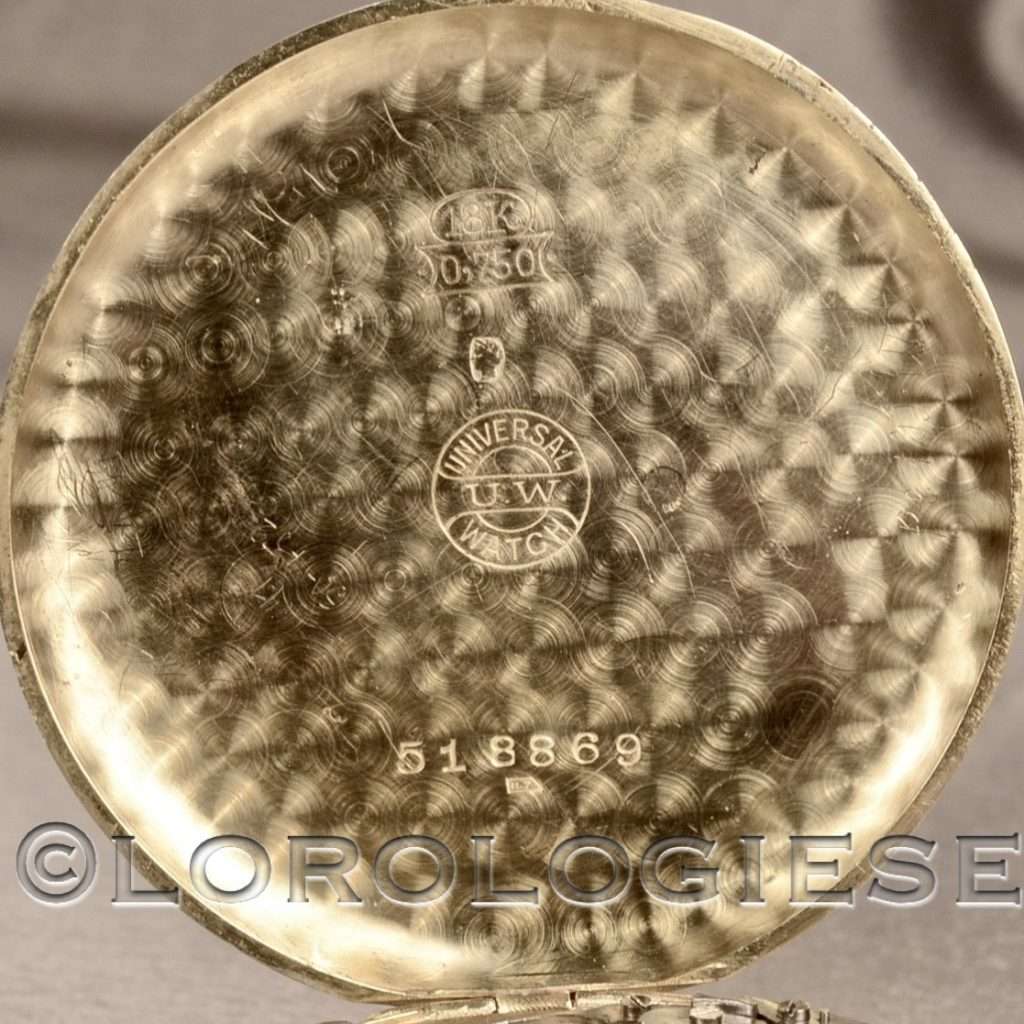
A 518K range later UNIVERSAL WATCH Cal. 16
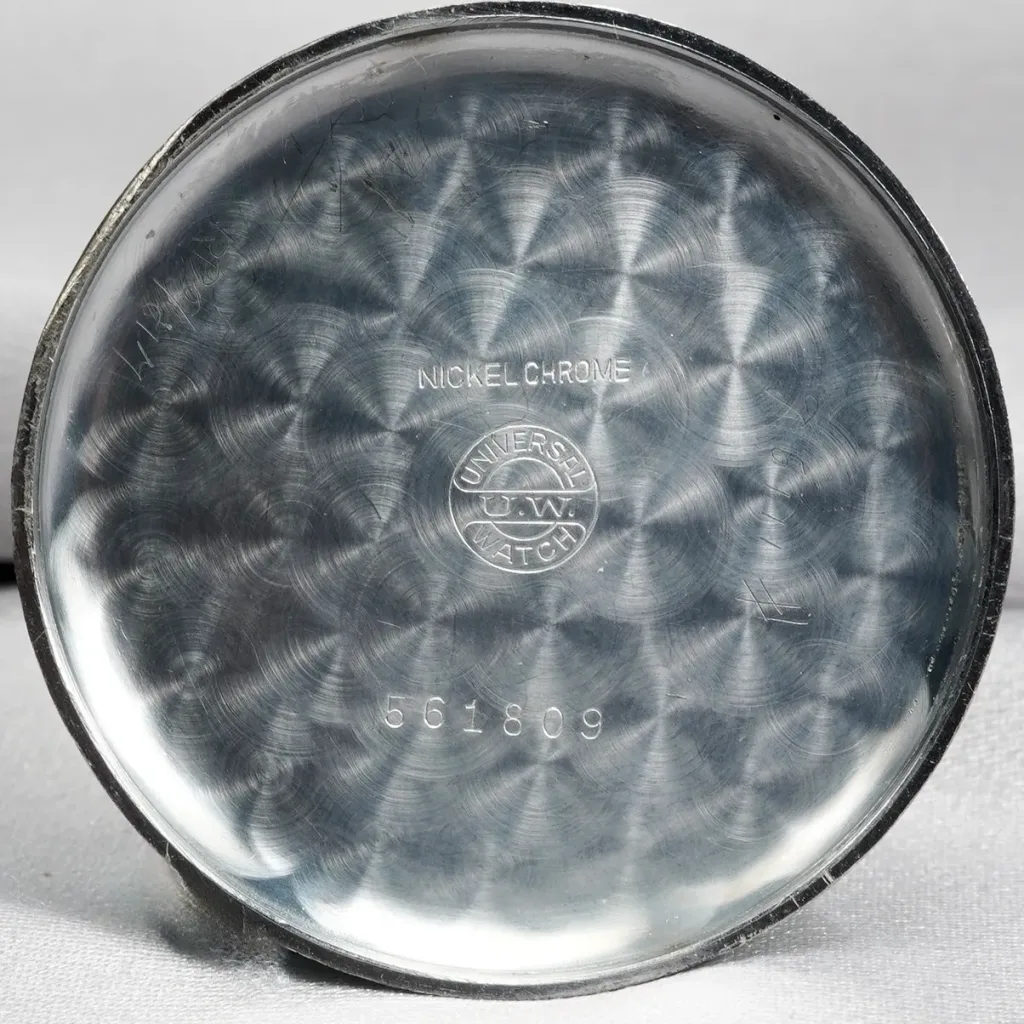
A late 561K range UNIVERSAL WATCH Cal. 16 3:4
| Calibro | Pusher | Ø cassa | Range seriali osservati | Ampiezza | Diffusione | Periodo implicito |
|---|---|---|---|---|---|---|
| 16¾ lignes | ore 6, sempre | 42–43 mm | 55.000 – 561.000 | ~506.000 | il più diffuso dei tre | dal periodo pre-tabella fino alla forbice 1930–36 |
| 16 lignes | ore 6 di norma; ore 2 documentato | ~40 mm | 505.000 – 561.000 | ~56.000 | — | quasi interamente entro la forbice 1930–36 |
| 14½ lignes | ore 2 | ~38 mm | 509.000 – 548.000 | ~39.000 | — | quasi interamente entro la forbice 1930–36; diventerà poi UG cal. 285 |
Serial ranges are from our own records, taken from watches examined. Period is inferred from the published Universal serial table (500,000 = 1930; 500,000–600,000 = 1930–36); the table gives brackets, not a rate, so no single year should be read off a number.
One watch in our hands breaks the pattern, and it is worth recording it.
The dial is signed UNIVERSAL WATCH EXTRA, the trademark Universal registered on 2 September 1898, no. 10407, on white grand feu enamel, with a red telemetric scale on a base of 1000 and a red tachymetre.
A very rare UNIVERSAL WATCH EXTRA CHRONO Cal Valjoux R22GH
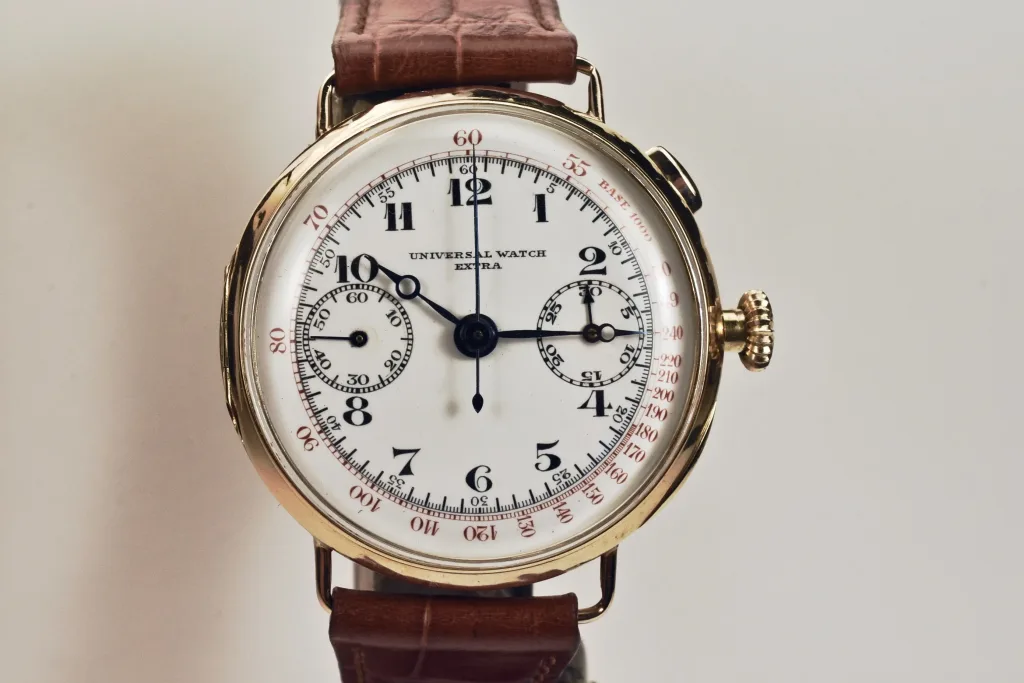
The case is 18kt. gold, with wire lugs, and has a serial in the 495,000 range; The single pusher sits at 2 o’clock, because the movement is a Valjoux 22GH — not a Martel calibre.
This indicates that Universal before Compur was buying calibers from more than one supplier. And it explains where Roessler’s account of the period, early Zenith wrist chronographs built on Reymond Frères (Valjoux) movements.
Next: Compur — the name that came first.
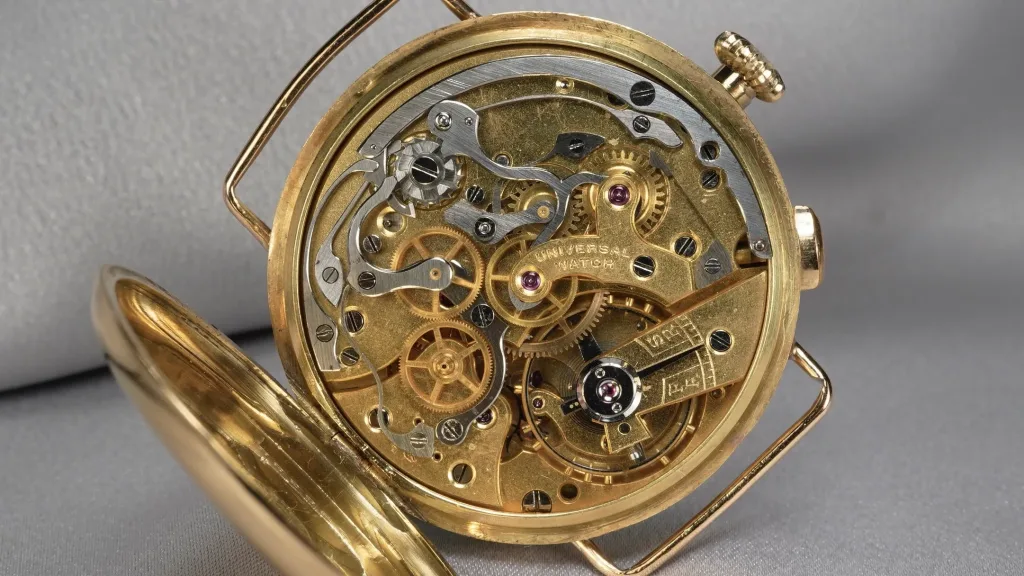
The movement UNIVERSAL WATCH EXTRA CHRONO Cal Valjoux R22GH
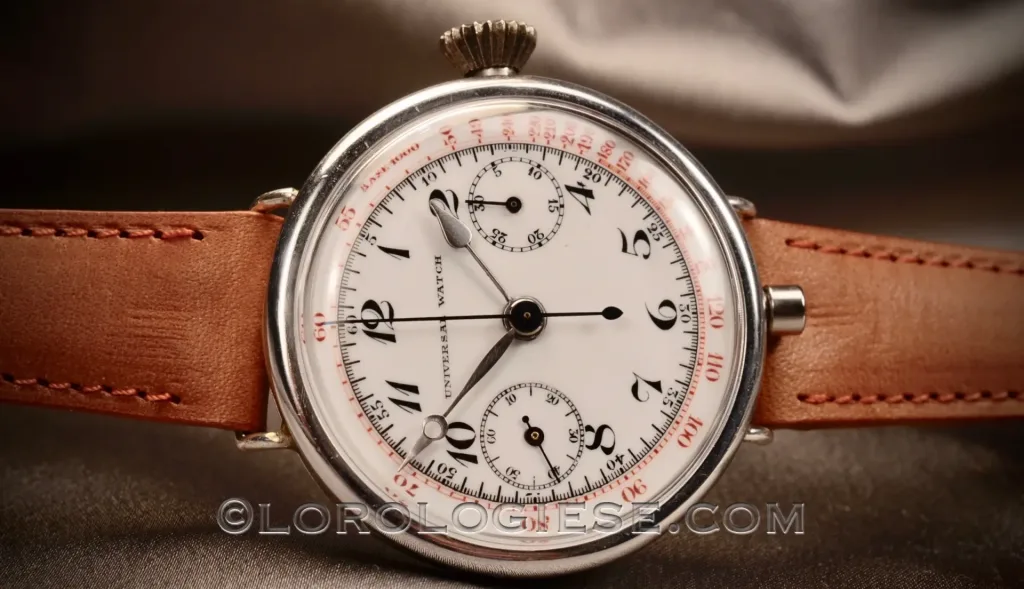
UNIVERSAL WATCH CHRONO STERLING 800 Cal. 16 3:4
Sources: Pietro Giuliano Sala, Universal Watch Genève: Cronografi e orologi da polso complicati
(Vallardi), for the trademark chronology and the 1894, 1898 and 1917 records;
our own history of Martel Watch Co. for the corporate chronology, the shareholding and the 1941 factory;
period Universal Watch advertisement,
the author’s collection;
published movement reference literature where noted, and disagreed with where noted.
Case, movement and dial observations are our own, from watches examined in the workshop over many years.
[contact-form-7 id=”4235″ title=”Contact form 1″]