No products in the cart.


Newsletter
[contact-form-7 id=”4235″ title=”Contact form 1″]

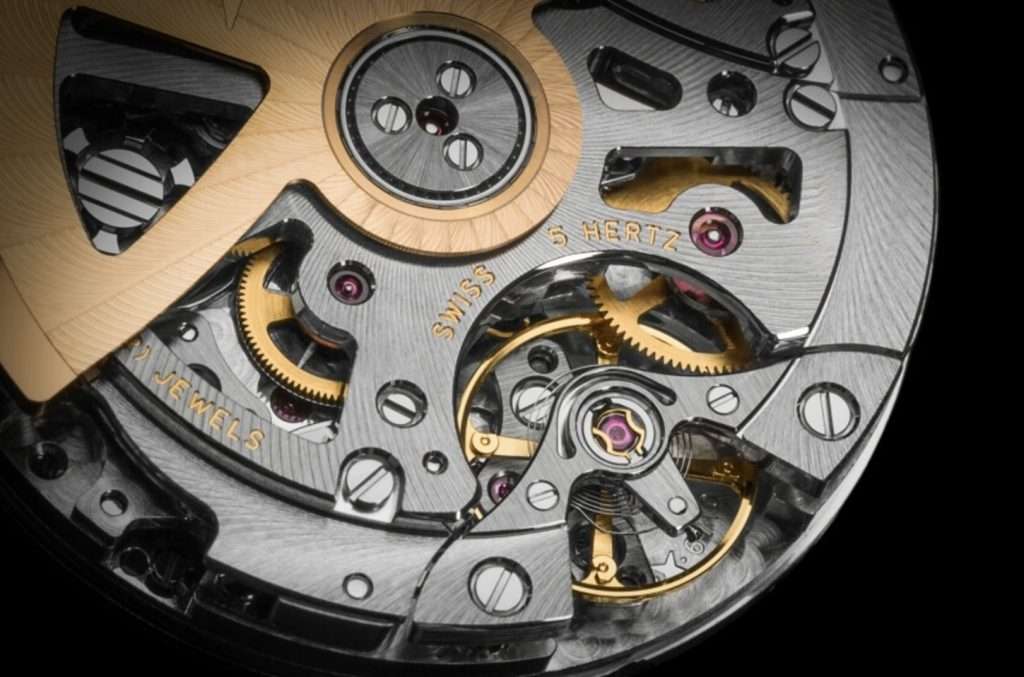
So here is a scale that works.
Ask a brand what makes its movement a manufacture calibre and you will get an answer. Ask a lawyer and you will get silence.

The Universal Geneve Factory – Circa 1960`s – Courtesy Universal Geneve
There is no legal definition of “manufacture” in Swiss watchmaking. The ordinance that governs the industry’s vocabulary — the one behind “Swiss made” — regulates the geographic indication and nothing else; the word “manufacture,” in the sense of a house that builds its own movements, appears nowhere in it.
The Fédération de l’industrie horlogère has never adopted criteria. The Fondation de la Haute Horlogerie’s encyclopedia offers only trade convention: a company that makes a watch “almost in its entirety.” No threshold. No auditor. No consequence for getting it wrong.
The same is true of “in-house.” There is no percentage a brand must reach, no body that certifies it, no process that checks. A watch may lawfully be sold as having an in-house movement that its maker neither designed nor machined.

Fédération Horlogère Suisse Bienne headquarters

What the law does regulate is worth understanding precisely, because it is regularly mistaken for something it is not.
Since 2017, a Swiss watch must incur at least 60 per cent of its manufacturing costs in Switzerland, have its technical development done there, and be cased and finally inspected there; for the movement, that 60 per cent applies again, alongside a surviving older rule that Swiss-made parts must represent at least half the value of all parts.
Vacheron & Constantin
Rigorous enough. But read what it measures: where value is added, never who added it. A watch can be impeccably Swiss made with a purchased Sellita movement and an imported oriental case, bracelet, dial and hands, and its maker may still call itself a manufacture, because nothing forbids it.
Nor do the seals close the gap.
The Poinçon de Genève requires only four operations inside the canton — assembly, regulating, casing-up and final inspection of the watch head. The components may be made anywhere on earth.
Beguet


Qualité Fleurier goes further than any other standard on origin, demanding that conception, production, assembly and testing all happen in Switzerland with no tolerances at all, and adds a cased-watch rate test of zero to plus five seconds a day. It is the strictest label in existence, and it still says nothing about who built the movement.
Poinçon de Geneve
Patek Philippe Seal In 2009 it walked away from the Poinçon de Genève after more than a century, on the view that a seal certifying geography and finishing had stopped meaning much, and issued a mark of its own.
The Patek Philippe Seal covers the whole watch — movement, case, dial, hands, pushers, spring bars — and sets rate tolerances the public standards do not approach: minus three to plus two seconds a day on calibres above twenty millimetres, tightened in 2024 to minus one, plus two for watches carrying an overcoil, a tourbillon or a Spiromax hairspring. It is self-administered by Patek.
Parmigiani Toric Qualité Fleurier – Courtesy Parmegiani


The industry knows. Pascal Brandt, writing in Europa Star, put it as sharply as anyone: some brands “continue to tout this concept even though they work with a network of outsourcers and are only manufactures based on the fact that they produce their own in-house Excel spreadsheets.”
Patek Philippe PP Seal
So the word is unusable as it stands. What follows is a scale – our opinion of a scale — four grades, each defined by how much of the movement someone else made.
The top grade builds the entire movement, including the part almost nobody makes: the balance spring.

This is worth dwelling on, not as a definition but as a measure of how rare full integration actually is. The balance spring and its escapement — the assortment — is the hardest thing in a watch to produce, and one company dominates its supply.
Nivarox-FAR, inside the Swatch Group, was estimated by the Swiss competition authority at over ninety per cent of third-party assortment deliveries in 2010. The regulator’s own conduct tells the story better than any figure: in 2013 it allowed Swatch to phase down ETA’s movement supply to third parties, and in the same decision expressly refused to allow any reduction in Nivarox parts, calling that premature.
Patek Philippe Cal. 240 :111 – Courtesy Patek Philippe
The industry could survive losing ETA, but it could not survive losing Nivarox. A later report found Nivarox held a dominant position and, on one account, estimated five to eight years to replace its capacity.
Against that, the houses that make their own springs stand out precisely because they are so few.
The Nivarox-FAR factory – Courtesy Nivarox


Rolex produces Parachrom, a niobium-zirconium alloy, and the silicon Syloxi. Patek Philippe uses Spiromax, made from Silinvar — developed by a consortium of Patek, Rolex and Swatch at CSEM, who jointly hold the licence.
Grand Seiko makes its SPRON alloys from ingot to wire.
Rolex Cal. 7135 – Courtesy Rolex
A. Lange & Söhne has made its own since 2003, though it buys in the raw wire. Vacheron Constantin draws its own.
H. Moser gets its springs from Precision Engineering, a sister company founded by a descendant of the man who invented the Nivarox alloy.
Lange & Sohne – Courtesy Lange & Sohne


H.Moser cal. HMC-327 – Courtesy of Moser
What it does instead is build complete complicated movements for Van Cleef & Arpels, MB&F, Hermès, Fabergé, Harry Winston, Chaumet, Singer Reimagined, Parmigiani and H. Moser — and nine awards at the Grand Prix d’Horlogerie de Genève have gone to watches running on its calibres, not one of them carrying its name.
Agenhor Ming AgenGraphe movement – Courtesy Agenhor


Its regulating organs come from Precision Engineering, the H. Moser sister company that is one of the few real alternatives to Nivarox, under an arrangement secured in 2023 when Moser’s owner MELB Luxe took a minority stake in the atelier. Where the springs came from before that has never been made public.
That is close to the whole list.
Agenhor Ming AgenGraphe Courtesy Agenhor
The second grade designs and builds its own movements but buys the assortment in. This is not a criticism; it is where most of the houses everyone calls manufactures actually sit, Audemars Piguetamong them — the same AP that co-developed the Nivachron alloy with Swatch in 2018, which tells you where its springs come from.
Two entries here are worth naming because they are usually misfiled.
Chanel Boy Friend Skeleton X-Ray – Courtesy Chanel

Chanel is one. The Boy·Friend Skeleton’s Calibre 3, and the Calibre 1 and 2 before it, were developed by G&F Châtelain — Chanel’s own subsidiary in La Chaux-de-Fonds — with the independent watchmaker Romain Gauthier, in whom Chanel holds a stake. These are Chanel’s movements in every meaningful sense. The J12’s calibre 12.1 is not; it comes from Kenissi, and belongs a tier below. A brand can sit in two places at once, and Chanel does.

Chanel Monsieur-de-Chanel Jump Hour H5467 – Courtesy Chanel

Chanel Caliber 1 Courtesy Chanel
La Joux-Perret is the other, and it is the sharpest illustration of why a single label fails. LJP makes its own G100 and G200 base calibres, its own L100 integrated column-wheel chronographs, and its own tourbillons — flying, skeletonised and fully finished, with hand-chamfering done in house.
By any honest reading that is manufacture work. The same company also reworks Valjoux 7750s, which puts it in a lower tier as well.
The third grade is the interesting one, because the movements are often excellent and the claim attached to them is not.
Vaucher Manufacture Fleurier is a genuine manufacture: seventy-five per cent Sandoz Family Foundation, twenty-five per cent Hermès since a twenty-five million franc capital increase in 2006, with sister companies making its hairsprings, its turned parts, its dials and its cases.
The Vaucher Manufacture – Courtesy Vaucher

It also runs an explicit private-label programme. Its own chief executive: “In our prestige segment, we accept orders upwards of twenty-five pieces.” Twenty-five watches, and the calibre carries your name.
Which produces an interesting example: the Audemars Piguet calibre 5800, in the Royal Oak Selfwinding 34mm, is a Vaucher 3002. AP credits “calibre 5800” and nothing else. A house whose identity rests on being a manufacture, selling a supplier’s movement under a number of its own.

audemars-piguet-Royal-Oak-Selfwinding-34mm-cal-5800

Vaucher Cal. 3002-Courtesy Voucher

Kenissi, founded in 2016 at Tudor’s initiative and twenty per cent owned by Chanel, supplies Tudor, Chanel, Breitling, Norqain, Fortis, Bell & Ross, TAG Heuer and Ultramarine. And here the industry deserves credit rather than a beating: that client list is published by the Fédération itself, and the brands named Kenissi at launch.
There is no documented case of a Kenissi movement being passed off as in-house. The tier is not automatically dishonest.
Tudor : Kenissi Manufacture – Courtesy Time+Tide Watches
ValFleurier, Richemont’s movement arm, shows how it can go wrong. Its calibres are its own — the movement that became Panerai’s P.900 was developed for the Baume & Mercier Baumatic and carries Richemont’s own silicon hairspring. But Panerai marketed ValFleurier calibres as its own in-house work, and Investigative watch-expert Perezcope documented ValFleurier date codes stamped on Panerai mainplates.
Valfleurier – Courtesy Valfleurier


The bottom grade takes a bought base — an ETA or a Sellita — and reworks it.
Worth remembering what Sellita is: founded in 1950 as an établisseur, an assembler, and for years it assembled ETA’s own movements in volume. When ETA cut off third-party assemblers and then components, Sellita began building the same movements, whose patents were expiring, itself. Its SW200, SW300 and SW500 answer the 2824, the 2892 and the 7750. It made a million and a half movements in 2022.
The Sellita factory – Courtesy Sellita
The rework can be substantial and honest. La Joux-Perret built a 7753 with two column wheels for Panerai’s OP XVIII in 2005, and further column-wheel versions for Graham, Vulcain and Hublot. But note that ETA did the same to its own base — a column-wheel 7753 for Longines, and the Omega 3330 with a column wheel, a free-sprung balance and a silicon hairspring. A column wheel proves nothing about who did the work.

Panerai Op XVIII

Le Joux Perret Cal G100 – Courtesy Le Joux Perret
And this is where the ladder ends, with Panerai’s P.9200: an ETA 2892 with a Dubois Dépraz chronograph module, sold as in-house, and identified because somebody left the “ETA 2892-A2” stamp on the plate.
Modularity is not a rung on this ladder, it is a second axis, and it cuts across every tier.
Dubois Dépraz has been in the Vallée de Joux since 1901 and now serves more than fifty brands, mostly at the top and middle of the market. Its chronograph module on an ETA 2892 is the archetype — the Omega Speedmaster Reduced is exactly that, an ETA base with a DD 2020 on top.
From Dubois Dupraz Website


The modular ETA 2894-2 stands 6.10 mm tall against the integrated Valjoux 7750’s 7.90 mm as modularity was historically the route to a thinner automatic chronograph.
It also inverts the usual arrangement. A conventional module sits between dial and base movement, so a display back on a modular chronograph shows a plain automatic with a rotor and no chronograph at all.
Omega Cal. 1143 – Courtesy Urdelar
The costs are real, though, and worth naming. A module takes its drive from the seconds wheel rather than the fourth, so starting and stopping the chronograph disturbs the running seconds hand — the small shudder that gives a module away from the dial side alone.
OMEGA SPEEDMASTER REDUCED 3510.50.00 Cal. 1140


Many modular minute counters have no jumper spring, so the minute hand creeps continuously instead of snapping cleanly from one mark to the next. The module is harder to service: the ETA 2894-2 needs dedicated holders to go back together correctly, and on a Dubois Dépraz the wheels and levers sit mostly beneath a single bridge, which makes the work slow and fiddly and the bill larger.
None of that makes a modular chronograph a bad watch. It makes it a different set of compromises, and the owner is entitled to know which ones he has bought.
When we buy a modular chronograph, we always double check the chrono functions, if these are defective they can be costly to fix
CHOPARD MILLE MIGLIA Ref. 8934 JACKY ICKS Cal. 2894-2
Most of what circulates as diagnosis is worthless. Dimensions, jewel counts and power reserves prove nothing; a redesign moves jewels and bridges freely; subdial layout is meaningless once you have seen a 7750, a 7751, a 7753 and a 7754 side by side — one architecture, four faces. What follows survived that cull.

ETA: Valjoux 7750 – These are the most common telltales

Le Joux Perret Cal G100 – Courtesy Le Joux Perret 2

Longines Cal. L688

IWC Cal. 69355 Courtesy IWC
| What you observe | What it indicates | Strength |
|---|---|---|
| Chronograph pushers aligned with the crown, in a thick case | Almost certainly an integrated 7750 or its family | Strong |
| Crown and pushers not on the same plane, or not aligned | A module added to an ETA base — the module dictates the pusher height | Strong |
| Rotor rattles or vibrates audibly when the watch is shaken | The 7750’s winding system | Strong |
| Display back on a chronograph showing no chronograph works | Modular construction, conclusively | Conclusive (except the AgenGraphe, which inverts the stack) |
| Etachron regulating assembly — a rotatable brass pin block on the upper arm, a nickel stud block on the lower | An industrially regulated, bought-in assortment. Consistent with an ETA or Sellita base, and inconsistent with a high-grade free-sprung calibre. Note it is not proof of an ETA base: Cartier, TAG Heuer, Nomos and Seiko all use it | Strong on grade, weak on origin |
| Column wheel versus cam | Column wheel gives a sharper, more defined pusher action; a lever-and-cam chronograph feels softer and longer in the travel | Reliable by feel |
| Pale, colourless jewels rather than red rubies; nickel-plated balance rather than Glucydur | A lower ETA grade — Standard or Elaboré rather than Top | Reliable within a known base |
| ETA 7750 regulating assembly | An industrially regulated, bought-in assortment, very recognisable across a variety of calibres | Strong |
| Hand-chamfered internal angles, polished bevels, black polish, consistent finishing throughout | Genuine manufacture-grade work — the labour does not scale, which is why it is rare | Strong |
| An ETA or SW factory stamp visible on the movement plate, usually below the balance wheel | Conclusive, and it is what actually caught Panerai | Conclusive |

Aligned chrono pusher and crown on a TUDOR OYSTERDATE BIG BLOCK 94210 Cal. 7750

Non-aligned pushers and crown indicate a modula chrono caliber on a CHOPARD MILLE MIGLIA Cal. 2894-2
Two honest limits. A sharp internal angle is widely said to prove hand work; modern CNC reaches corner radii of a tenth of a millimetre and electrical discharge machining half that, so treat it as evidence rather than proof.
And most of what settles the question — the dial-side plate, the parts cross-reference that resolves to an ETA number — requires opening the watch. A specification sheet will not tell you.

Non-aligned pushers and crown indicate a modula chrono caliber on a CHOPARD MILLE MIGLIA Cal. 2894-2
None of this makes a reworked ETA a bad watch. The 7750 is one of the most successful mechanisms ever built, a column wheel fitted by La Joux-Perret is real engineering, and a Dubois Dépraz module made thin automatic chronographs possible before anyone else could. Vaucher and Kenissi build excellent movements.
The offence is never the machine. It is the word, and the price attached to it — because “manufacture” is doing work in the marketing that nothing in the movement supports, and no law anywhere requires it to be true.
That is why this scale matters, it is not to rank brands, but to aske the question: how much of this movement did you actually make?
[contact-form-7 id=”4235″ title=”Contact form 1″]