No products in the cart.

Newsletter
[contact-form-7 id=”4235″ title=”Contact form 1″]

Post one ended on a number. Universal’s single-pusher chronographs — the 14½, 16 and 16¾ ligne movements in their pocket-derived cases — run out at about 561,000, all three together, in the same stretch of the register as 1934. Something replaced them and it had a name: Compur.

It is the least understood object in Universal’s chronograph history, for a reason that is easy to state and hard to work around: the thing that defines the first generation cannot be seen. Not on the dial, not on the case, not through the back. It is in how the chronograph is commanded, and the only way to find it is to press the buttons.
Compur, Circa 1934
On 12 August 1933, Georges Perret died at sixty-five. His son Raoul succeeded him, and the firm was reconstituted as Universal Watch Co. Ltd. Genève, opening its new Geneva offices — the city where its administration had sat since 1919, and where the head office would move again in 1935, to 43 rue du Rhône.
The calibres were built at Les Ponts-de-Martel, in the Neuchâtel Jura and in 1934 Raoul Perret joined its board.
The state of the trade in those years is also more specific than “the Depression”. Swiss watch exports had fallen from a pre-1929 peak above 300 million francs to roughly 95 million in 1931, the trough, with around half of the industry’s 60,000 workers out of work.
Universal Geneve – 43 rue du Rhône in 1949 – Courtesy Universal Geneve


The response was structural and came from the state: ASUAG was founded on 14 August 1931 (ASUAG: “Allgemeine Schweizerische Uhrenindustrie AG”, in French: “Société Générale de l’Horlogerie Suisse” was a group of Swiss watch companies formed to protect the industry from financial collapse in 1931 and which became part of SMH, now the Swatch Group, in 1985.) with Confederation capital, and the first federal watch decree of 1934 licensed manufacture and export, restricted the sale of movements in parts for assembly abroad, and fixed each firm’s permitted headcount. By 1935 export volumes were back to roughly three-quarters of pre-crisis levels.
By 1934 the industry was recovering and Universal, for the first time in forty years of trading, decided to give its chronographs a name.
An Asuag Ad, Circa 1940`s
Within ten months of taking over, Raoul Perret filed a cluster of trademarks:
Two things in that list are worth stopping on.
Supra comes first, by three months — and it went onto dials. We set out below a watch that carries it. Whatever Universal intended by the name in March, by June it had registered another one, and Compur is the name that survived.
And on 9 June the firm filed twice. Registering the house-qualified version protects a product.Registering the bare word protects a name you expect to travel on its own — on a dial, in an advertisement, in a conversation between a retailer and a customer.
Courtesy G. Sala


Nothing Universal had sold before this point carried a model name. The monopushers of the 1920s wore Universal Watch, sometimes followed by Extra, and nothing else.
Compur is where that stops. It is not a model so much as a decision about how watches would be sold from now on, made by new management in the same year that management took a seat on the board of the factory building the movements.
Because 1934 is also the year Raoul Perret joined the board of Martel Watch Co. — and of Zenith. The naming and the ownership arrive together, which is the pattern we traced in our history of Martel.
UNIVERSAL WATCH COMPUR PILOT Cal.14 1:2
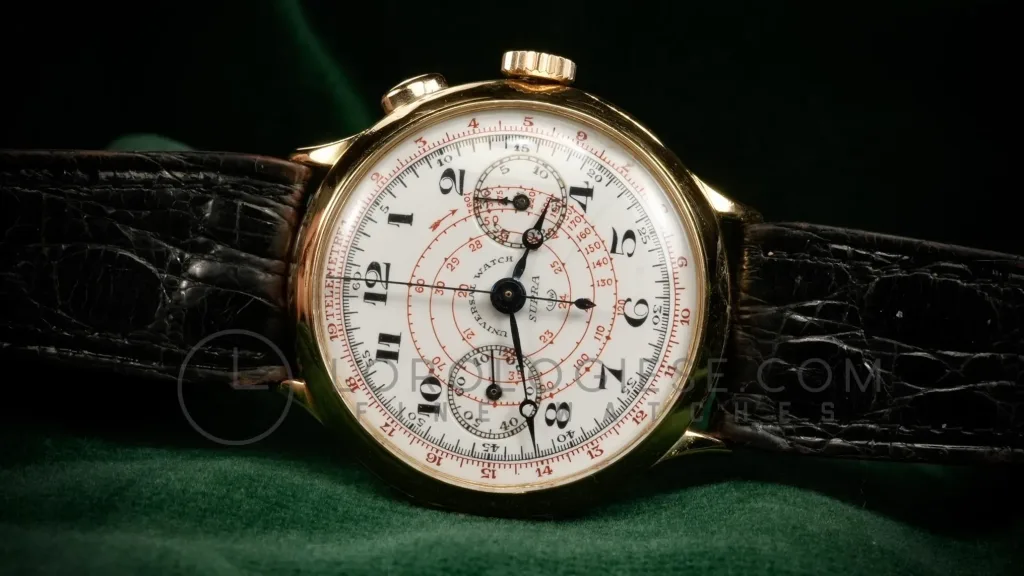
In this chronograph the enamel dial is signed UNIVERSAL WATCH above and SUPRA below, on a white “grand feu” enamel dial, inside is the two-column-wheel calibre of the first-gen. Compur. The case is gold with soldered lugs, unaltered, and has a single pusher at 2 o’clock — so the watch runs as a monopusher, driving the column wheel on the movement side while the second, beneath the dial, is fitted and never reached.
UNIVERSAL WATCH SUPRA Cal. 14 1:2


The serial, in the 548K range, falls where Universal’s monopushers were running out and its first two-pusher chronograph was beginning. It is transitional production: a new movement cased in the stock still on the bench, under a name the firm used for a few months and then abandoned.
Over decades this is the ony Unuversal Supra we have found, likely these watches were in production for a short window of a few months before “Compur” became the adopted trade name for this chronograph family.
UNIVERSAL WATCH SUPRA Cal. 14 1:2 4
Here is the part that matters, and it has nothing to do with how the watch looks.
The first generation has two column wheels — one dedicated to each pusher. The second sits under the dial: one column wheel on each side of the mainplate. The consequence is that each button controls two fixed functions and cannot perform the others. The dial column wheel is built differently from the other one, it is more a ratchet wheel, however, given its function, it should be regarded as a proper column wheel.

The Dial-Side column wheel – Cal. 14 1:2

UNIVERSAL COMPUR 1 the column wheel on a Cal. 14 1:2
The chronograph cannot be reset from the 4 o’clock pusher at all. The sequence is locked by the physical separation of the two column wheels.
| Pusher | Commands |
|---|---|
| 2 o’clock | Start and Reset |
| 4 o’clock | Stop and Restart |
That is the modern convention, the one every mechanical chronograph on a shop counter today still follows. The Compur is where Universal arrives at it — and the first series is what came before.
| Pusher | Commands |
|---|---|
| 2 o’clock | Start – Stop – Restart |
| 4 o’clock | Reset, and only once the chronograph is stopped |

UNIVERSAL COMPUR 1 SERIE Cal. 14 1:2

UNIVERSAL COMPUR 1 SERIE Cal. 14 1:2
Start the chronograph from the 2 o’clock pusher. Press 2 again.
If it resets, you are holding a first series. If it stops, you are not.
No tools, no case back, no dial removal. It works across a counter, at an auction viewing, or on a video call — which is precisely where these watches change hands. We know of no other Universal generation that can be identified this way.
Two consequences follow. Handle a first series as what it is: the top pusher resets, so the reflex of pressing it twice to start and stop will instead command a reset. Treat the sequence as fixed.
One other common characteristic, this is not a key feature, it is just an indication, Compur 1st. Gen. Usually do not have a reference number as these appear on Universal`s watches at a later year
There is a reason the first generation works this way, and it runs straight back to the watches in post one.
On a monopusher, one button does everything in sequence: start, stop, reset. On a first-generation Compur, start and reset stay together on the 2 o’clock pusher — exactly where they sit on a monopusher. The second button was not added to take over the reset. It was added to give the user something the monopusher could not do: stop the chronograph and start it again without losing the elapsed time.
It also explains the size. The lineage is continuous: the 14½-ligne monopusher of post one, with its pusher at 2 o’clock; the 14½-ligne first-series Compur, which keeps that pusher and adds a second; the single-column-wheel version; and then the 285 family at 14 lignes that carried Universal’s chronographs through the 1940s and 50s. One line of descent, one deletion, one modest reduction in diameter.

UNIVERSAL WATCH COMPUR Gen. 1 – no reference, just the serial number

| Family | Serial range | Source |
|---|---|---|
| Monopushers (14½, 16, 16¾ ligne) | 55,000 – 561,000 | Our records |
| Compur, first series (two column wheels) | 546,000 – 562,000 | Sala’s published archive + our records |
| Compur, first series — lowest we have examined | 555,000 | Our records, double column wheel confirmed |
| Compur / Uni-Compax overall | to 1,120,000 | Our records |
Universal Geneve ad. Circa 1935
Dating anchors from the published Universal table:
500,000–600,000 = 1930–36
600,000–700,000 = 1936–38
700,000–800,000 = 1938–41
800,000- 900.000 = 1941- 42
Three things follow:
The first series is narrow. The Compur + range is only 16.000 so this was a short production the firm moved past quickly. The band sits around 1933–34 — which means the watch reached the market months before the trademark was filed.
The two constructions end on the same number. The monopushers stop at 561,000. The first-series Compur stops at 562,000. Possibly Universal stopped both in the same period and continued with the single-column-wheel version.
One caution, carried forward from post one: a serial records when a part was numbered, not when a watch was sold. Some examples were assembled years after their components were made. Every band above is wider at its upper end than it looks.
UNIVERSAL COMPUR 1 SERIE Cal. 14 1:2


Counter capacity. Most first-series Compurs have a 45-minute counter; some show a 30. The difference is a counter wheel and its intermediate coupling wheel — a specification choice, not a construction change. Published sources disagree on whether the Compur was a 30- or a 45-minute chronograph. Both are right, and neither dates anything.
Calibre 281. It is 12 lignes movement and it is not found and the Compur Gen. 1.
UNIVERSAL WATCH COMPUR 45 Minutes Counter
Pushers, hands and dials. See above. Correlations,, and the reason mis-attributed watches circulate. The same pushers, dials and hands an be found both in gen. 1 and gen. 2 Compurs, as an indication, Gen. 1 chronographs usually mount olive pushers or the longer / larger rectangular faceted pushers

UNIVERSAL WATCH COMPUR with larger pushers

UNIVERSAL COMPUR 1 SERIE Olive Pushers

UNIVERSAL COMPUR Larger : lOnger pushers
Compax arrived alongside. Uni-Compax followed. Neither replaced the Compur as a mechanism — the Uni-Compax is the same two-register configuration under a newer name, and the production continues unbroken into the mid-1940s.
What ended, at circa 562,000, was the double column wheel. Universal built a chronograph that worked like a monopusher with an extra button, sold it for about a year, and then built the one everybody else would eventually build. The first series is the shortest-lived construction in the marque’s chronograph history and the only one that behaves differently in the hand. UNIVERSAL COMPUR 1a Cal.14 1:2

On 10 December 2024, ninety years after the original filing, COMPUR was registered as Swiss trade mark no. 823964 by Universal Genève SA of Meyrin, with protection running to 2034. The register does not mention the renewal of the 1934 patent, it was filed fresh.
The 1934 registrations were a new management’s decision to make a name do commercial work, and so is this one.
Next: the Compur system — the new references and what each number actually means.

Sources: Pietro Giuliano Sala, Universal Watch Genève: Cronografi e orologi da polso complicati(Vallardi), for the trademark chronology, the 1933 succession, the 1934 presentation and the first-series serial range; universalgeneve.info for the Compur 1st Gen command sequence; Swissreg, Swiss Federal Institute of Intellectual Property, trade mark no. 823964 (COMPUR), filed 10 December 2024; published movement reference literature for calibre dimensions. Command testing, serial records, the dial-side photograph and all construction observations are our own, from watches examined in our workshop.
[contact-form-7 id=”4235″ title=”Contact form 1″]