No products in the cart.


Newsletter
[contact-form-7 id=”4235″ title=”Contact form 1″]

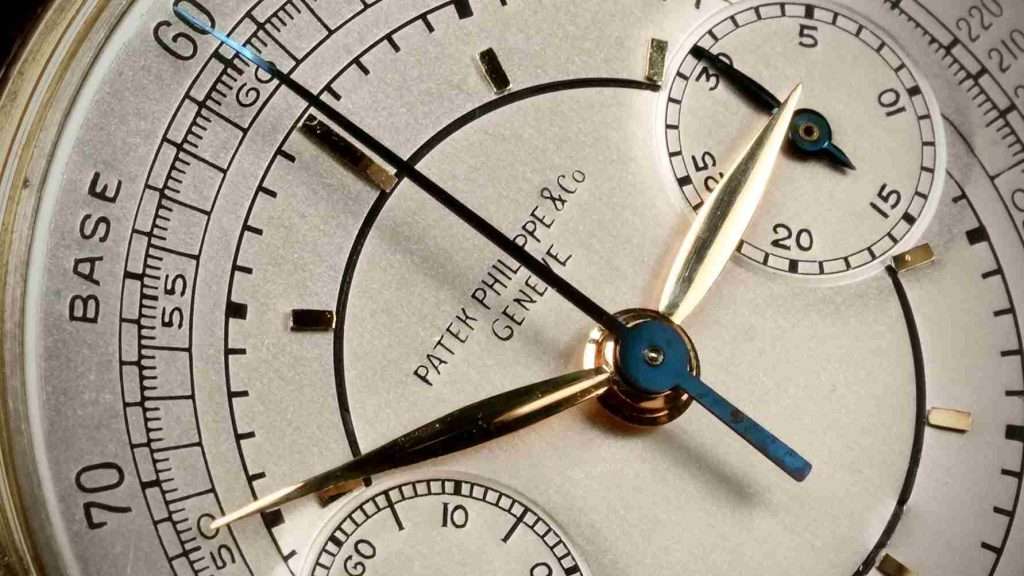
Between 1936 and 1964, Patek Philippe produced approximately 1,500 examples of the Reference 130 — a single-pusher wrist chronograph that would become the standard against which all subsequent vintage Patek Philippe chronographs are measured. Powered by the in-house Calibre 13′′′ 130, a 23-jewel manually wound movement beating at 18,000 vph with a 36-hour power reserve, the Ref. 130 carried a horizontal dual-register layout with running seconds at nine o’clock and a 30-minute totalizer at three. The case measured 33mm in yellow or rose gold, 33.5mm in stainless steel.
Cal.13 -130


What distinguishes the Ref. 130 among vintage collectors is not its movement alone — superlative as it is — but the extraordinary breadth of its dial configurations.
Patek Philippe offered clients a degree of personalisation that was standard practice in mid-century Swiss horology but is almost unimaginable today.
The result is a reference with no two populations of dials that are truly identical, and a collector hierarchy defined almost entirely by what sits on the front of the watch.
Collectors and scholars generally organise Ref. 130 dials into four broad families, defined by graphic language and era of production. Each family also corresponds to a specific dial manufacturing technique, a distinction that carries both aesthetic and technical weight.
Photo Credits: Sotheby`s
The earliest and rarest Ref. 130 dials are sector designs — the “scientific” configuration inherited from pocket watch horology and instrument design.
The sector dial divides the chapter ring into alternating tonal zones radiating from the centre, with a pronounced chemin de fer (railway) minute track at the outer boundary, consisting of parallel lines with fine ticked divisions.
Hour indices are rendered as Arabic numerals, typically positioned at the sector boundaries. The sub-registers echo the same geometric discipline: crisp, unadorned, utilitarian.


These dials were produced by Stern Frères, Patek Philippe’s exclusive dial manufacturer throughout this era, using the engraved enamel technique: each line and numeral was hand-engraved into the metal dial blank, then filled with vitreous enamel powder and fired in a kiln — a process repeated a minimum of eight times to achieve the requisite surface hardness and colour depth. The result is a surface with the permanence of glass.
Fewer than 15 sector dial Ref. 130 examples are documented across all case metals. The combination of a sector dial with a stainless steel case is among the most sought-after configurations in all of vintage horology.
The second family substitutes the sector architecture for a cleaner, more legible layout anchored by applied solid gold Breguet numerals — the stylised Arabic figures with flowing serifs and characteristic open sixes and nines first designed by Abraham-Louis Breguet.
On the Ref. 130, these numerals appear at the four cardinal positions (12, 3, 6, 9) or in fuller configurations, three-dimensional and physically raised from the dial surface, against a matte silver base.
The outer tachymeter graduation and railway seconds track are typically retained.
Photo Credits: Revolution


Approximately 170 yellow gold examples with Breguet numerals are documented.
Steel examples with Breguet numerals are rarer by an order of magnitude; those fitted with black dials instead of silver are rarer still, with only a handful known. These dials were produced using the same engraved enamel process as the sector examples, with the applied gold numerals added after firing.
Photo Credits: Sotheby`s
The third family encompasses a wide range of graphic configurations combining printed or applied numerals with baton indices for the remaining hour positions.
Common arrangements include Arabic numerals at 12 and 6 with baton markers throughout, or Roman numerals at the cardinal positions.
This period also produced the majority of multi-scale examples: tachymeter scales for speed calculation, telemeter scales for measuring distance by sound delay, and pulsometer scales for pulse-rate measurement — in some cases two scales printed on the same dial.
Photo Credits: Sotheby`s


Tiffany & Co. retail examples almost universally belong to this family, distinguished by a tachymètre scale calibrated in miles rather than kilometres — the only known Ref. 130 dials bearing an American retailer’s name. Christie’s has documented six examples.
These were produced using both engraved enamel and, in certain printed scale configurations, early decal or transfer-printing processes, though the precise technique varies by example.
Photo Credits: Sotheby`s

The final configuration family, which spans the latter half of the reference’s production, moves toward a more contemporary aesthetic: flat rectangular baton indices applied directly to the dial surface, with no printed numerals. This layout — cleaner and more abstract than its predecessors — reflects the broader mid-century shift in dial design toward geometric minimalism. The matte silver or occasionally gold-toned dial remains, but the decorative language is reduced to its structural minimum.
Photo Credits below and above: Sotheby`s


These dials continued to be produced by Stern Frères using engraved enamel, though with the decline of purely hand-engraved work during this period, later examples show the early influence of more standardised print and enamel transfer techniques in ancillary elements such as the Patek Philippe signature and “SWISS MADE” designation.
The technical divide in vintage watch dial production is most clearly expressed in the contrast between grand feu hard enamel and tampon (pad) printing — two processes separated by centuries of development and fundamentally different philosophies.
Hard enamel, as used throughout the Ref. 130’s production run, begins with powdered vitreous glass mixed with metallic oxides for colouration. Applied to an engraved metal blank, the powder is fired in a kiln at temperatures between 800°C and 1,200°C, fusing permanently into the engraved channels. This cycle is repeated up to nine times to build colour depth and surface hardness. The result is chemically inert, colourfast, and as durable as the metal substrate itself. No ultraviolet light, humidity, or cleaning solvent will alter an enamel-fired dial. The surface carries a characteristic glass-like depth and precision of edge that no other technique replicates.
Tampon printing (tampography), by contrast, is a mechanical transfer process developed for industrial application in the late 1960s and first adapted to watch dial production around 1968. A silicone pad picks up ink from a chemically etched plate (the cliché) and transfers it to the dial surface in a single press movement. The process is rapid, highly repeatable, and compatible with complex multi-colour designs on curved surfaces. Its limitation is permanence: printed ink lies on the surface rather than within it, making it susceptible to fading, scratching, and the effects of solvent-based cleaning. Under magnification, the edges of tampon-printed text show a slight softness absent from engraved enamel work
Photo Credits: Sotheby`s


For the Ref. 130, this distinction is unambiguous: the reference’s entire 28-year production predates the commercial adoption of tampon printing in watch manufacturing. Every Ref. 130 dial was produced using engraved hard enamel by Stern Frères. The introduction of pad printing into Patek Philippe’s chronograph line occurred in subsequent references, after 1964. This makes dial condition assessment on the Ref. 130 straightforward: degraded or retouched text is a warning sign of restoration, not a manufacturing characteristic.
Photo Credits: Sotheby`s
The Ref. 130 collector market is structured with unusual clarity. At its apex sit the steel sector dial examples — fewer than 15 known in any metal, the steel variants compounded in rarity by a total stainless steel production of only approximately 270 to 280 pieces across all dial configurations. These represent, in the words of multiple specialist dealers, a grail of grails.
Photo Credits: John Goldberger

Immediately below sit monopusher configurations from the earliest production, steel examples with Breguet numeral dials, and black-dial variants of any configuration. The six documented Tiffany & Co. retail examples occupy their own rarity category — their miles-scale tachymètre and American retail signature generating consistent collector premiums estimated at 10 to 15 percent over equivalent non-retail examples.


Breguet numeral dials in yellow gold — approximately 170 documented — command 20 to 30 percent premiums over standard baton-index configurations. Standard Ref. 130 examples in yellow gold realise between $30,000 and $80,000 at major auction. Exceptional examples — steel sector dials, monopushers, Tiffany variants — have achieved well in excess of $500,000, with one documented two-tone steel and pink gold example hammering at $684,626 at Christie’s.
The sole known Ref. 130 with a grand feu enamel time-only dial, offered through OBW Collection, represents the absolute singular extreme of the reference’s dial variation — one example, one technique, no comparanda.
Photo Credits: Sotheby`s


All auction records cited are drawn from publicly available auction house records. Production figures are collector-documented estimates; Patek Philippe does not publish official production data for vintage references.
[contact-form-7 id=”4235″ title=”Contact form 1″]