No products in the cart.
Newsletter
[contact-form-7 id=”4235″ title=”Contact form 1″]


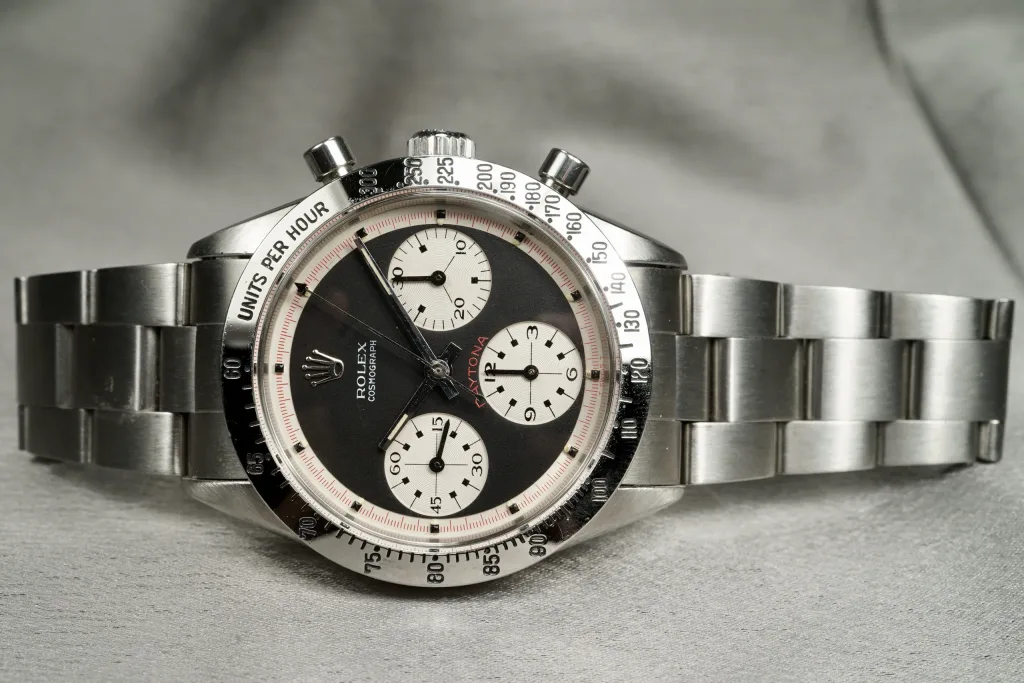
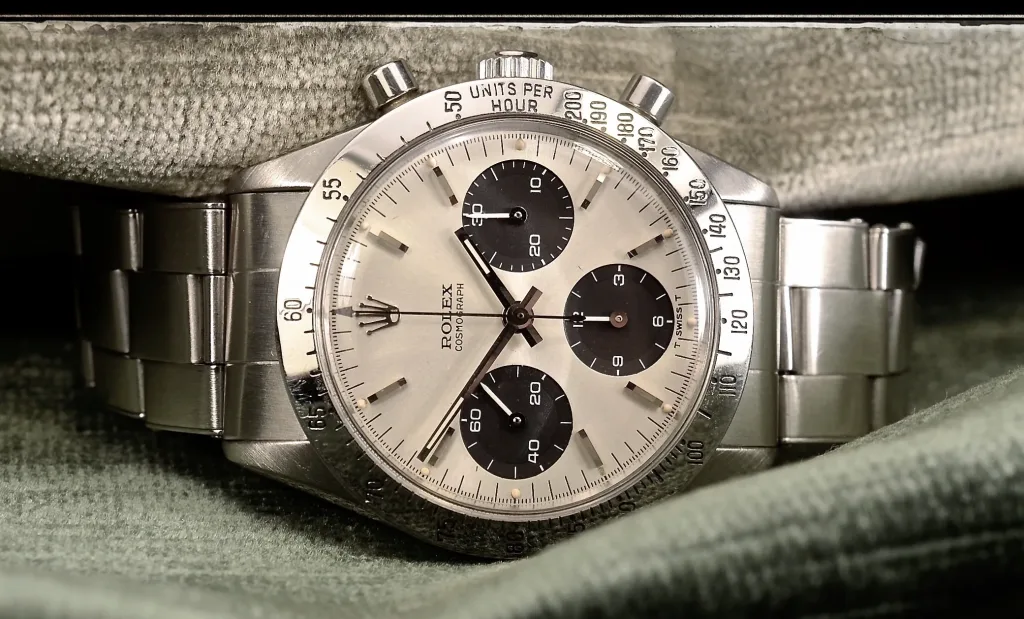
There is a watch in front of me that marks an ending. A steel Cosmograph Daytona, reference 6265, made in 1979: black dial, inverted panda subdials and the red line above the six o’clock counter that gives these watches their nickname, the Big Red.
The 6265 and its sibling the 6263 were the last hand-wound Daytonas Rolex made. When they left the catalogue in 1988, the manual chronograph that had defined the model for a quarter of a century went with them, replaced by an automatic. Everything about the Daytona that came after, and the Daytona became, in the decades after, the most sought-after steel sports watch in the world, was built on top of these references. This one closed a book and quietly, drew the cover of the next.

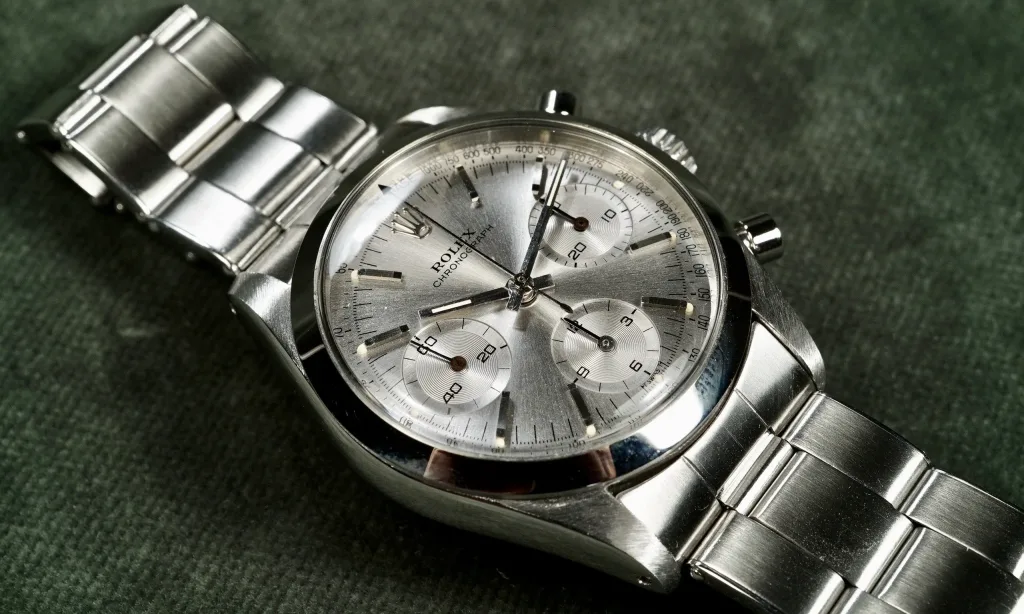
The Daytona did not begin as a legend, and for most of its early life it did not sell. Rolex introduced the Cosmograph reference 6239 in 1963, a 37mm hand-wound chronograph running a Valjoux 72-based movement, with a tachymetre scale moved off the dial and onto the bezel, which cleared the dial and gave the watch the clean, legible face it has kept ever since.
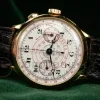
A Rolex Pre-Daytona Ref. 6238 – 1963
The “Daytona” name appeared on the dial around 1965, tying the chronograph to the Florida speedway and the world of motor racing Rolex. The commercial reality was less romantic: the watches were slow to sell, a fact that reads as irony now that some of the same references cross the block for seven figures.
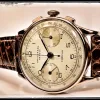
A Rolex Daytona Ref. 6239
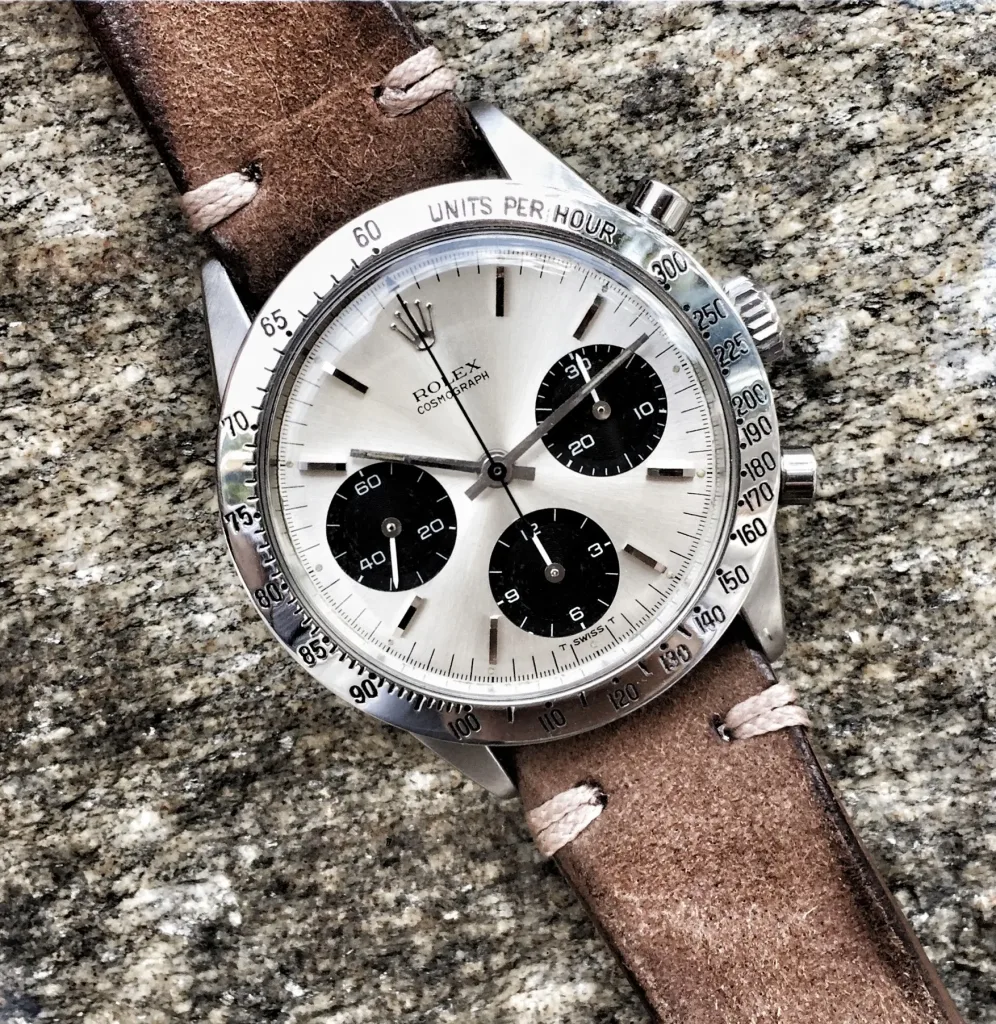
The line evolved in steady, deliberate steps rather than reinventions. In 1965 the reference 6240 introduced screw-down pushers and, with them, the “Oyster” designation on the dial, the chronograph was now a water-resistant tool watch.
A Rolex Ref. 6239 with a Paul Newman dial
At the turn of the decade the transitional references 6262 and 6264 carried the model over to the upgraded Valjoux-based calibre 727. And in 1971 the two references that would run longest and define the manual Daytona arrived together: the 6263, with a black acrylic bezel, and the 6265, with an engraved steel one. Same case, same movement, same screw-down pushers. The bezel was the difference between them.
A Rolex Ref. 6240 – Courtesy Phillips
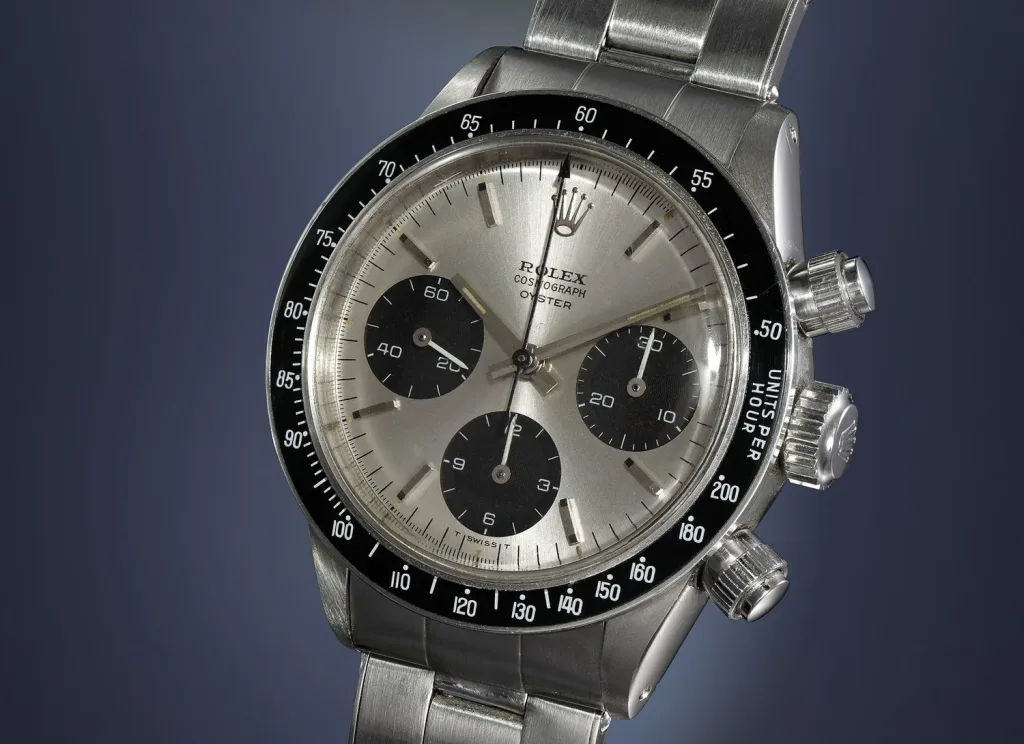

The 6265 ran from 1971 to 1988, which makes it, alongside the 6263, the longest-lived of all the vintage Daytonas with seventeen years in the catalogue.
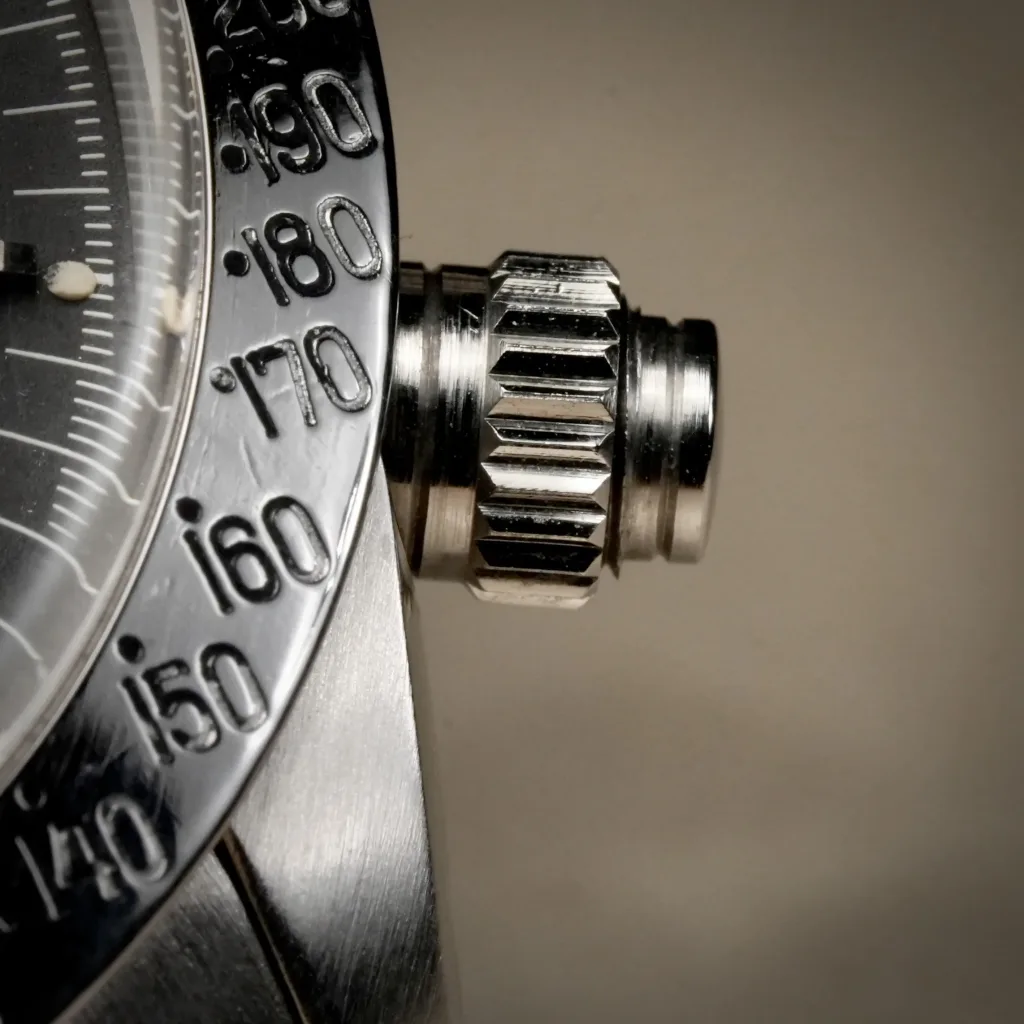
The case is steel, 37mm, with the broad shoulders that give the vintage Daytona its particular stance on the wrist. The defining feature that separates the 6265 from the otherwise identical 6263, is the bezel: a steel tachymetre bezel, engraved and graduated from 50 to 200 units per hour, where the 6263 wore black acrylic.
Screw-down “Oyster” pushers and a 7mm screw-down Triplock crown, the same crown fitted to the Submariner and Sea-Dweller, took the water resistance to 100 metres and made this the most robust chronograph Rolex had yet built. The pushers and crown are not incidental: they are the reason the 6265 reads as a tool watch rather than a dress chronograph.
Inside is the calibre 727, this is Rolex’s version of the Valjoux 726, a column-wheel, lateral-clutch, hand-wound chronograph, running at 21,600 vibrations per hour. It seems the move from 18,000 to 21,600 vibrations per hour was Valjoux’s own evolution of their base calibre, not a Rolex invention. What Rolex added on was the Microstella balance, and a Breguet overcoil hairspring.
The Microstella is the meaningful modification, and the true fingerprint of this Rolex-modified Valjoux. It is a free-sprung, variable-inertia balance, regulated not by an index but by small adjustable nuts on the rim of the balance wheel.
As a consequence the watchmaker can fine-tune the rate by turning those nuts without removing the balance from the movement; and, because there are no regulator index pins to interfere with the hairspring, the balance keeps its amplitude better than a conventionally regulated one.
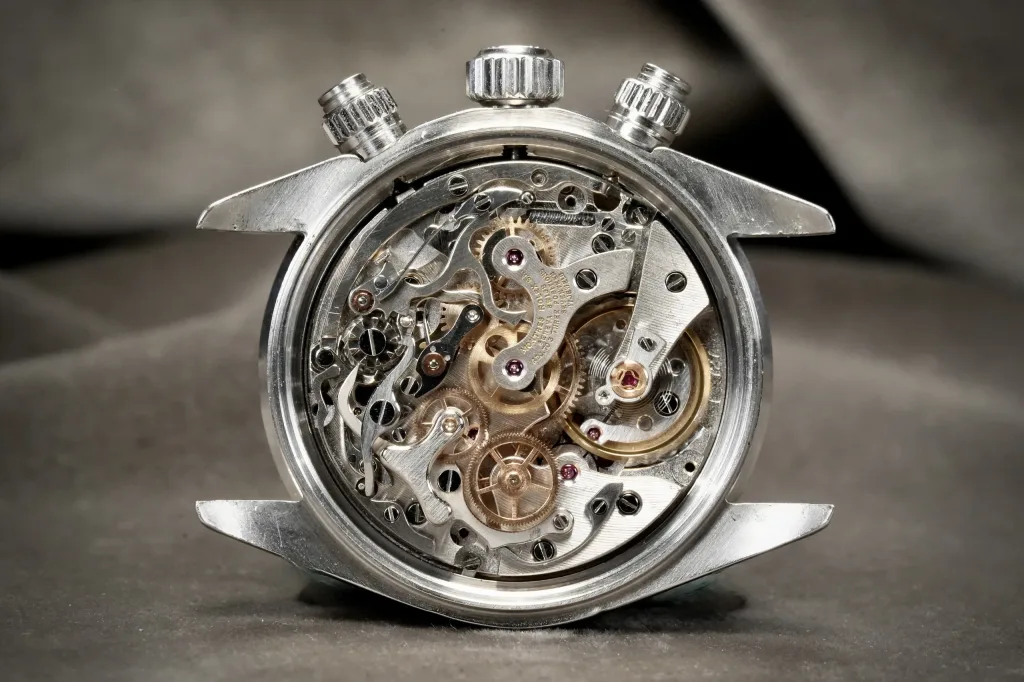
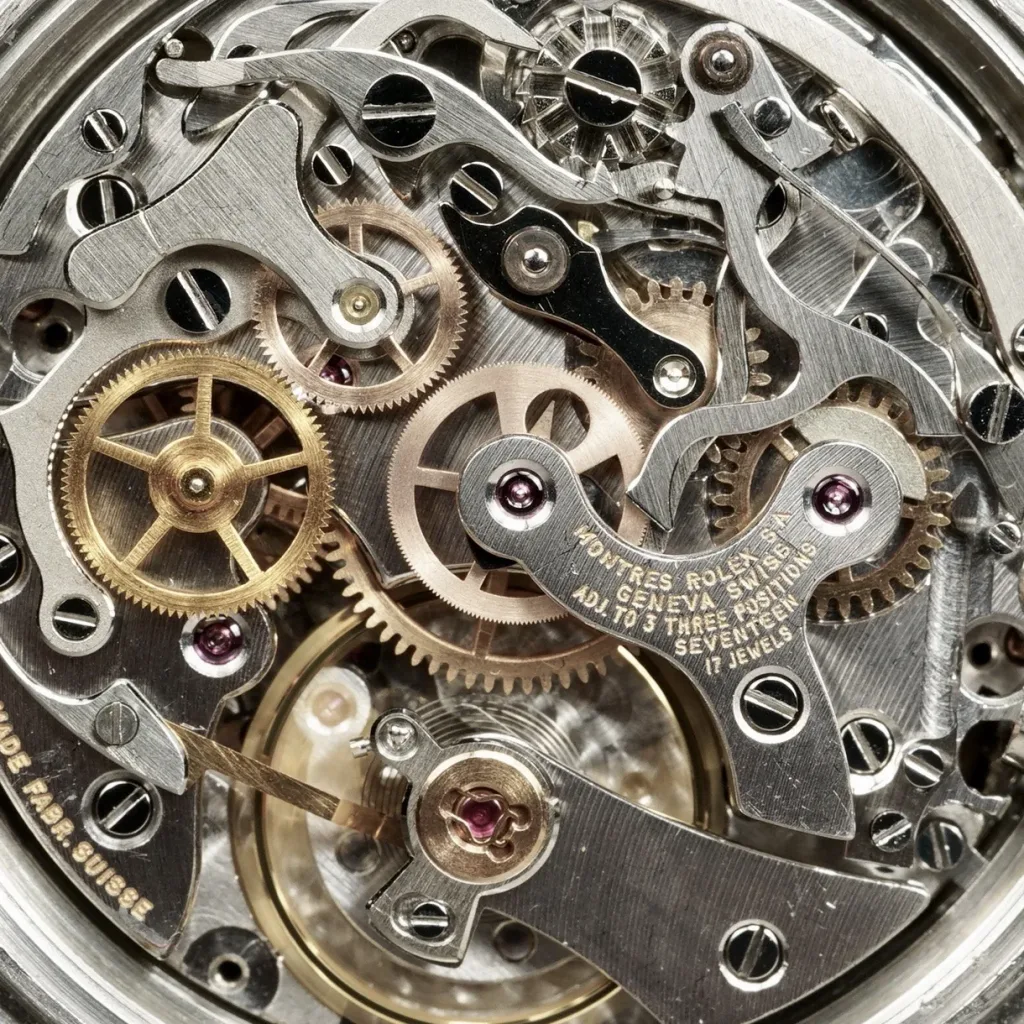
The Breguet overcoil, a hairspring whose outer coil is raised and curved back over itself, lets the spring breathe concentrically as it expands and contracts, improving stability across positions. Neither change touches the chronograph mechanism itself, which remains the flat, single-plane Valjoux architecture that makes these movements so serviceable and still beloved by watchmakers.
Nor is the movement left rough: the actual finish quality is very good, the levers satin-polished with anglage, the bevelled, polished flanks, and Côtes de Genève on the bridges. Rolex, for the rest, left a very good movement alone.
The result is a chronograph that is neither a bought-in commodity nor a Rolex-from-the-ground-up manufacture calibre, but something in between and, in the context of everything this blog has argued about what “manufacture” does mean, an honest example of a brand improving an excellent base to bring it to a higher performance standard.
These vintage Daytonas are among the most altered and “improved” watches a collector will ever encounter. What follows is what matters when you examine one.
The case, how to tell “never touched and never polished”. The 6265 case has a specific geometry: lugs with a sharp bevel and a defined transition between the brushed surfaces and the polished flanks. Over-polishing destroys all of it with rounded and / or thinned lugs with bracelet holes that have migrated toward the edge as metal was removed and softened or vanished bevels.
A Rolex Cosmograph Daytona Ref. 6239
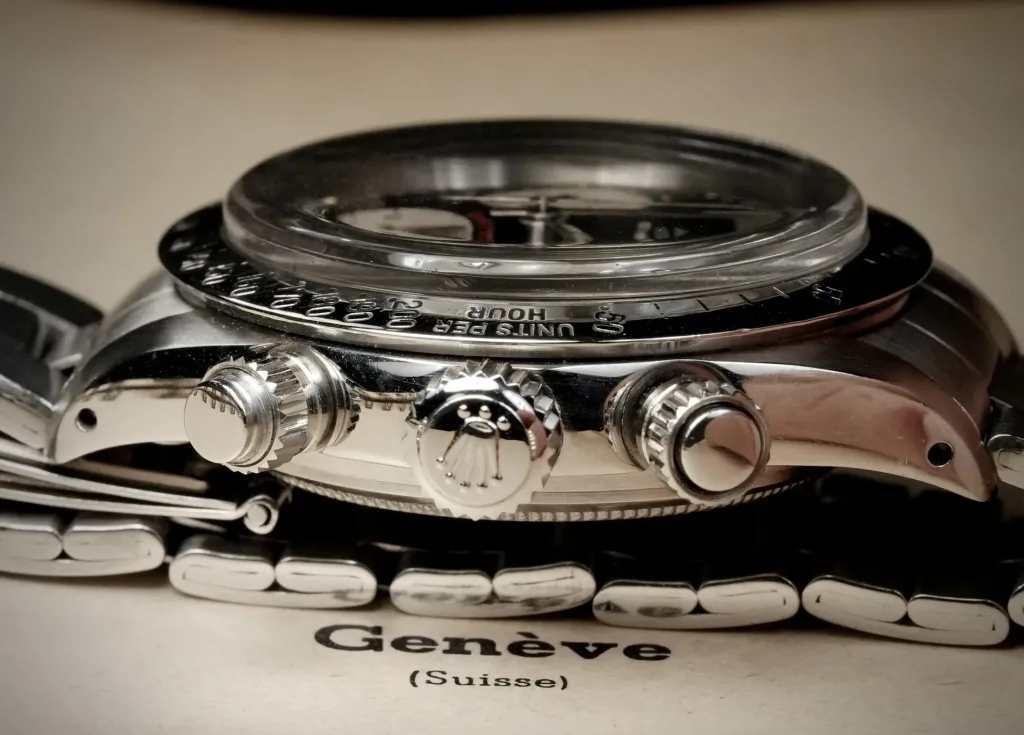
Learn the correct profile from documented original watches and compare. A sharp, full, unpolished case, is one thing commonly lost. Hold the watch at an angle to the light and look at the lug bevel: if it is a crisp line, the case may be honest; if it is a soft rounding, it has been worked on.
But there is a caution here. A case that is perfectly polished is not necessarily a sign of originality. A professional repolish to factory specifications, with factory-type tooling, a lapidary wheel and a sandbelt and a well-trained hand can be nearly impossible to detect. Done properly, it restores the geometry and the result can look like an honest original.
So flawlessness is ambiguous: it may mean an exceptional survivor, or it may mean an expert refinish. The condition to want is an honest, normal wear on a case that has kept its sharp geometry and clean edges, a watch that shows its age while retaining the crisp bevels and defined geometry it left the factory with.
That combination is harder to fake, because it cannot be created by polishing; it can only survive. A case that is both sharp and lightly worn is telling you that likely it was never significantly touched.
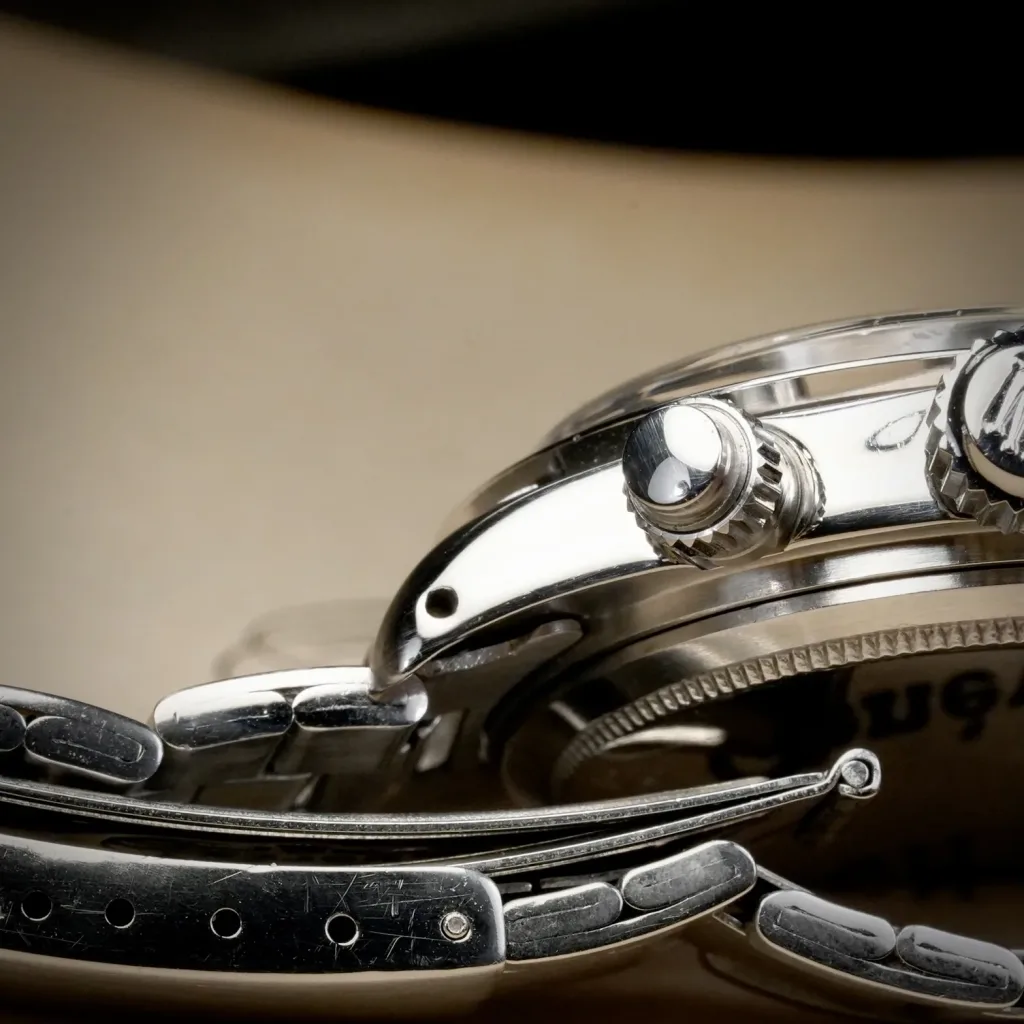
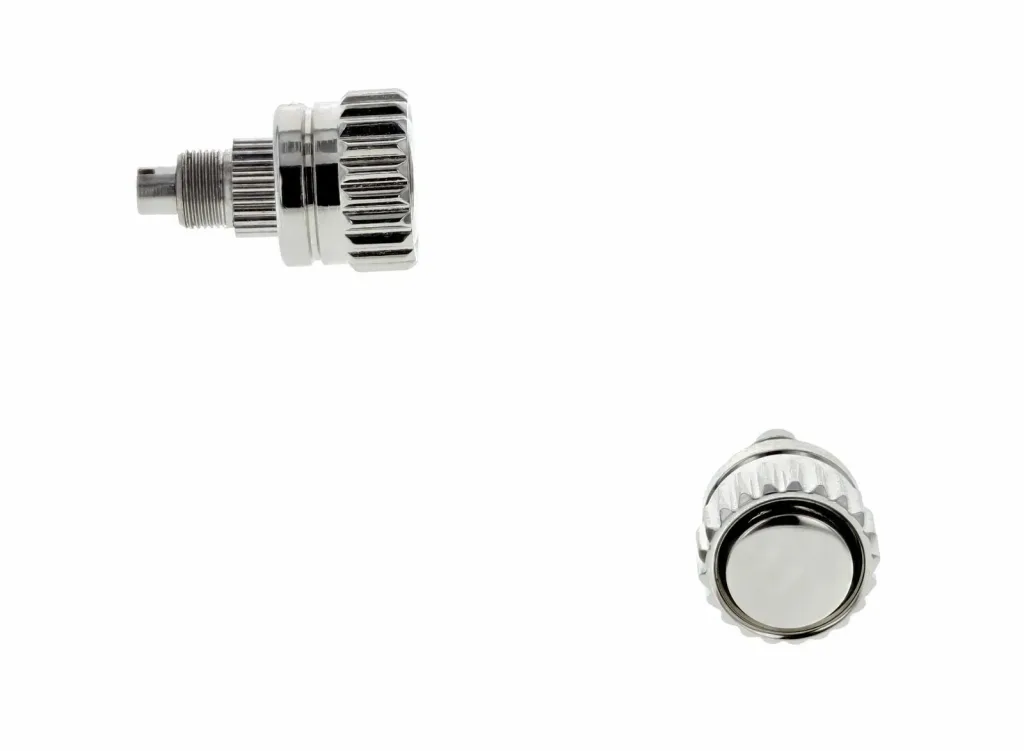
Service parts. Rolex service, over decades, routinely replaces components to factory specification and every replaced part moves an original watch further away from originality. On a 6265 the parts to scrutinise are almost all of them; the crown, pushers, bezel, hands, case, dial, and in some cases the movement too.
A later Triplock crown or bracelet are common service replacements and are considered as acceptable service parts.
Replacement 6263/6265 aftermarket chrono pushers
The bezel. The steel tachymetre bezel is the 6265’s signature, and it is one of the more reliably readable parts. Three main variations, three “marks”, of bezel are known for this reference. The graphics differ slightly between them, but they share one constant: a descending bar on the numeral 7. Every known original bezel has it. The service bezels supplied over the years do not. It is a small detail and an unusually dependable one, before anything else on the bezel, find the 7 and look for that descending bar.
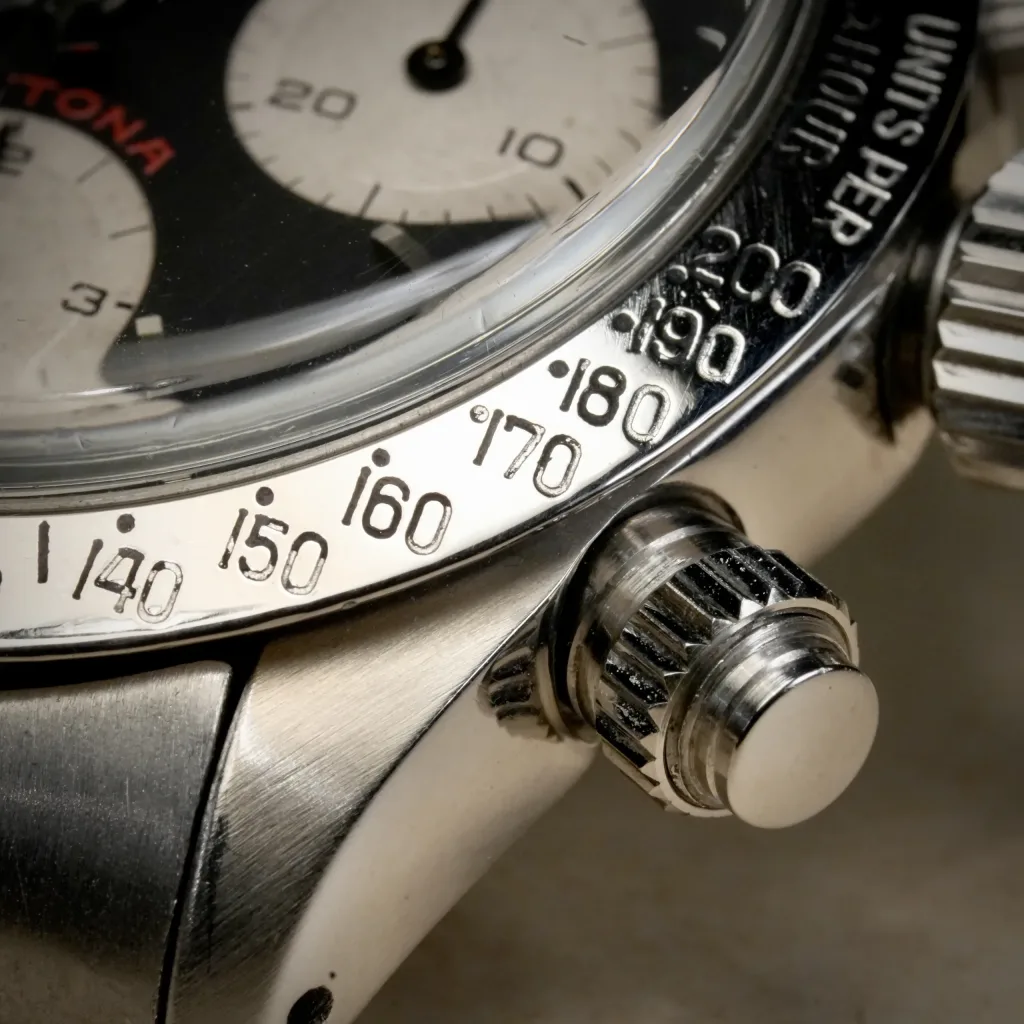
Original
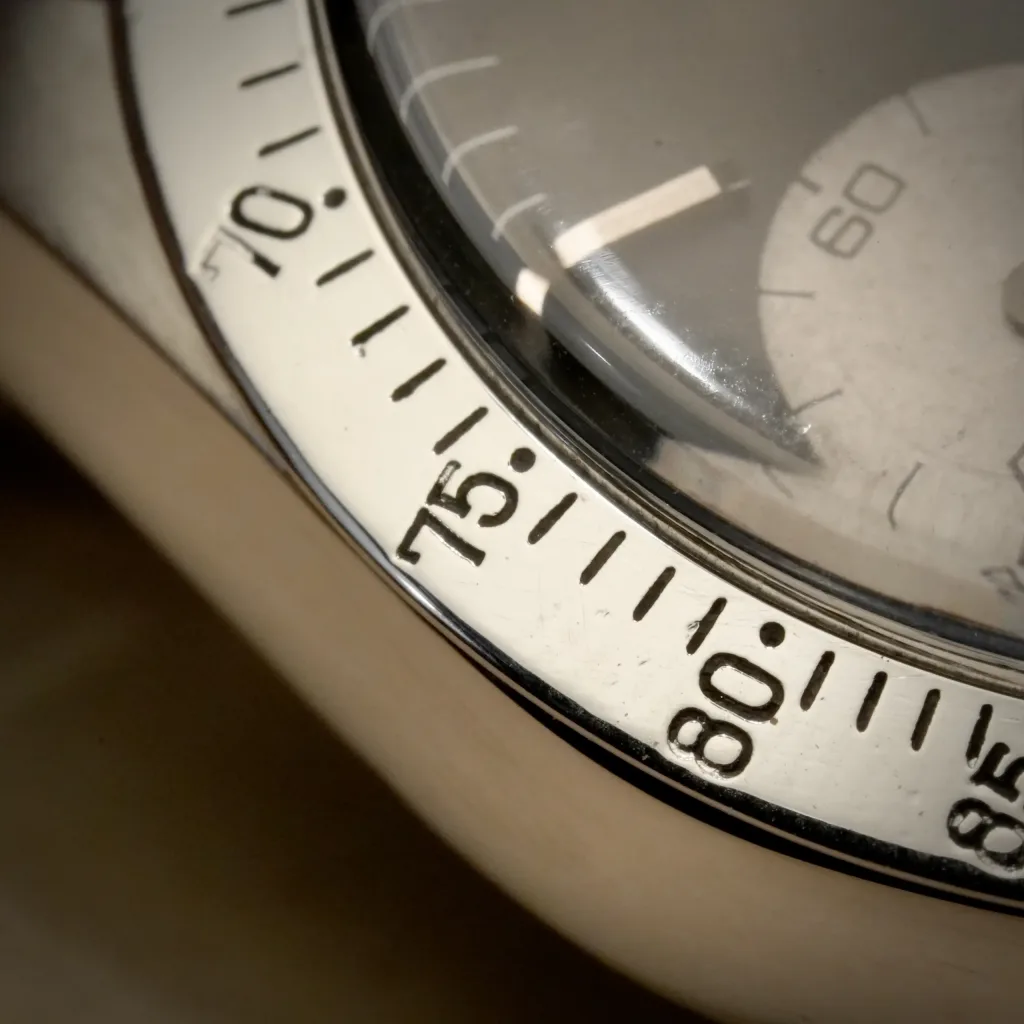
Original
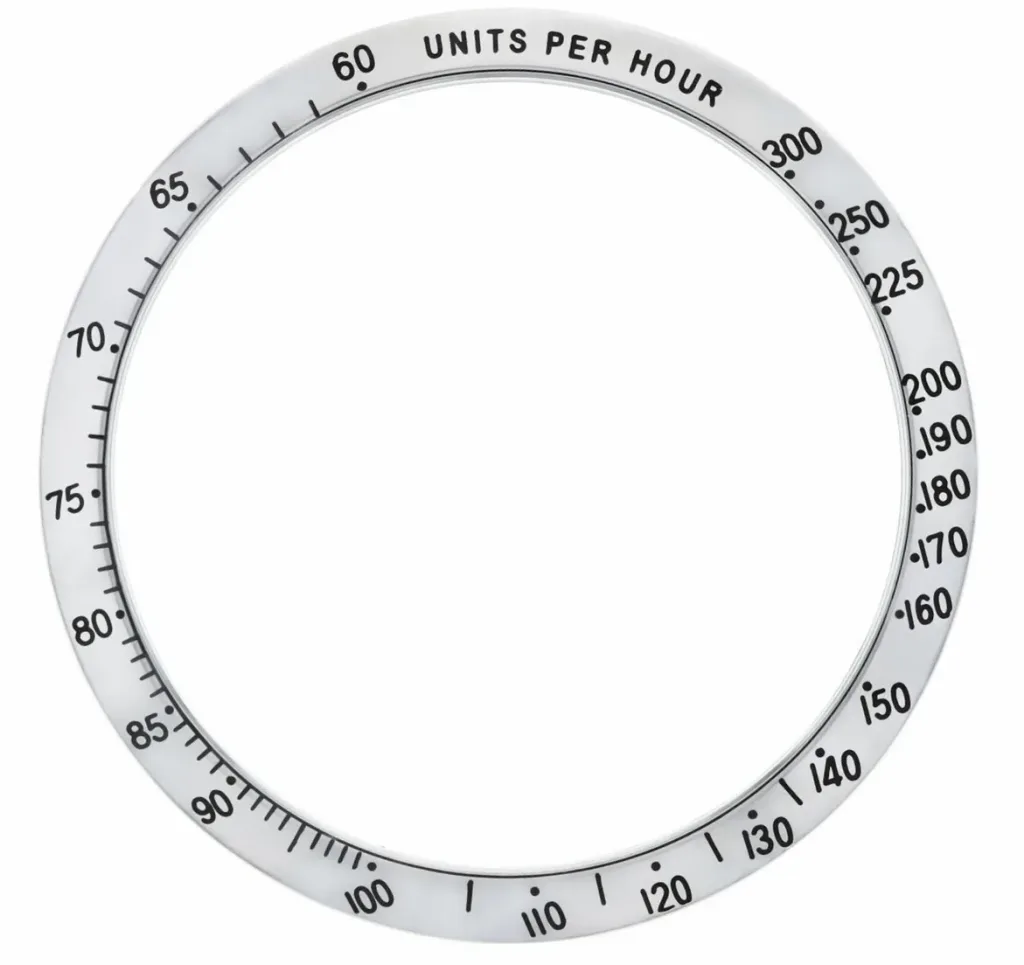
A Rolex 6265 replacement bezel
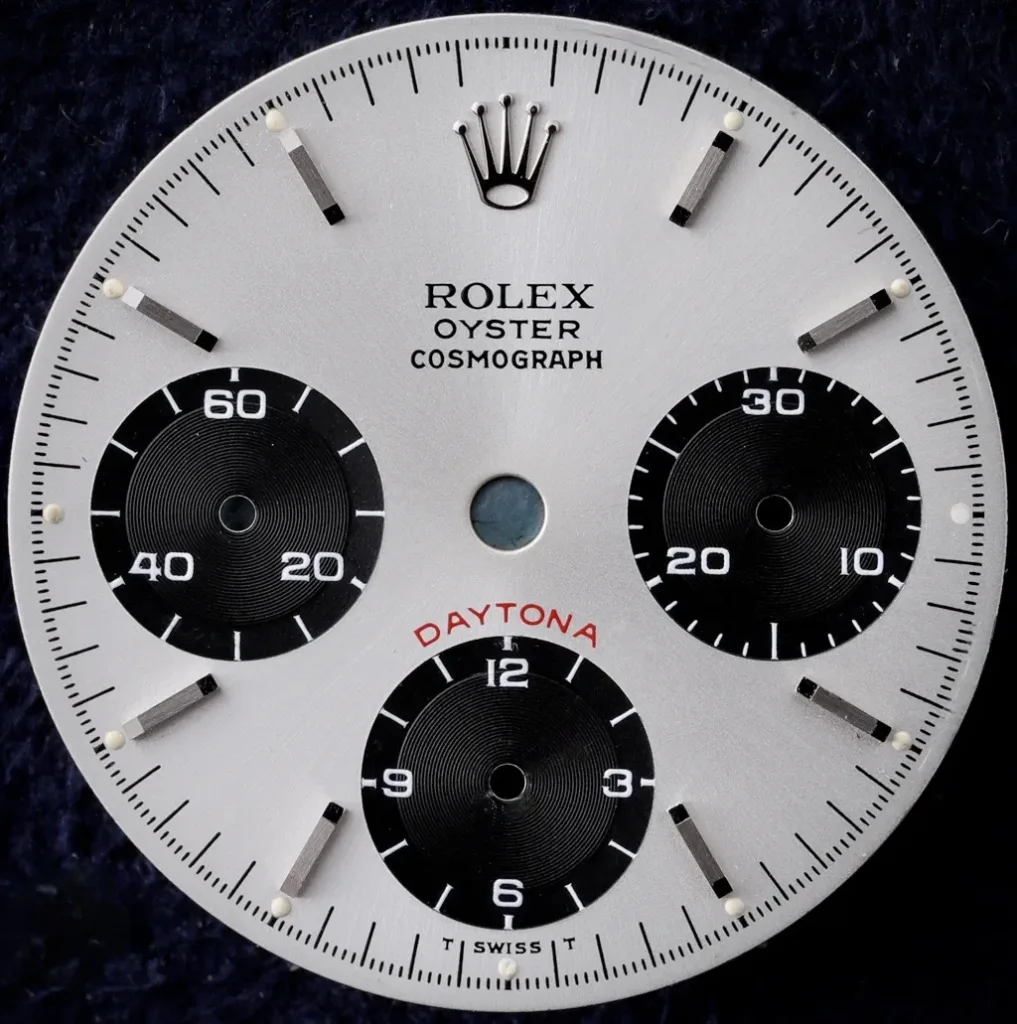
Service dials and redials. The dial carries the clearest tells, and they live in the quality and the detail of the printing.
Original 6265 dials are distinguished by serifs, small finishing strokes on the letterforms and by consistently sharp print quality. The two places to look are:
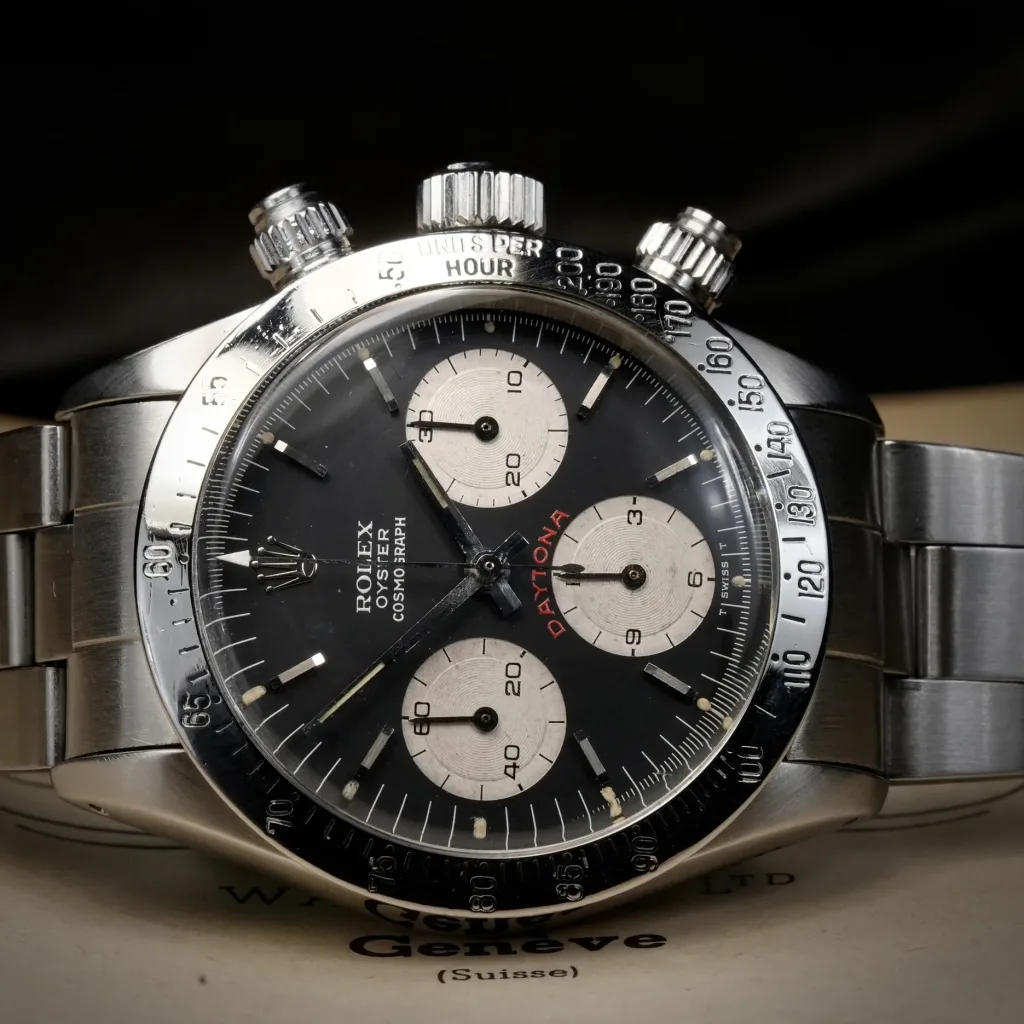
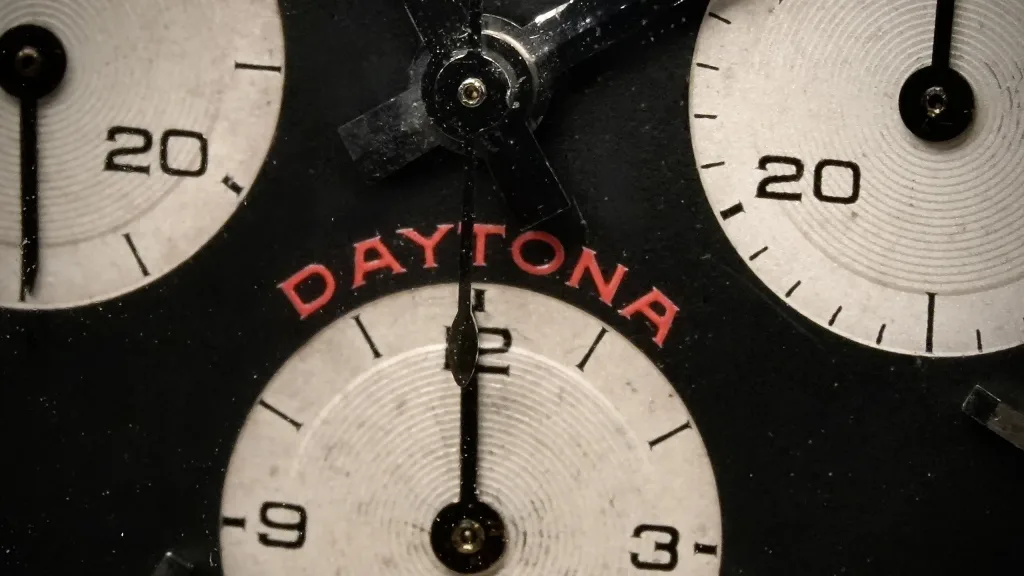
First, the red DAYTONA script: on an original, whether the thin or the fat version of the printing, the letters have serifs. Service and reprint dials typically are without serifs and print quality is more defined.
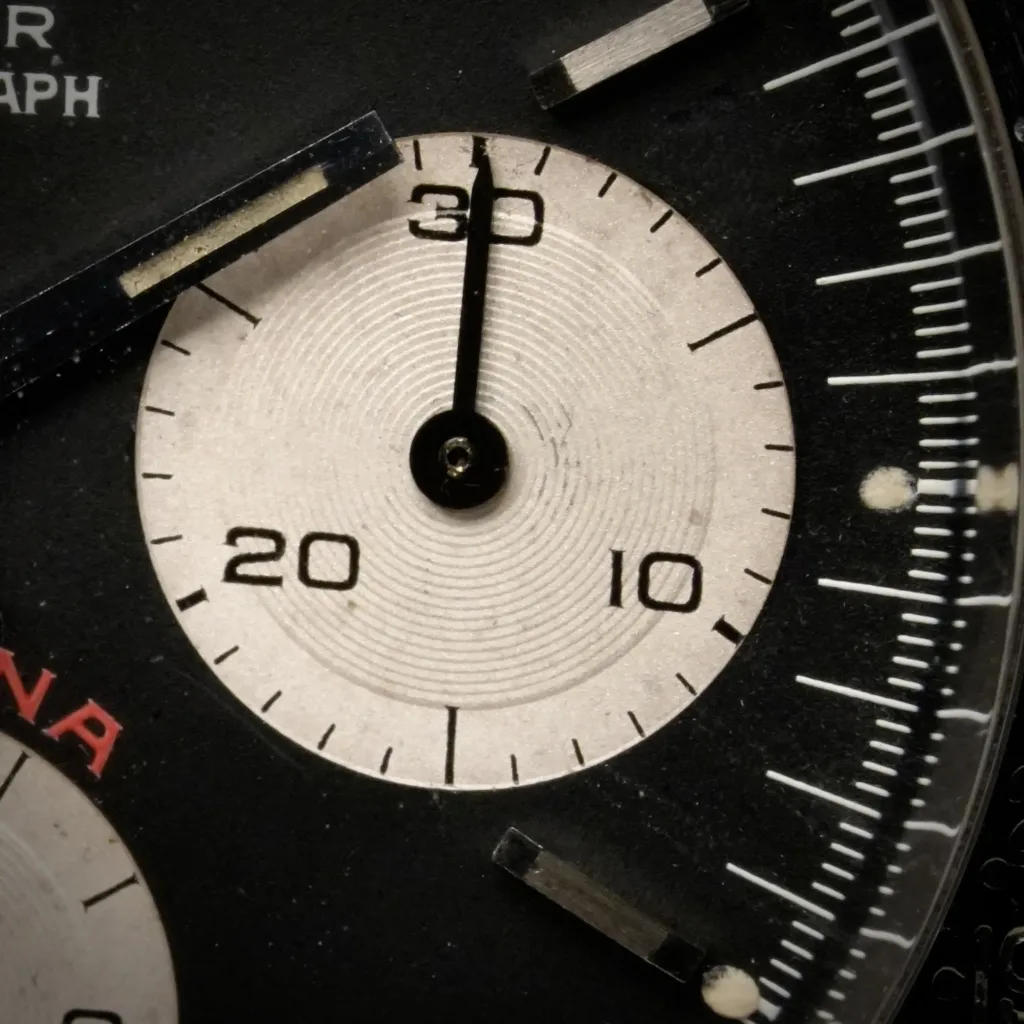
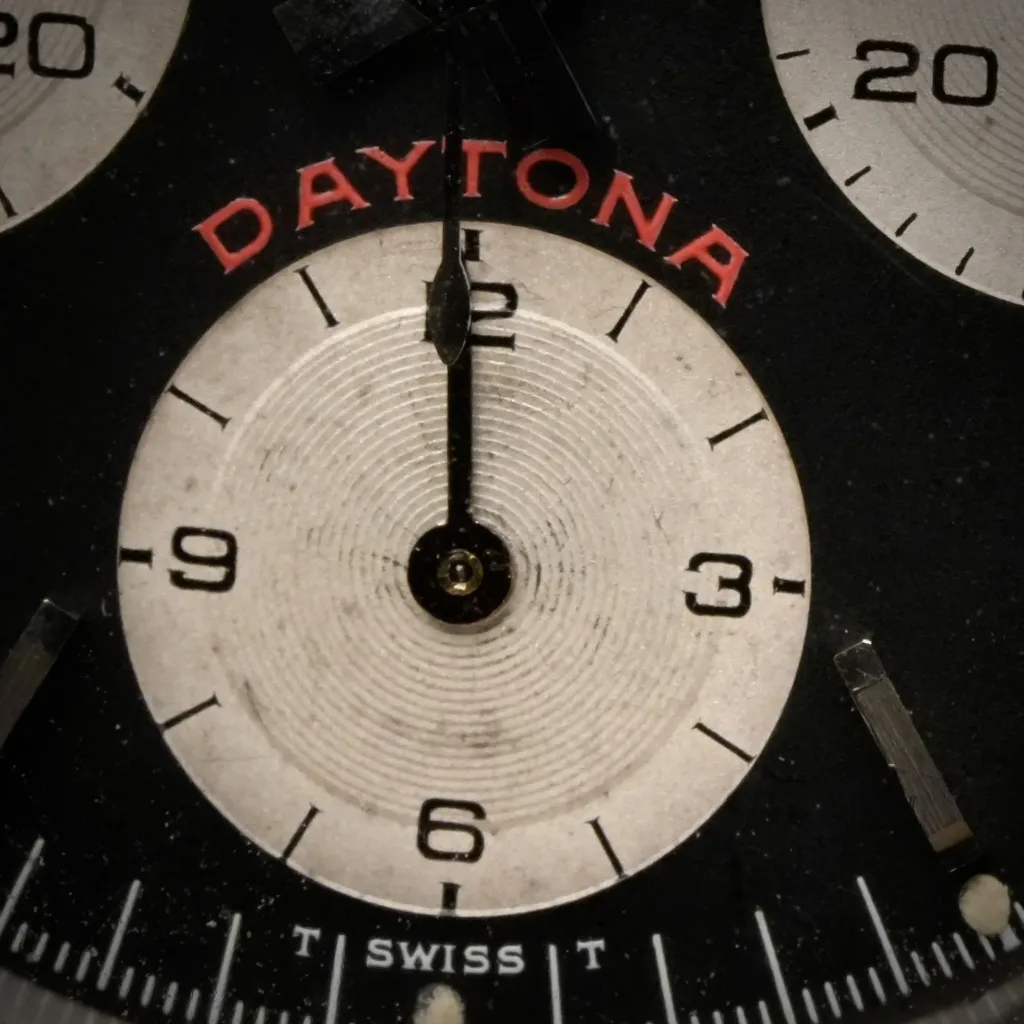
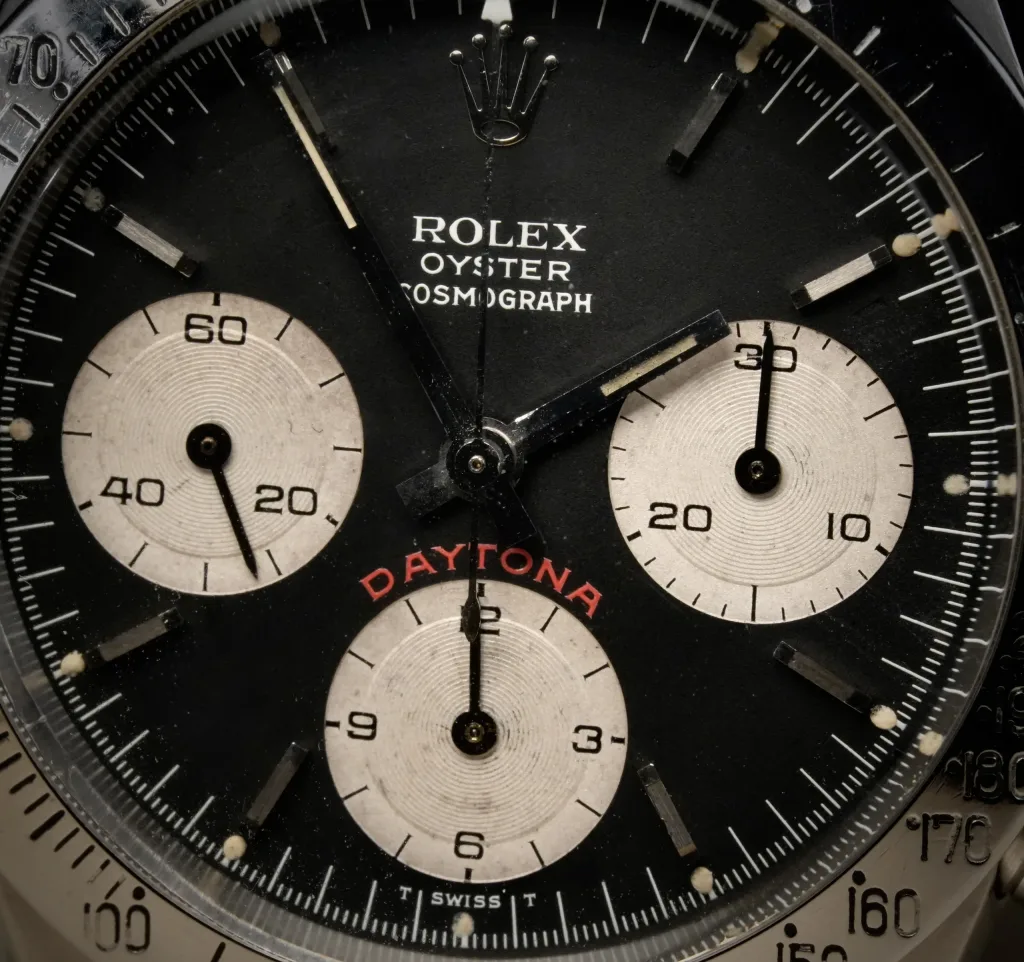
Second, the printing inside the sub-dial counters: original dials show serifs on the counter graphics, cleanly and sharp; service dials and redials usually drop the serifs, or print them with a lower quality. Between the red script and the counter printing, a dial that has lost its serifs or softened its print has almost always been replaced or reprinted.
A necessary caveat. All of this rests on the parts that are known today. It is diagnosis by comparison against a documented record, not absolute proof. If a replacement bezel surfaces tomorrow carrying the descending 7, or a redial is printed with the correct serifs and factory-grade printing, these tells will no longer separate good from bad, and the experts will have to fall back on deeper analysis to tell them apart.
The record is a strong tool because the fakes have not yet caught up to it, but it is a record, not a law.
A Rolex 6263/65 service dial
Faked and swapped movements. The calibre 727 is a known quantity, and its parts circulate. Confirm the movement is a 727 and not a plain Valjoux 72 dressed up; confirm the Microstella balance and Breguet overcoil are present; confirm the presence of appropriate movement serials, and confirm the movement’s finish matches what Rolex delivered.
The engravings on the movement. The quality of the movement’s markings — the signatures and calibre designations, and above all those on the chronograph bridge. Look at three things: the quality of the engraving itself, its alignment with the part it sits on, and whether the graphics match those used in the period for that specific calibre.
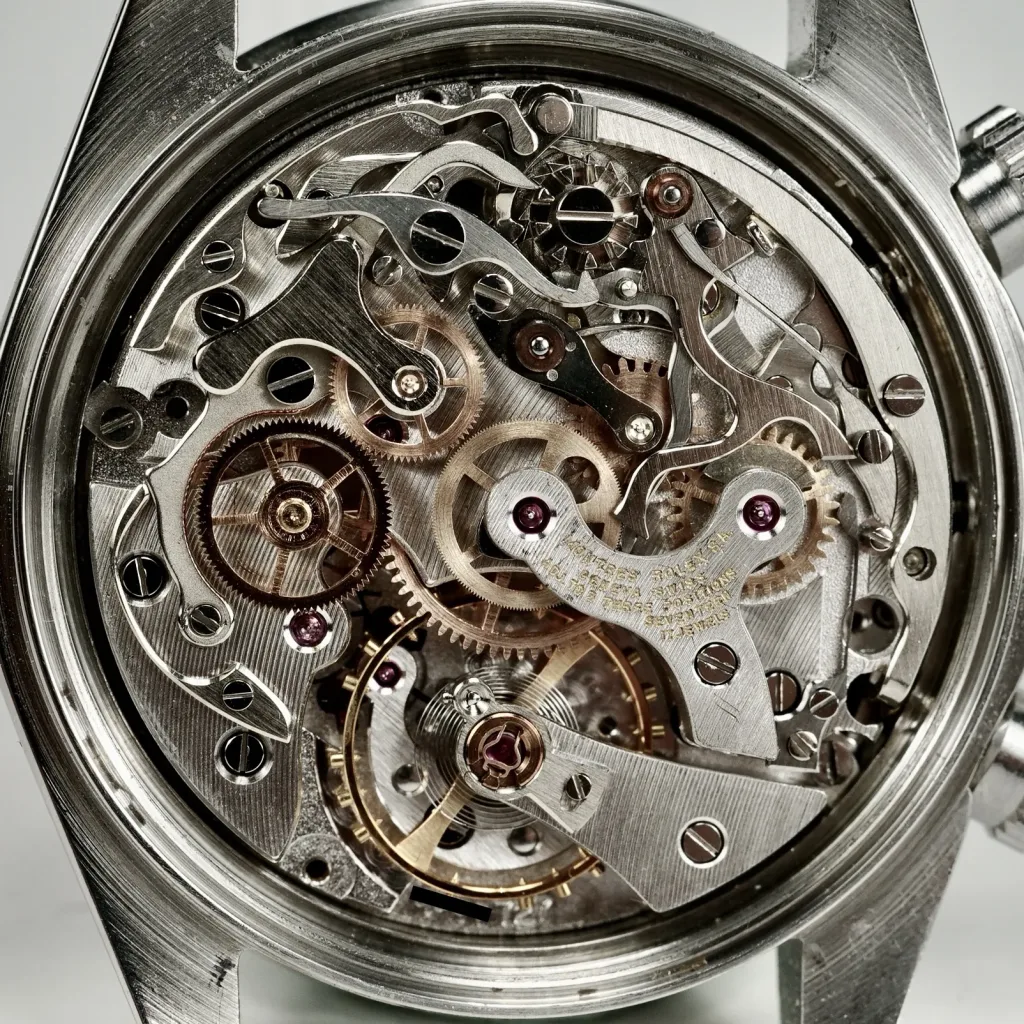
Sharp, correctly aligned, period-correct engraving is a good sign; crude, misaligned or anachronistic lettering is a warning.
But this is not proof in isolation as an original, correctly signed chronograph bridge can be fitted to a generic Valjoux 72, and the movement will then read correctly. The engraving confirms the bridge, not the whole movement — so treat it as one piece of evidence among several.
Caseback markings are a specific point of confusion: the inner caseback of a 6265 is very often stamped 6263, because Rolex used a common caseback across both references. On this watch the caseback is stamped 6263, and that is correct, knowing this reference.
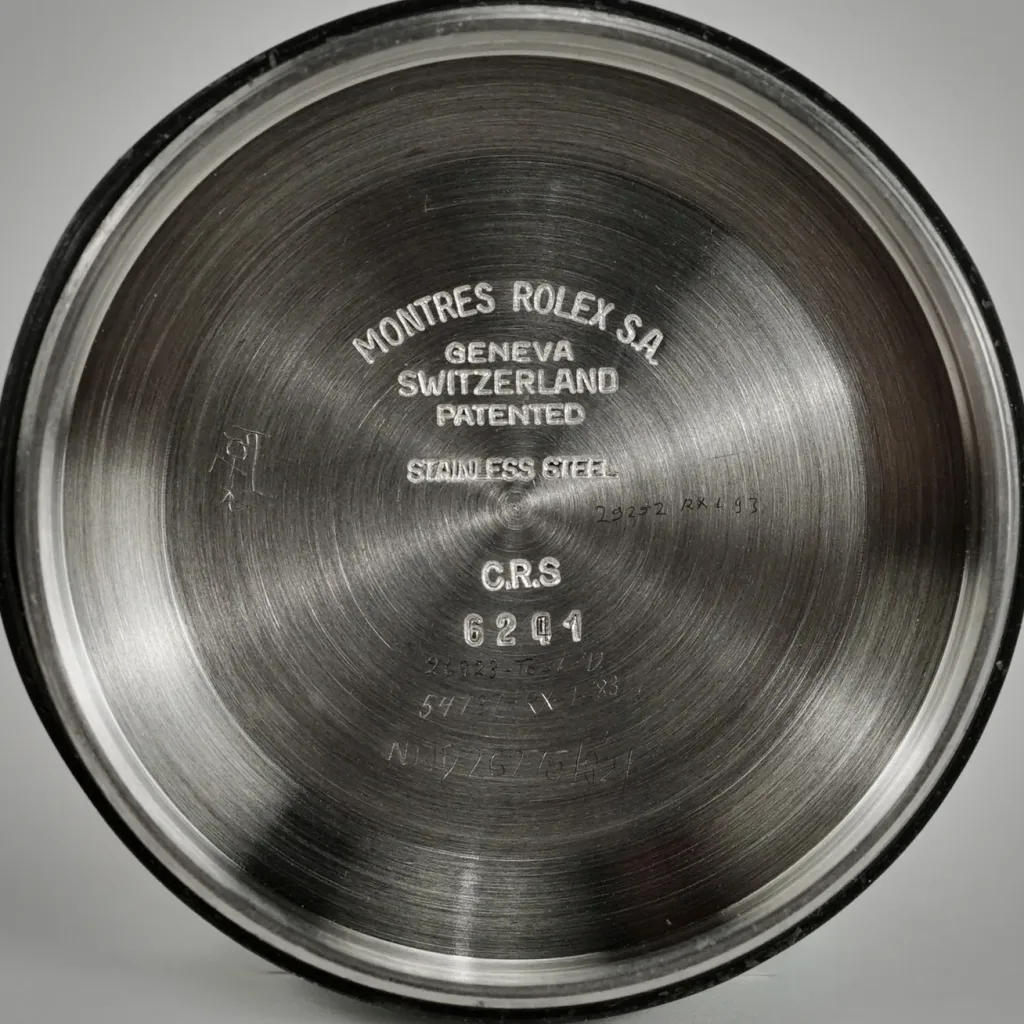
A Ref. 6264 caseback with Ref. 6241
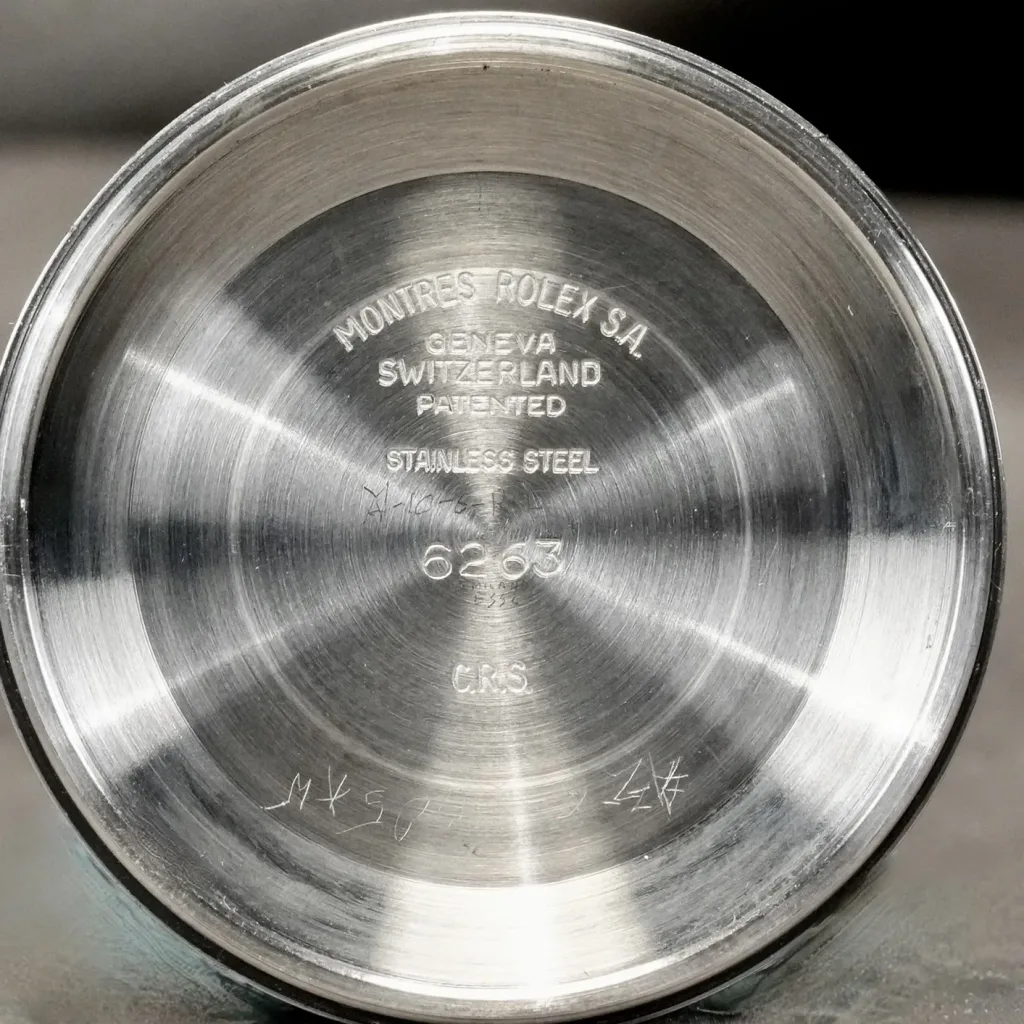
This 6265 has a 6263 caseback
Service cases. Beyond over-polishing, there is the question of entirely replaced cases. Over the decades Rolex service would, where an original case was corroded or damaged, supply a new one, and a watch with a service case is a fundamentally different object from one in its original case.
The first recognition point is the serial number between the lugs at six o’clock. A genuine original case shows a correct serial consistent with the watch’s period; an altered one may sit wrong, that is be poorly centered, differently engraved, or inconsistent in font or style with a factory engraving, or not matching with the caseback date code and the movement.
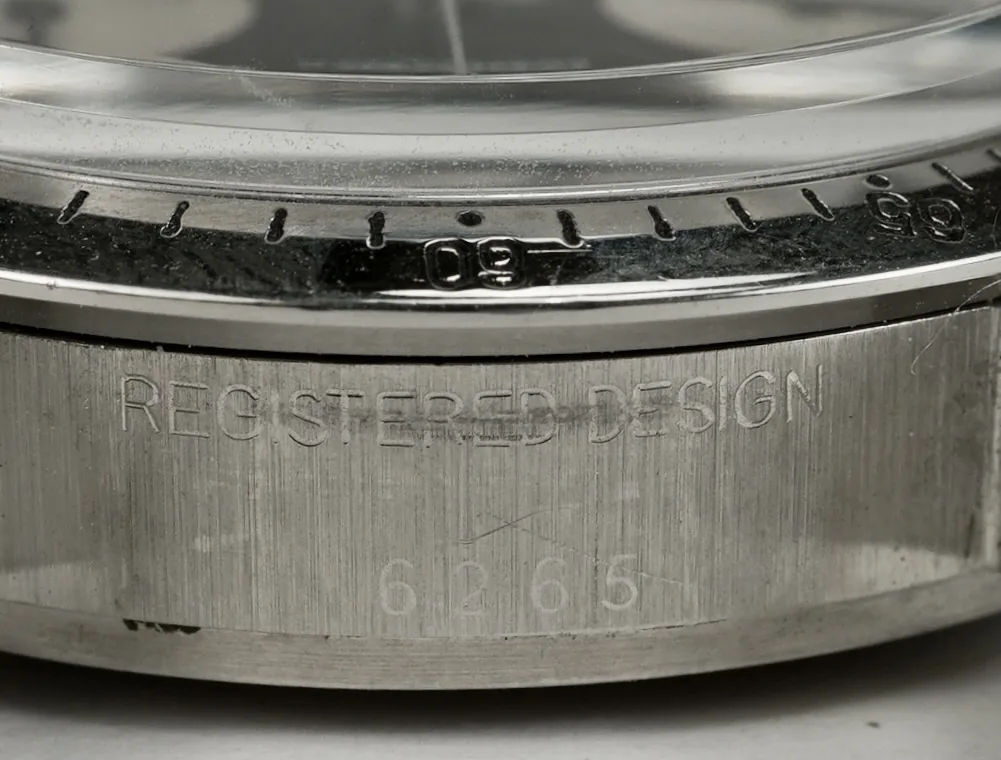
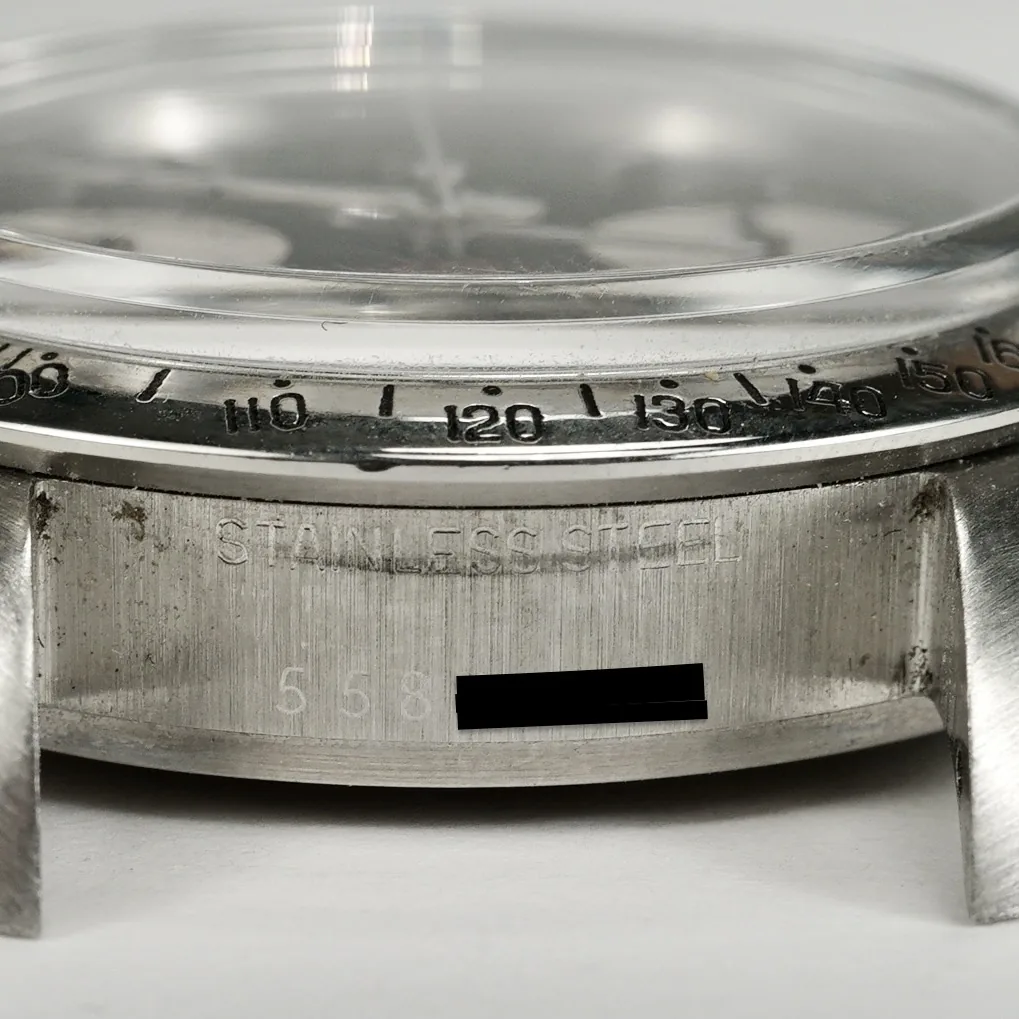
The second point is not something Rolex documents, but it is well established among the collecting community: serial numbers in the range of 4.44 million to 5 million are understood to be service cases and a knowledgeable buyer treats a vintage Rolex whose serial falls in that range as a likely service-cased watch, and prices it accordingly.
The lesson is the same one that runs through all of this: a service case is not worthless, and a watch built on one can be perfectly good to own and wear, but one should not pay original money for it.
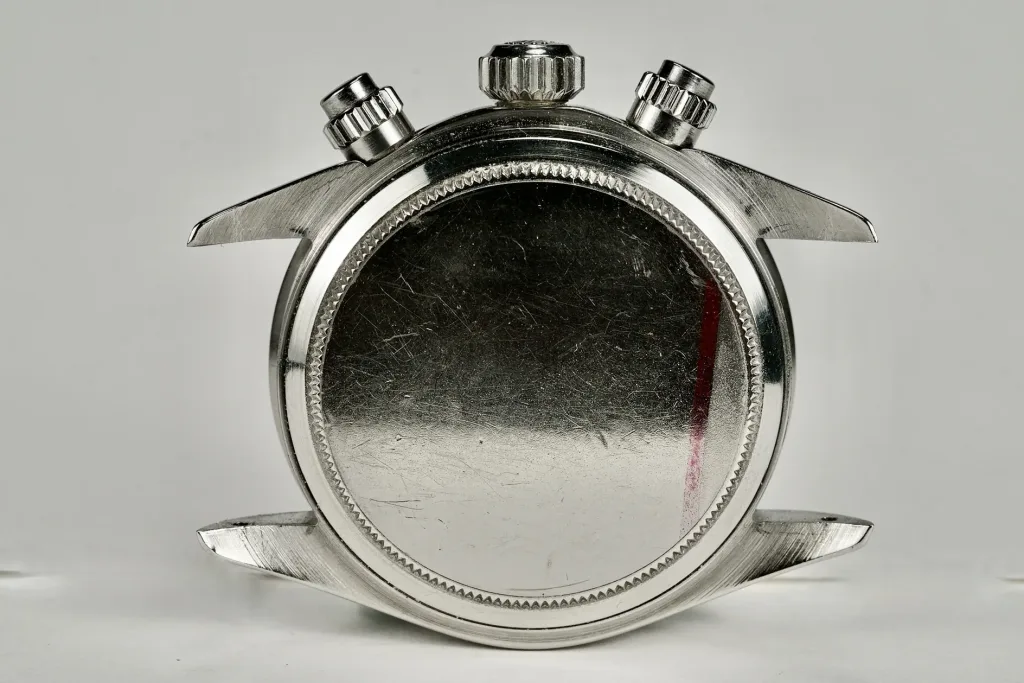
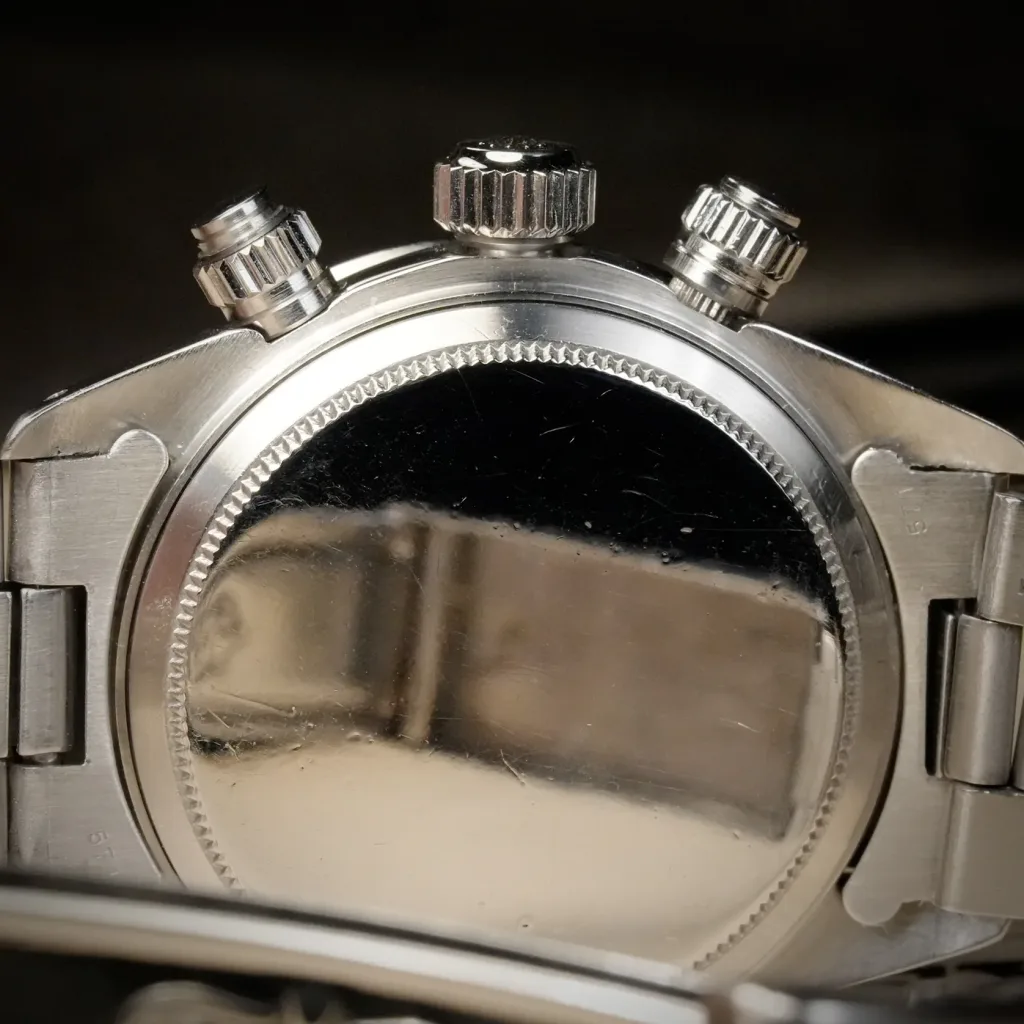
The case outline. The 6265 case is not a round case, it is a tonneau, a subtly barrel-shaped form. This geometry is part of the watch’s identity, and it is one of the things a fake or a heavily reworked case struggles to reproduce. On an original, the tonneau silhouette is precise; on a counterfeit or an over-polished one, the outline softens toward a rounder, less-defined shape and the finish transitions blur.
Hold the case against a documented original and compare the profile, the correct outline is hard to fake and hard to restore once lost. This is not a proof on its own, but a case whose tonneau geometry is wrong is a case to walk away from.
The overall lesson. None of these checks is about finding a perfect watch; perfect original 6265s are vanishingly rare and priced accordingly. They are about knowing what you are buying, which parts are original, which are service, which have been replaced and paying the right price.
Rarity is where vintage Daytona descriptions most often slide into salesmanship, so it is worth being precise about what is known and what is not.
The company has never published production figures for these references, so any total is an estimate assembled by scholars from observed pieces and serial ranges, and the estimates vary widely. Anyone who quotes you a firm total-production number for the 6265 is quoting a guess dressed as a fact.
What can be said with confidence is that the 6265 ran for seventeen years, and over that span it was produced in larger numbers than the short-lived references that preceded it: the 6262 and 6264 each lasted barely two years. In absolute terms the steel 6265 is not a very rare watch.
The one production figure that is firmly and repeatedly documented concerns gold. Rolex scholars estimate that only about a tenth of all 6263 and 6265 production was cased in gold, on the order of 2,000 gold pieces in total across both references, over the entire run. A gold 6265 is therefore genuinely scarce.
So the rarity that matters on a steel 6265 is not the reference. It is condition, originality, coevity and configuration.
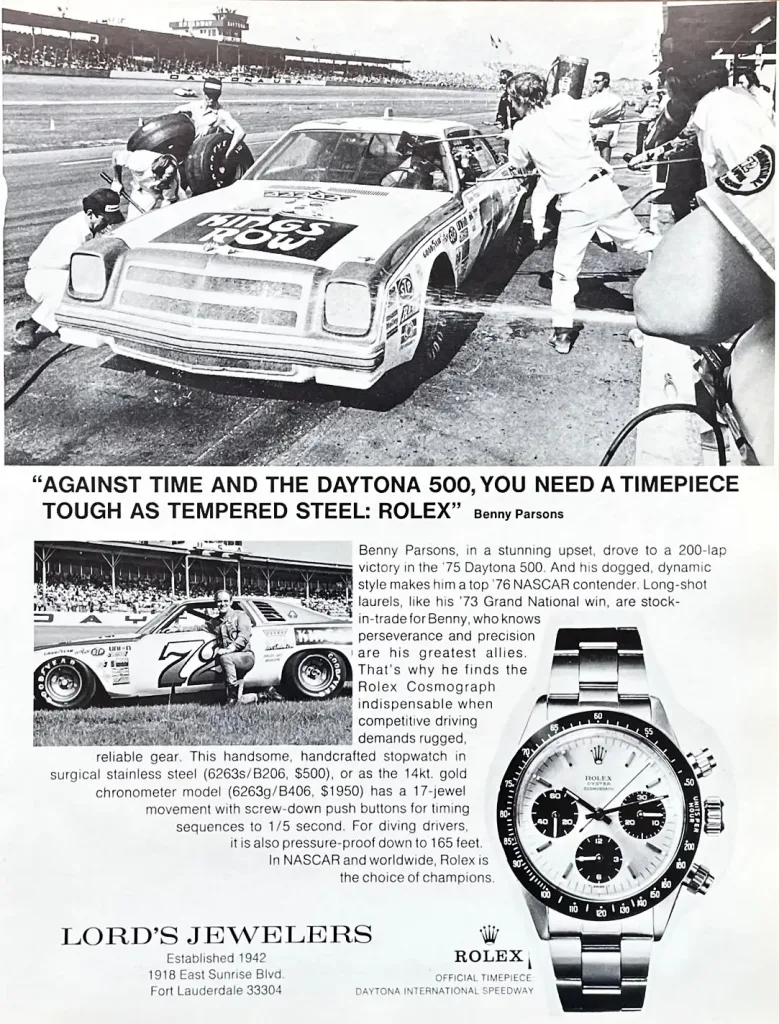
A 1976 Rolex Daytona Ref. 6263 ad
Across seventeen years this reference has worn different dials.
At the summit are the exotic “Paul Newman” dials and here a specific fact is worth knowing: the steel 6265 Paul Newman is known to have existed only with a white dial.
Below that sit the named and dated dial variants: the Big Red, with its bold red, single-line DAYTONA above the six o’clock counter, the final evolution of the manual Daytona dial;
the “Sigma” dials, marked with the σ symbols flanking SWISS to denote solid gold indices; Rolex used sigma dials from around 1970–71 until the end of the 1970s, so roughly 8 to 9 years, so a sigma Rolex dial dated outside that window is a red flag.
Sigma dial Rolex Daytona
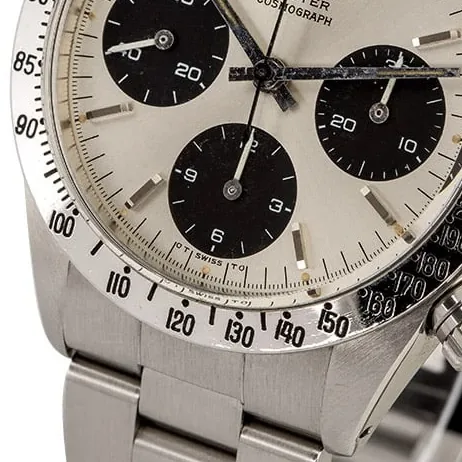
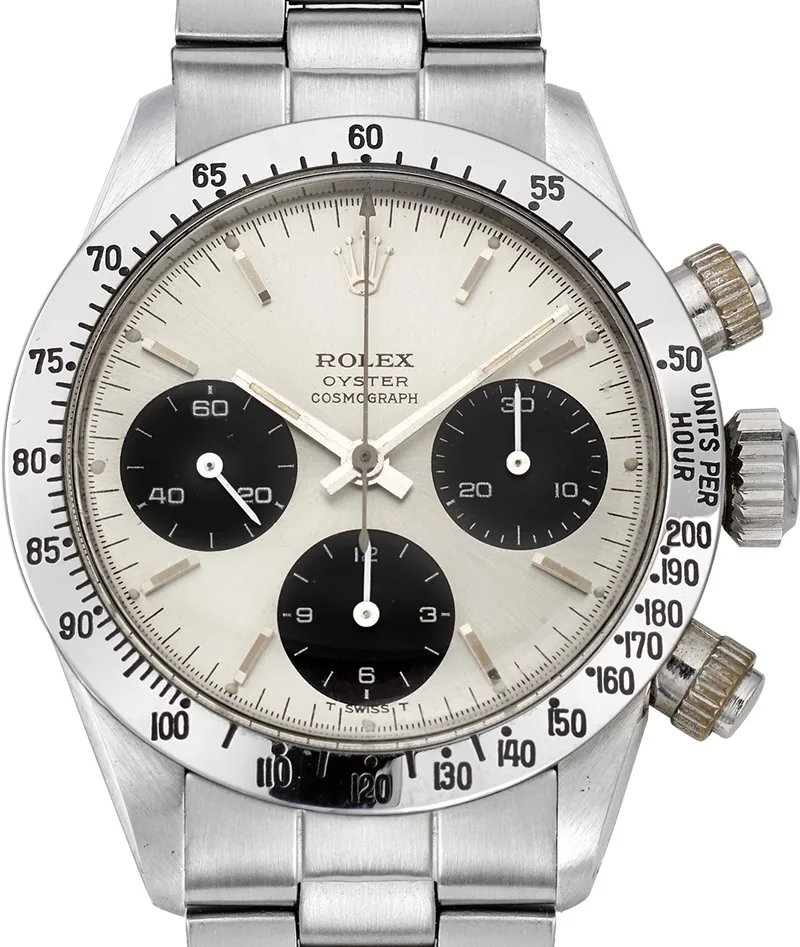
No-Daytona dials. The earliest 6265s, from the 1971 launch, have no “Daytona” designation, just the three lines reading Rolex Oyster Cosmograph, the variant known as the ROC. The red DAYTONA script arrived in 1972 and became standard across the range from around 1975. So the watches without the Daytona line were made for roughly four years out of seventeen, making these a scarcer configuration. Yet they are less in demand because the market favours the red DAYTONA: it is the most instantly recognisable and iconicity, not rarity, sets the price.
Rolex 6265
The red script is one of the clearest places pointing to an original dial. The factory printing is the bold, large “Big Red” — the word extends well beyond the hour markers flanking the sub-register, struck cleanly and with serifs.
Against it stands the “Small Red”: a narrower rendering that only slightly overreaches the sub-dial indices. On the established evidence, the Small Red with no serifs is usually a service dial: on a service dial the printing inside the chronograph counters is less refined, the numerals and minute markers coarser, and the serifs are poorly defined or absent.
There is one exception: some Small Red left the factory original, fitted to the last 6263 and 6265 chronographs with the “R” range serial numbers.
Outside that narrow case, a small, thin red DAYTONA points to a service dial.
In 1988, at the Basel fair, Rolex reinvented the Daytona. The older manual-winding Daytonas were now obsolete and the market was now on automatic movements, so reference 16520 was the first automatic Daytona: out went the hand-wound Valjoux-based 727, and in came the calibre 4030, a modified Zenith El Primero 400, reworked with some two hundred Rolex modifications, the date removed and the frequency brought down from 36,000 to 28,800.
With it came a 40mm case instead of 37mm, a sapphire crystal replaced the acrylic one, and crown guards the manual Daytona never had. This was a new watch, but the DNA that carried across came proportionately from the 6265 rather than the “black” acrylic-bezel 6263.
The 16520’s bezel is a stainless steel with an engraved tachymetre scale, the 6265’s defining feature, that which separated it from the 6263. The first-series 16520 was graduated to 200 units per hour, exactly as the 6265 had been, later it was moved to 400.
Rolex Daytona 16520 200 Cal. 4030
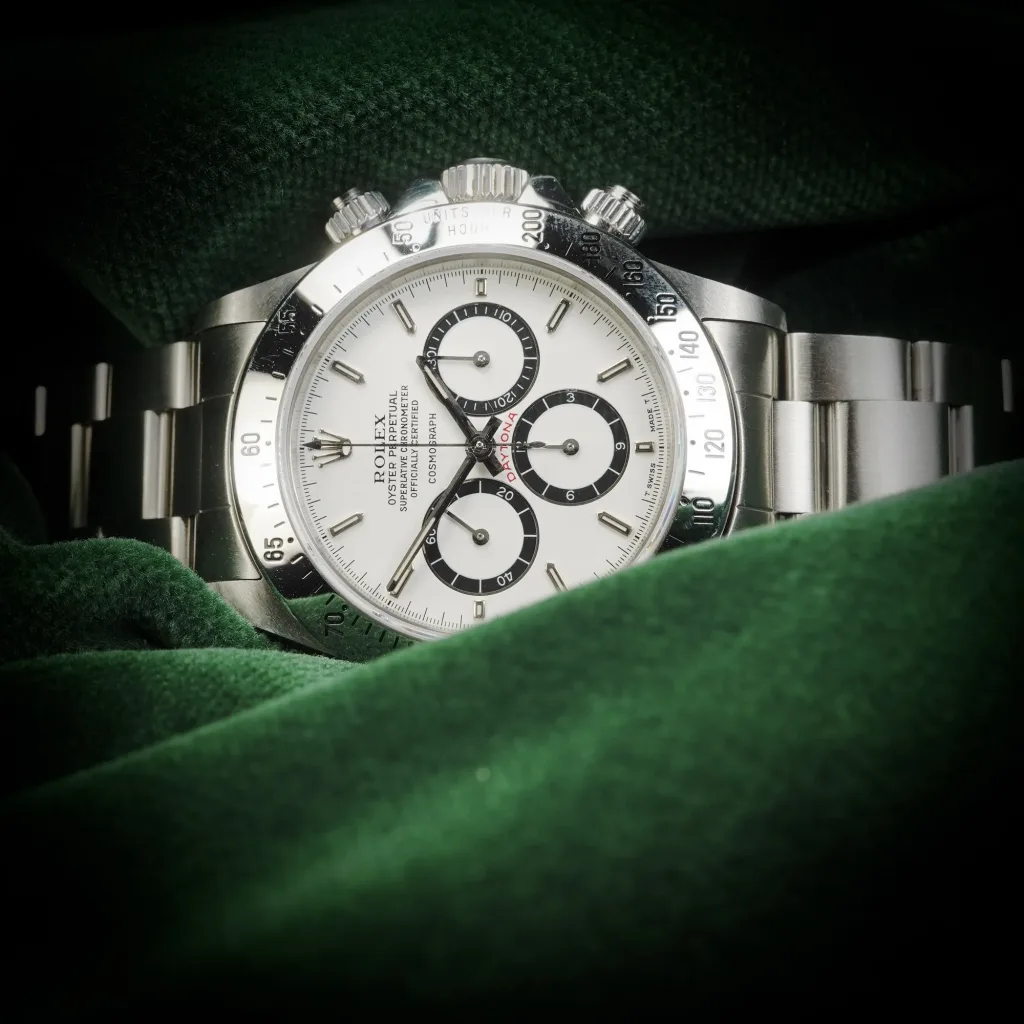
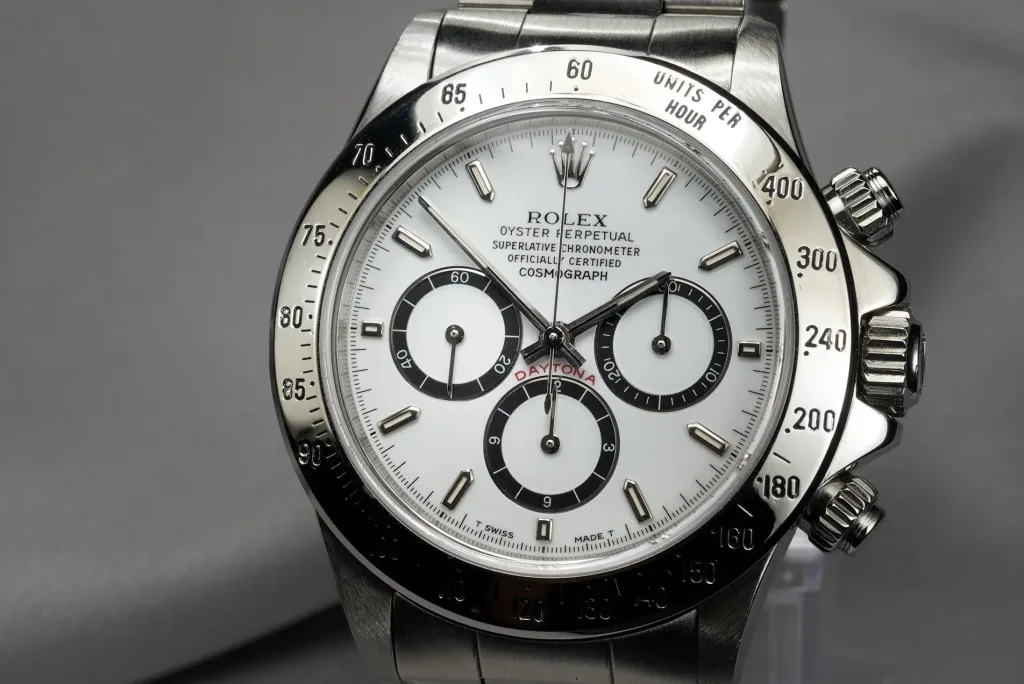
The screw-down Oyster case, the screw-down chronograph pushers, the Triplock winding crown, the 100 metres of water resistance — all of it carried forward, unbroken, from the 6263/6265 generation into the automatic era.
That is the sense in which the 6265 is more than an endpoint, it closed the manual chapter, but it also handed the automatic Daytona its enduring face: the reference that ended the line also set the template for the next generation.
Rolex Daytona 16520 N93 Cal. 4030
There is a neat symmetry in how this ends. The 6263’s black bezel sat out the 16520 era, but it was not forgotten. In 2016, with the reference 116500LN, Rolex brought the black bezel back to the steel Daytona — no longer acrylic but black Cerachrom ceramic, scratch-proof and fade-proof, with the tachymetre engraved and filled with platinum.
Commentators read it immediately for what it was: a deliberate visual return to the black-bezel Daytonas of the manual era. So both the 6263 and the 6265 live on. The 6265 gave the modern Daytona its steel bezel; the 6263 gave it, a generation later, its black one.
Rolex Daytona 116500LN
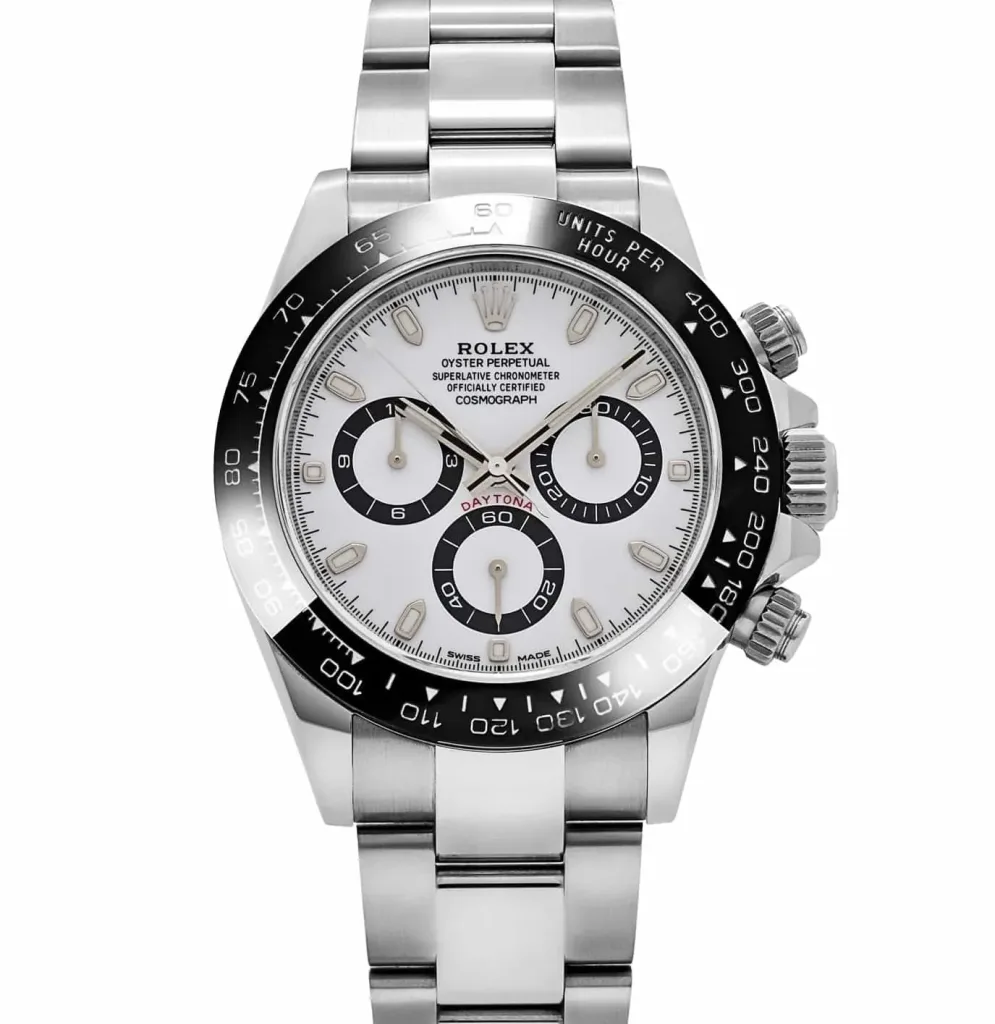
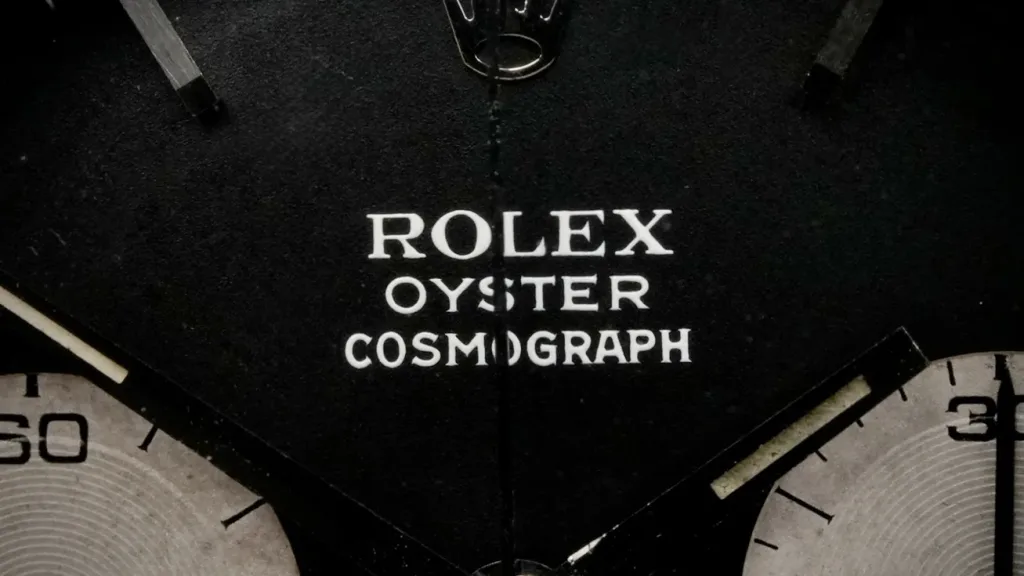
Which returns us to the watch on the desk. A 1979 Ref. 6265, Big Red, inverted panda, is an honest example of the watch that ended one era and quietly designed the next.
[contact-form-7 id=”4235″ title=”Contact form 1″]