No products in the cart.

Newsletter
[contact-form-7 id=”4235″ title=”Contact form 1″]

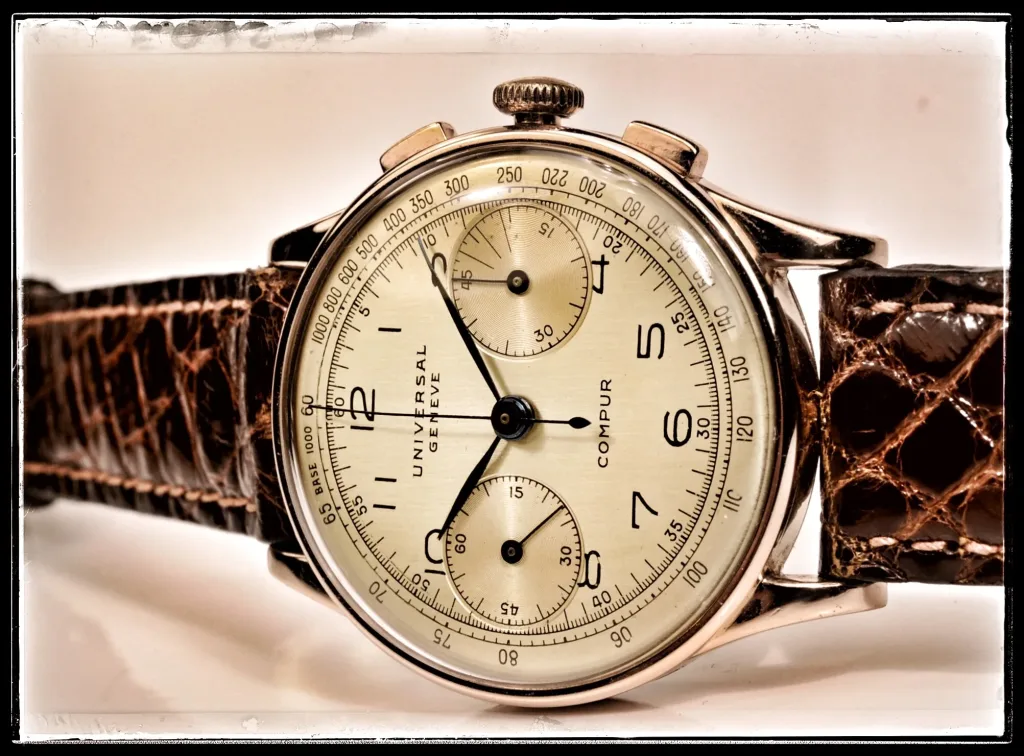
The first generation had no reference number. The second did and the number is a description, it tells you the metal, the movement and the case style before you have touched the watch.
Post one ended on a mechanism. This one begins on a number, because between the first-generation Compur and the chronographs Universal sold through the 1940s the firm started numbering its references. The materials reproduced here are Universal’s own, the factory’s reference photographs, each watch Compur-signed, each with its number in the clerk’s hand. They are the system itself, and they decode it.
A Compur Ad 1934


There are two reference numbering schemes.
The earliest references, from the mid-1930s to around 1938, are four digits. The published record is honest that there is “no exact science” to them, many watches of the period have no reference at all, so no definite guideline has been established.
Around 1938, in the 723,000 to 727,000 serial range, Universal introduced a five-digit system that is logical as it encodes four things in order: the case material, the caliber type, the calibre size and the case design.
NO REFERENCE number on an early 1930’s UNIVERSAL WATCH COMPUR Cal. 285

OLD 4-DIGITS REFERENCE on an UNIVERSAL COMPUR Cal. 285

UNIVERSAL COMPUR BABY-CHRONO Ref. 12102 Cal. 270
The leading digit is the case metal. Five codes are known:
1 — 18k yellow or rose gold
2 — steel
3 — chrome
4 — gold plated
5 — 14k gold
Two further codes sit at the edge of the system, and are of uncertain usage.
Numeral 6 was not used in the 5-digit reference system but it can be found in post-1950s white gold references; we have never found a 6-prefix Compur.
One exception: on sheet reference Ref. 12479, a gold-case number, the metal is recorded by hand, in ink as: platine. This is probably a unique piece and, as the system had no code for platinum, a human wrote it in. That single annotation tells you more about how the scheme actually functioned: the number carried the rule, and the annotations carried the exception.
Digit 2 indicates it is a chronograph.
If it was a time-only, the second digit would read 1 (this also applies to calendar watches, as the base movement is a time-only with a calendar module added).

The third digit indicates the movement by its diameter; the Compur ran in three size families:
Third digit 1: the Cal. 289, at 23.3mm, found in “baby” or “lady’s” chronographs, the smallest and possibly the rarest, the miniature Compurs that surface now and then as curiosities.
Third digit 2 or 3: the Cal. 281 and 283, in the 28mm range, are fitted in the mid-size family, the smaller-cased Compurs, usually in the 33mm case-diameter size.
Third digit 4: the 285, 385 and 386, the full-size family at 31.7mm, the main Compur engine, and the movement behind the majority of these watches (with the related Cal. 287, 292 and 387).

The 14½-ligne and 15-ligne movements of the earliest Compurs belong to the four-digit era: they usually have no reference, or occasionally an early 4-digit reference.
Universal Geneve Chronograph Calibers
The final pair indicates the case design: 63, design 32, and so on, up to 99. This means a specific reference can be found with different dials, but never with a different case.
Put the four parts together and the sheets read themselves.
A UNIVERSAL COMPUR Cal. 281


12445 — 1 18kt. gold · 2 chronograph · 4 full-size 285 caliber family · case design 45. A full-size gold Compur.
An 18kt. gold UNIVERSAL COMPUR Ref. 12445 Cal. 285
22278 — 2 steel · 2 chronograph · 2 mid-size 281 · case design 78.
An UNIVERSAL COMPUR 22278 Cal. 281

The movement lineage begins with the 14½-ligne caliber; the 285, 281 and 289 share a similar architecture but the movement diameter, and with it the case, change.
It is worth looking at the movements themselves, because the Compur is, at heart, a single mechanical concept built at three different sizes.
The 289 — 23.3mm — 10½”’, the “baby” or “lady’s”. The smallest and rarest of the three, and one of the smallest mechanical chronograph movements put into series production. The 289 sits inside the miniature Compurs that surface now and then, two-register chronographs shrunk to a size that looks impossibly minute. They were never common, and they are now among the most sought of the Compurs because of their beauty and rarity.

UNIVERSAL UNICOMPAX CARRÉ 12109 Cal. 289 movement

UNIVERSAL UNICOMPAX CARRÉ 12109 Cal. 289
The 281 and 283 — 27.8mm — 12¼”’, the mid-size. These movements sit in the mid-sized Compurs, typically in the 33mm case range: the 281 is one of the base calibres Universal would later build its most complicated chronographs around, the Tri-Compax.

UNIVERSAL COMPAX 52215 Cal. 281

UNIVERSAL COMPAX 52215 Cal. 281
The 285 family — 31.7mm — the full-size Compur. This is the main engine, the movement behind the majority of the Compurs. The 285 and its close relatives, the 385 and 386, are 14-ligne column-wheel chronographs, robust, serviceable, built with a no-nonsense architecture that makes these movements a pleasure on the bench.
The 285 family carried Universal’s standard-size chronographs through the late 1930s, the 1940s and into the 1950s, under the Compur name and later, Uni-Compax.

A UNIVERSAL COMPUR 30 22409 Cal. 285

A UNIVERSAL COMPUR 30 22409 Cal. 285
| Third digit | Calibre family | Size | Gold (1) | Steel (2) | Chrome (3) | Plated (4) |
|---|---|---|---|---|---|---|
| 1 | Baby, 10½”’ – 289 | 23.3mm | 121xx | 221xx | — | — |
| 2 or 3 | Mid, 281/283 (later 481) | 27.8mm | 122xx | 222xx | 322xx | — |
| 4 or 5 | Full, 285/287/385/386/292 | 31.7mm | 124xx | 224xx | 324xx | 424xx |

UNIVERSAL COMPUR BABY-CHRONO Ref. 12102 Cal. 270

UNIVERSAL COMPUR BABY-CHRONO Ref. 12102 Cal. 270
UNIVERSAL COMPUR BABY-CHRONO Ref. 12102 Cal. 270
Here is another baby-chronograph Ref. 12102, Cal. 270: we have not included this caliber in our list as it is not a manufacture movement but a modified Valjoux 269, but this chrono is a beauty and very rare.
| Calibre | Lignes | Diameter | Family | Notes |
|---|---|---|---|---|
| 289 | 10½ | 23.30mm | standalone | Purpose-built for ladies’ and square (carré) chronographs. Two-register only. Used mostly as Compur but also as Uni-Compax |
| 281 | 12¼ | 27.80mm | 281 (base) | The capofamiglia, the standard mid-size |
| 381 | 12¼ | 27.80mm | 281 | Near-identical to 281, generally supplied to other brands |
| 283 / 383 | 13 | 29.50mm | 281 | Larger-platine variant of the 281 |
| 285 | 14 | 31.70mm | 285 (base) | The standard full-size, the main Compur engine |
| 385 / 386 | 14 | 31.70mm | 285 | Near-identical to 285, usually the ruby count is lower + flat hairspring |
| 287 / 387 | 14¾ | 33.20mm | 285 | The 285 with a larger platine + Breguet hairspring, 387 – flat hairspring |
| 292 | 15½ | 35.20mm | 285 | The largest – in our experience not all parts are interchangeable with the 285 |
All run at 18,000 vph. The 481 is based on the 281 but belongs to the Compax and Tri-Compax family, a later instalment.

And here is a breakdown of the main Compur references divided by case metal and caliber size.
A UNIVERSAL COMPUR 12512 Cal. 287
18k gold (first digit 1)
| Calibre family | References |
|---|---|
| Baby — 10½”’ — 23.3mm (121xx) | 12101 · 12102 · 12103 · 12104 · 12105 · 12106 · 12107 · 12108 · 12109 · 12110 · 12111 |
| Mid — 281/283 — 27.8mm (122xx) | 12205 · 12207 · 12214 · 12215 · 12216 · 12218 · 12219 · 12220 · 12221 · 12227 · 12235 · 12238 · 12240 · 12249 |
| Mid — 281/283 (123xx) | 12303 · 12304 · 12307 · 12309 · 12311 · 12318 · 12319 |
| Full — 285/385/386 — 31.7mm (124xx) | 12401 · 12402 · 12403 · 12407 · 12408 · 12411 · 12416 · 12420 · 12422 · 12423 · 12425 · 12429 · 12430 · 12436 · 12439 · 12457 · 12461 · 12462 · 12463 · 12464 · 12465 · 12467 · 12472 · 12473 · 12474 · 12475 · 12477 · 12479 (platine) · 12480 · 12481 · 12482 · 12493 |
| Full — 285 (125xx) | 12512 · 12519 · 12523 · 12532 · 12539 · 12544 · 12547 |

A rare UNIVERSAL COMPAX pocket watch 22250 Cal. 292

A rare UNIVERSAL COMPAX pocket watch 22250 Cal. 292
Steel (first digit 2)
| Calibre family | References |
|---|---|
| Baby – 10½”’ – 23.3mm (221xx) | 22101 · 22102 · 22103 · 22104 · 22105 · 22106 · 22107 · 22108 · 22109 · 22110 · 22111 |
| Mid – 281/283 – 27.8mm (222xx) | 22207 · 22208 · 22214 (Amérique, sans relief) · 22218 · 22219 · 22221 (lunette or) · 22223 · 22224 (Amérique, radium) · 22226 · 22227 (cornes or) · 22228 (lunette et cornes or) · 22229 (lunette or) · 22234 · 22235 (cornes or) · 22236 · 22237 (Amérique, cadran noir) · 22238 · 22255 · 22256 (cornes or) · 22257 · 22267 · 22269 · 22270 · 22271 |
| Mid – 281/283 (223xx) | 22301 · 22304 · 22305 · 22307 · 22308 (cornes or) · 22316 (cornes or) · 22317 (cornes et lunette or) · 22322 |
| Full – 285/385/386 – 31.7mm (224xx) | 22407 · 22415 · 22416 · 22417 · 22418 · 22422 · 22425 · 22426 · 22428 · 22431 · 22433 · 22443 · 22444 · 22445 · 22451 (cornes or) · 22452 (lunette et cornes or) · 22453 (lunette or) · 22458 · 22459 (cornes or) · 22460 (lunette et cornes or) · 22461 (lunette or) · 22466 (cornes et lunette or) · 22467 (lunette or) · 22468 (cornes or) · 22476 (cornes et lunette or) · 22481 · 22483 · 22492 · 22497 |
| Full – 285 (225xx) | 22509 · 22515 · 22516 · 22517 · 22518 · 22519 · 22520 · 22533 · 22534 · 22535 |
Chrome (first digit 3)
| Calibre family | References |
|---|---|
| Mid – 281/283 (322xx) | 32202 |
| Full – 285/385/386 (324xx) | 32401 · 32402 · 32404 · 32405 · 32406 · 32408 |
Gold plated (first digit 4)
| Calibre family | References |
|---|---|
| Full – 285/385/386 (424xx) | 42401 · 42402 · 42403 · 42404 |
Platinum (no code, hand-annotated)
| Calibre family | References |
|---|---|
| Carried in the gold full-size block | 12479 (platine) |
Universal Geneve Calibers, chronograph


The printed number indicates the standard production; the handwriting beside it indicates the exception. Along the edges of these sheets are notes in ink, next to the reference, recording model variations: cornes or (gold lugs on a steel case), lunette or (gold bezel), lunette et cornes or, because the first digit must choose one metal and the margin records the rest; Amérique, avec cadran radium, avec cadran noir, US market with radium dial, or with black dial, which sit easily with the rule that within one reference the dial can change but the case cannot.
These annotations describe factory variations which are correct and original.
The Compur is the first watch family of Universal’s modern era, and it remains one of its most interesting. These are old-school chronographs in the fullest sense, strong Art Deco design, stepped and coin-edge cases, dials of real period character, yet they wear with a presence that is entirely contemporary. The quality is excellent throughout, manufacture-grade movements and well-made solid cases.
And for all that, the market still undervalues the Compur family: a chronograph of genuine horological quality and design conviction, available for a fraction of what some of its contemporaries command. For the collector who reads the reference and knows what sits behind it, this gap is an opportunity.


Courtesy of G. Sala / Universal Geneve

Courtesy of G. Sala / Universal Geneve

Courtesy of G. Sala / Universal Geneve

Courtesy of G. Sala / Universal Geneve

Courtesy of G. Sala / Universal Geneve

Courtesy of G. Sala / Universal Geneve

Courtesy of G. Sala / Universal Geneve

Courtesy of G. Sala / Universal Geneve

Courtesy of G. Sala / Universal Geneve
[contact-form-7 id=”4235″ title=”Contact form 1″]