No products in the cart.


Newsletter
[contact-form-7 id=”4235″ title=”Contact form 1″]

The designation C.O.S.D. has been subject to competing interpretations among researchers, reflecting the fragmentary nature of wartime documentation.
The prevailing attribution — Combined Operations Stores Depot — positions the watch within the procurement structure of Combined Operations Headquarters, the British War Office division responsible for coordinating amphibious and paratrooper raids against German-occupied Europe.


An alternative reading, supported by period documents and specialist researchers including Ziggy Wesołowski, identifies the acronym as Company Ordnance Supply Depot, the department responsible for manufacturing and issuing equipment to British Special Forces and SOE (Special Operations Executive) units.
credit Wikipedia
Evidence for the earlier reading is substantive. A restricted-access publication dated 1943–44, titled Amphibious Landings and Operations, contains an itemised equipment list in which every article is prefixed with the COSD designation — including wristwatches and plastic protective cases for wristwatches. A photograph in the same document shows a British special forces soldier wearing the full complement of COSD-designated gear.
This establishes that COSD as a supply classification was in use by 1943 at the latest, predating the Longines Reference 2340 production run by approximately two years.
credit Konrad Knirim


The watches were associated with Operation Market Garden at Arnhem, where they were worn by specialist personnel participating in the advance. Paratroopers at Arnhem, however, are likely to have carried either privately owned timepieces or watches issued under the earlier ATP (Army Trade Purchase) procurement designation, rather than the later Longines COSD reference.
The Longines Reference 2340 was, according to a separate line of research, developed specifically for the bomb disposal units that spearheaded the D-Day assault on the Normandy beaches — a role that would account for the case’s deliberate engineering against shock and waterborne exposure.
The COSD procurement framework extended across several of Britain’s most operationally active wartime formations. The Royal Marines Boom Patrol Detachment (RMBPD) — whose equipment is documented in an exhibit at the Royal Museum, Eastney Barracks, Portsmouth, and whose operational profile is referenced in the SOE display at the SAS Museum — was among the units operating under this supply chain.


The RMBPD, the institutional predecessor of today’s Royal Marines Special Boat Service (RM SBS), conducted two operations of particular historical note: Operation Frankton in December 1942, in which canoe teams were inserted into the Bay of Biscay, paddled approximately 100 km up the Garonne River, and attached limpet mines to German blockade runners at the port of Bordeaux-Bassens; and a joint British-Australian attack on Singapore.
credit Airborne and SO Museum
Further RMBPD operations were carried out against targets in Norway, Leros, and Turkey. The same COSD equipment standard was also applied to the Royal Navy COPPS (Combined Operations Pilotage Parties), the clandestine beach reconnaissance teams whose canoe-borne surveys of enemy-held shorelines provided the intelligence for major amphibious landings, and the RN SRU (Sea Reconnaissance Unit).
In the final months of the Second World War, the British military issued the Longines Reference 2340 in a production concentrated within a window in the last months near the close of hostilities in Europe. The late date of issue has led some researchers to conclude that operational deployment may have been limited; the watch was, in part, a contingency procurement whose full distribution was overtaken by the end of the war.


The rarity of the black-dial variant — fewer than ten confirmed — and the near-mythical status of the three known solid gold COSD watches illustrate how constrained this production run was.
Procurement and Supply
Procurement followed a dual-source model characteristic of wartime supply logistics. Longines, based in Saint-Imier in Switzerland, supplied the movements, dials, and hands to the United Kingdom through Baume & Co., their established British agent.
The Longines archive is specific on the point on this watch: “The serial number 6900xxx identifies a Longines mechanical manually wound movement cal. 12.68N, it was invoiced on May 2, 1945, to the company Baume & Co. which was at the time our agent for the UK. The other parts were produced locally under licence for Longines. Unfortunately, since the relevant archives are not in our possession, we are unable to provide any further information.”
The case — designed by the British War Department’s research and development office — was manufactured domestically to a specification that addressed a specific operational concern: the mechanical vulnerability of the movement during special and amphibious operations.
The broad arrow symbol, stamped on the dial beneath the Longines signature, is the heraldic mark of British Crown Armed Forces property.
The Longines Reference 2340 COSD predates the formal Dirty Dozen specification and represents an earlier, independently developed solution to a similar set of operational requirements.
Case
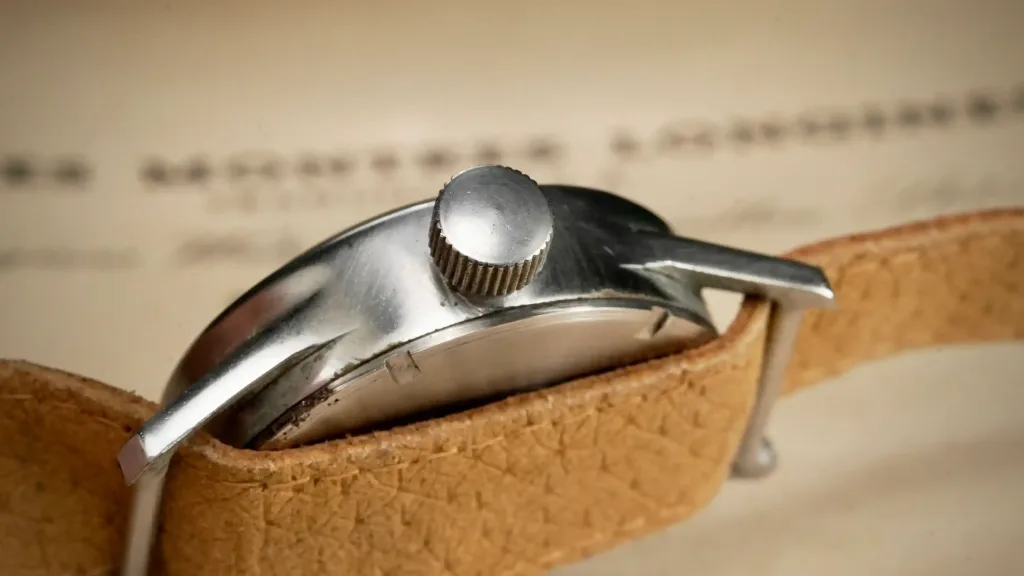
The case of the Longines Ref. 2340 COSD is nickel-plated brass, it measures 36.8 mm in diameter excluding the crown — a substantial proportion by the standards of mid-1940s military wristwatches.


The architecture is immediately recognisable: a thick, stepped bezel with a broad flat profile gives the watch the geometry that has earned it the collector description “tuna can,” a reference to the case’s compressed, cylindrical form.
The construction method is technically noteworthy. An inner ring is screwed into the interior of the main case body to secure the crystal, which is inserted from the rear and held by a compressed flat gasket tightened by this inner ring, locking the glass against external impacts that might otherwise dislodge it.


The caseback is a screw-in type with a rough satin finish, engraved with the C.O.S.D. designation and the reference number 2340. The fixed lugs are welded integral to the case body rather than joined by independent spring bars, contributing to structural rigidity.
The crown tube still shows a hardened rubber gasket. These characteristics, screw back, taloned glass with ring, large crwon tube with gaskets, indicate that this watch was engineered with water resistance in the forefront, making its use by corps like the RN SRU likely.


The crown is conspicuously large and prominently positioned — original to the reference — sized to permit manipulation by a gloved hand.
Dial
The dial of the Reference 2340 COSD is singular within the Longines catalogue. It has a dual- scale 12/24-hour layout: outer Arabic numerals in black for standard 12-hour reading, with the 13-to-24-hour figures printed in red for 24-hour military timekeeping.
The layout is unornamented, the typography utilitarian, with no decorative elements. All confirmed pieces mount luminous COSD-pattern hands and a luminous dial.


This same dial — the Longines-signed 12/24-hour layout with broad arrow — was also sold into the civilian market, typically paired with cases produced by Dennison, one of the principal British watch case manufacturers of the era. Dennison “Denisteel” examples with identical dials carry no MOD markings.
The dial back is stamped FJ – which stands for swiss dialmaker Fluckiger et Fils SA, one of Longines suppliers at the time, as a confirmation that dial moveent and hands were delivered by Longines
Movement: Calibre 12.68N
The movement is the Longines Calibre 12.68N, a manually wound mechanical movement of 12 lignes diameter (approximately 27 mm). The 12.68 family was introduced in 1938 and deployed across both civilian and military references and is considered one on Longines most reliable and time-proven calibers.
The case was engineered around the movement rather than the reverse: the larger-diameter case creates a protective buffer between the external case wall and the calibre, intended to absorb shock without reliance on Incabloc or similar internal shock protection systems. The absence of an antishock system represents the primary mechanical limitation of the reference relative to the operational demands placed upon it.


The movement is secured within the case by a serrated brass movement retaining ring — known in the trade as a bague crantée (French) or anello crantato (Italian). Machined from brass to match the exact diameter of the calibre, the ring is fitted between the movement and the inner wall of the case body, where its circumferential jagged teeth engage the case to prevent rotational displacement and manage axial tolerances through controlled elastic compression.
This compression function was intended to absorb and dissipate the shock forces generated during use.
Collectability and Significance
19 The Longines Ref. 2340 COSD occupies a specific and well-defined position in the vintage military watch market. With approximately 100 watches known to survive from a total production of a few hundred pieces, it is genuinely scarce.
Authenticated examples in period-correct condition — original dial, original case, original hands, intact caseback markings — are infrequent. The watch’s historical range of issue adds a dimension that purely technical rarity cannot replicate.
From the bomb disposal units on the Normandy beaches to the clandestine formations whose operations are documented at Eastney Barracks and the SAS Museum, the C.O.S.D. designation connects to a specific tier of British wartime capability that operated outside standard infantry supply channels.
For collectors of Longines and military wristwatches, rarity is not an abstract number but a matter of coherence and originality. When original dial, case, and period-correct components align without later intervention, the C.O.S.D. stands apart as a historically grounded and increasingly elusive reference — one that continues to reward careful selection and informed appreciation.


Sources:
• Operation Frankton – Wikipedia
• RMBPD – Special Forces Roll of Honour
• Herbert ‘Blondie’ Hasler: A Cockleshell Hero – National Army Museum
• COMBINED OPERATIONS PILOTAGE PARTIES EQUIPMENT 1943–1945 –Imperial War Museums
• Combined Ops Assault Pilotage Parties – combinedops.com
• Konrad Knirim – British Military Timepieces
• Z.M. Wesolowski – Military Timepieces 1880-1990
[contact-form-7 id=”4235″ title=”Contact form 1″]